 Advertise

Note: This article was AI-translated from Arabic and is currently under manual review. The author is not responsible for any translation errors. Please refer to the original Arabic text for the most accurate and authoritative information.
Did you know that some fats and oils that are included in your daily meals may have profound health effects behind their simple appearance?
Hydrogenation, one of the industrial processes created by science to convert liquid vegetable oils into more solid and stable fats, has played a pivotal role in the development of modern food industries. However, this process, if not managed scientifically and properly, may lead to the formation of hidden compounds that have been proven to be associated with serious health risks. In this article, we reveal how hydrogenation can be a tool for industrial innovation on the one hand, and a real challenge to protect consumer health on the other, and what both consumers and food makers should know.
At the beginning of the twentieth century, hydrogenation was a real revolution in the world of food industries. It made it possible to convert liquid vegetable oils into more stable solid or semi-solid fats and provided an economical and practical alternative to animal fats. This development has contributed to the widespread spread of new food products and has met the requirements of storage, transportation and industrial use with unprecedented efficiency.
However, this innovation was not without challenges. With the widespread application of partial hydrogenation, trans fatty acids emerged, compounds that the human body was not equipped to deal with. With the accumulation of scientific evidence linking these fats to an increased risk of cardiovascular diseases, partial hydrogenation has transformed from a common industrial technique to a global public health issue that has called for strict legislative and regulatory intervention by international and national health bodies.
This article begins with a simple scientific journey that deals with hydrogenation from its chemical basis and historical development, through proven health risks, to the international and Egyptian legislative response, highlighting the pivotal role of regulatory bodies and accredited laboratories in protecting consumer health.
In order to understand hydrogenation correctly, it is first necessary to correct a confusion that is common to many non-specialists. In essence, hydrogenation is a controlled chemical industrial process that is meant to convert some liquid vegetable oils — such as soybean oil or sunflower oil — into a more solid or semi-solid form by adding hydrogen to the double bonds in fatty acids in order to improve texture and increase stability during storage and industrial use.
It is common to mistakenly describe most vegetable oils as “hydrogenated oils”, with the exception of some well-known oils such as olive oil, without realizing that hydrogenation and refining are completely different processes. Refining is a series of physical and chemical processes aimed at purifying oil from impurities, unwanted substances, and odors, without necessarily changing its physical state or creating trans fats.
International reference bodies, such as the World Health Organization (WHO) and the U.S. Food and Drug Administration (FDA), confirm that the health problem does not lie in the “type of oil” itself, but rather in the method of industrial processing and its technical limitations, especially partial hydrogenation, which is linked to the formation of trans fats that have definite negative effects on human health.

What is hydrogenation?Hydrogenation is a controlled industrial chemical process in which hydrogen is added to the double bonds found in unsaturated fatty acids in vegetable oils, using a catalyst (often nickel) and under specified conditions of pressure and temperature.
Possible outcomes:
Historical development Hydrogenation started scientifically with the work of Paul Sabatier, and then turned into wide industrial application after Wilhelm Norman's patent in 1902. During the world wars, hydrogenated fats became a strategic alternative to animal fats, leading to the proliferation of margarine and artificial fats in the food industry.
The following table shows the main differences between the two types of hydrogenation:
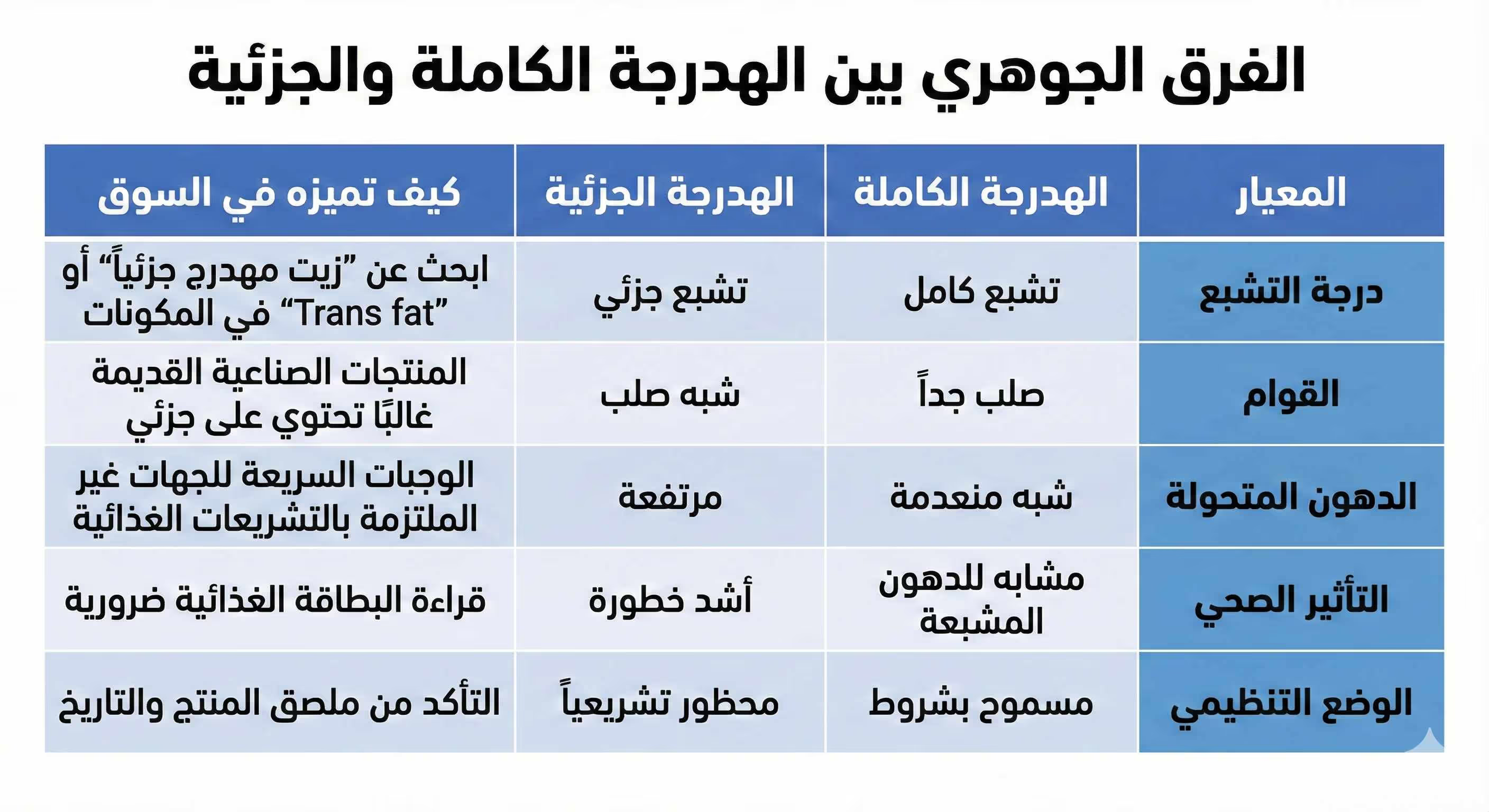
➡️ Partial hydrogenation is the main industrial source of trans fatty acids.
From Hydrogenated Oils to Natural Alternatives: Industrial and Legislative Transformation in the World of Fat
When moving from the technical understanding of hydrogenation to its applied and industrial effects, it is important to review the historical background, the oils used, and the subsequent transformation of the industry...”
First of all, it is important to emphasize that the hydrogenation process — whether partial or total — is essentially a chemical reaction that can be applied to any fatty material that contains unsaturated fatty acids, whether vegetable oils or animal fats. It is not related to the type of oil as much as to the degree of unsaturation and the nature of industrial processing. During the sixties, seventies and eighties of the last century, the manufacture of artificial ghee, shortening and margarine relied extensively on soybean, cotton, sunflower, and corn oils. Global industry data indicates that more than 60-70% of the oils used at the time were treated with partial hydrogenation to improve texture, stability and reduce cost. With the development of palm oil cultivation and manufacturing since the early eighties and nineties, and the emergence of conclusive scientific evidence on the risks of trans fatty acids resulting from partial hydrogenation, the industry has gradually turned to dispense with them, taking advantage of palm oil and its derivatives as natural vegetable fats that are solid at room temperature. Their properties are modified by physical processes such as fragmentation without the need for hydrogenation. This transformation has culminated in the issuance of international and Egyptian legislation prohibiting partial hydrogenation. On the other hand, total hydrogenation, when applied in accordance with the standards adopted by the World Health Organization and the Codex Authority, remains technically acceptable and safe for health. It is used with limited limits in some food applications, subject to careful control and analysis. The reader should make a clear distinction between the fact that all liquid oils are by their nature non-hydrogenated, and that consistency at room temperature does not necessarily mean hydrogenation. The real scientific difference between natural fats (such as palm oil and its derivatives) and any hydrogenated fat — whatever its source — is to analyze the content of trans fatty acids, not the shape or apparent texture of the fatty material.
How is it formed?During partial hydrogenation, not all double bonds are saturated. Rather, the geometry of some of them changes from the normal curved position (Cis) to the straight position (Trans), which is an unusual structure for metabolism in the human body.
Confirmed health risksAccording to the World Health Organization:
➡️ All Egyptian and international laws target industrial trans fats only.
Although partial hydrogenation remains the primary source, very small amounts of trans fat may be formed as a result of:
⚠️ These sources are secondary and not legislatively influential, and are not compared to the risk of industrial partial hydrogenation.
The journey to address the risks of trans fats has started since the seventies and eighties. Epidemiological studies such as Framingham have indicated their association with coronary heart disease. In the 1990s, large studies such as Nurses' Health Study confirmed that trans fats are worse than saturated fats, leading the U.S. Food and Drug Administration (FDA) in 1999 to require the inclusion of trans fat content on the food label as of 2006.
At the beginning of the millennium, leading countries such as Denmark (2003), Switzerland (2008), Austria (2009), Iceland and Norway started banning industrially produced trans fats and set the limit at 2% of fat in the product. In the last decade, several countries such as Canada (2017), the European Union (2021) and the United States (2018) have expanded their legislation to partially eliminate hydrogenated fats.
In 2018, the World Health Organization launched the REPLACE initiative, to provide practical tools that help countries enact and enforce legislation.
Global and Arab consensus with the goals of the World Health Organization for the elimination of partial hydrogenation
At the international level, many countries have made significant progress in complying with the requirements of the World Health Organization (WHO) regarding the elimination of synthetically produced trans fatty acids by banning or regulating their use in foods and setting strict standards for their percentage in food products. According to WHO statistics and updates, 53 countries have adopted “best practice” policies aimed at reducing or eliminating trans fatty acids in food supplies, protecting the health of 46% of the world population from their known health risks, compared to just five years ago.
In the Arab context, Saudi Arabia has emerged as one of the first countries in the region to commit to implementing policies consistent with the recommendations of the organization. It has obtained a certificate of recognition from the World Health Organization that its food products are free of industrially produced trans fats after implementing legislation that partially prohibits the use of hydrogenated oils and enhances monitoring and laboratory analysis systems.
The Sultanate of Oman is also achieving a similar achievement. It has received a certificate from the World Health Organization that reflects its commitment to free food products in the local market from artificial trans fatty acids, making it the second Arab country to achieve this level of compliance with the goals of the organization.
These Arab achievements are part of broader efforts to address trans fatty acids — compounds linked to increased risk of cardiovascular diseases — by adopting effective regulatory policies and enforcement procedures that protect public health and are based on international standards.
As part of the global trend to eliminate industrially produced trans fatty acids, Egypt has taken a clear and gradual legislative and regulatory path in line with the recommendations of the World Health Organization (WHO), especially the REPLACE initiative launched by the organization in 2018 with the aim of completely eliminating industrial trans fats from the food chain.
The National Food Safety Authority has played a central role in this regard, based on Law No. 1 of 2017 establishing the Authority, which gave it full jurisdiction to set binding rules for food safety, control locally or imported foods, and evaluate health risks associated with food ingredients. In this context, the Authority issued Resolution No. 19 of 2022, which is a landmark turning point in the trans fat file in Egypt. It explicitly prohibits the use of partially hydrogenated oils and fats in food products, while setting a maximum permissible limit for the content of trans fatty acids in finished foods, in accordance with the WHO reference framework.
This regulatory role is complemented by close cooperation with the Egyptian General Organization for Standardization and Quality (EOS), which prepares and updates Egyptian standards for oils, fats and food products to include accurate definitions of hydrogenated fats, clear quantitative limits for trans fatty acids, and mandatory requirements for food cards. This has included harmonizing national standards with international standards issued by Codex Alimentarius, the European Union, and WHO recommendations, ensuring that the technical reference of industry and control is unified together.
The system of laboratories accredited in accordance with ISO/IEC 17025 has also contributed to supporting the implementation of these legislations by using internationally recognized analysis methods (such as GC-FID according to AOAC and ISO) to monitor the content of trans fats in products, whether upon customs release or during control of local markets. This integration of the legal framework, standards, and analytical capabilities has allowed Egypt to effectively get closer to meeting the requirements of the World Health Organization, not only at the level of legislative texts, but also at the level of implementation and effective control.
This course reflects the state's commitment to protecting consumer health, reducing the health and economic burden of cardiovascular diseases, while supporting the competitiveness of the Egyptian food industry and adapting it to the requirements of access to global markets that apply strict policies on trans fats.
Expected impact
No legislation is complete without:
Hydrogenated fats have always been a key part of the food industry because of their high stability and ability to improve texture and taste. The most prominent products that used hydrogenated fats previously and currently are:
The controls that currently control their use
Many people confuse two types of margarine, and the difference between them is vast, as shown in the following table:

Conclusion: The vegetable ghee currently in the market (from the committed companies) is not the old hydrogenated “bogeyman”. It is mostly natural palm fat.
How to read a food card
Terms you should avoid
Safe technological alternatives to partial hydrogenation
They all achieve the desired texture without creating trans fats.
The story of hydrogenation is a lesson in the interaction of science with industry and public policy. The success of the consumer protection process depends on a true partnership between:
The hydrogenation journey, as presented in this article, reveals how a single industrial technique can be both a tool for dietary advancement and a source of serious health risks if it is abused. Science has conclusively proven that the problem does not lie in the oils themselves, but in partial hydrogenation and the resulting trans fatty acids. This has prompted the international community, led by the World Health Organization, to adopt strict legislation to protect human health.
International and Arab experiences, especially in Saudi Arabia, Oman and Egypt, have shown that legislative will supported by scientific control can make a real transformation in the quality of food without harming industry or innovation. The Egyptian steps, through the role of the National Food Safety Authority and the Standards and Quality Authority, represent an advanced model for complying with international standards and achieving a balance between consumer safety and industry sustainability.
The future is clearly moving towards a safer and smarter fat industry that relies on innovative technological alternatives, high-quality natural oils, and solutions that achieve texture and functionality without compromising public health. In this regard, the partnership between legislation, science, industry, and consumer awareness remains the real guarantee of healthy food, innovative products and a safer human being.
This vision puts the consumer and industry on a healthy, safe and sustainable path, while maintaining product quality and flexibility in use.
This article is based on the reports of the World Health Organization, the U.S. Food and Drug Administration, the legislation of the European Union, and the decisions of the Egyptian National Food Safety Authority. It serves as a scientific and practical reference for those working in the field of oils, fats and food safety.