
Lang
The global aquaculture industry, now the primary source of fish for human consumption, faces a critical environmental challenge: its reliance on wild-caught fish for feed. A Scottish startup, MiAlgae, is pioneering a novel solution by producing omega-3 fatty acids from microalgae fed on industrial byproducts, specifically waste from whisky distilleries. This innovation aims to reduce the immense pressure on dwindling wild fish populations.
Farmed fish, particularly salmon, are carnivores requiring omega-3s, which are traditionally sourced from fish oil extracted from wild-caught species. Douglas Martin, founder and CEO of MiAlgae, highlights the unsustainability of current practices, stating to Euronews Earth, 'The sustainable limits of what you can catch out of the ocean at the moment have been reached. You can't physically catch any more out of the seas.' This creates a paradoxical situation where the growth of aquaculture inadvertently strains ocean ecosystems.
MiAlgae addresses this by going directly to the source of omega-3 production: microalgae. Martin explains, 'The algae are the ones that actually produce the omega-3s. If you can produce the algae and you can grow that algae, you can get the omega-3s without actually having to go through the whole food chain.' Oily fish acquire omega-3s by consuming algae, a step MiAlgae eliminates entirely.
The economic hurdle of growing algae on expensive feedstocks has long hindered wider adoption. MiAlgae's breakthrough lies in utilizing low-value industrial waste: the liquid byproduct from Scotch whisky distilleries. After alcohol extraction, the remaining 92 percent of the whisky 'beer' – billions of litres annually across Scotland – is typically discarded.
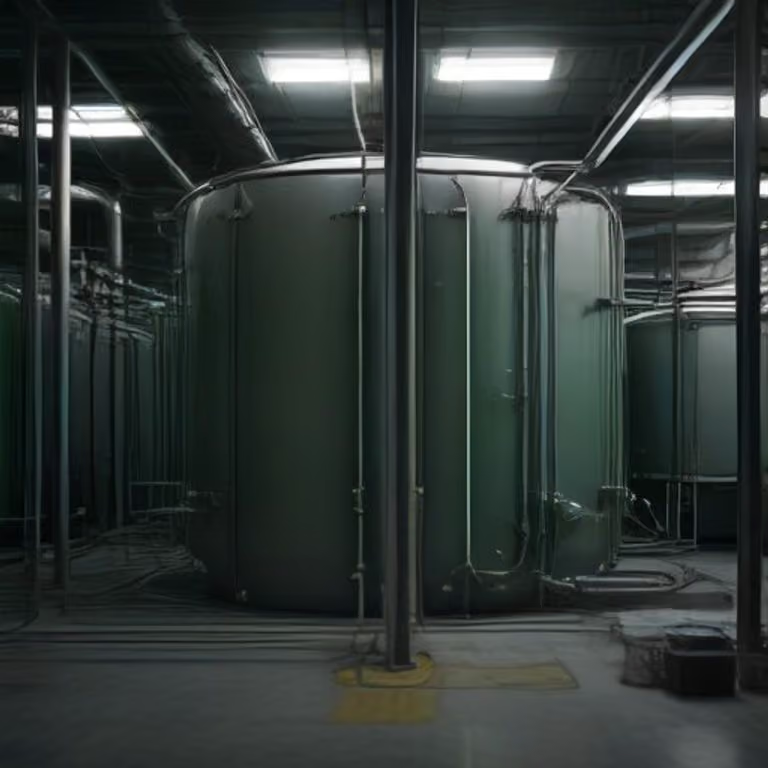
MiAlgae channels this nutrient-rich liquid into large stainless steel tanks, where algae cells are cultivated. Martin likens the process to brewing: 'You take a very small number of algae cells and you take all the whisky byproducts and some other bits and you put them into these big stainless steel tanks and you let the algae feed on all of that nutritious goodness.' The resulting biomass is then harvested as a direct substitute for conventional fish meal and fish oil.
The company's primary market currently is the pet food sector, with aquafeed manufacturers in the pipeline. MiAlgae is constructing its first full commercial production site, projected to yield thousands of tonnes of product per year. While significant, Martin acknowledges this is 'a drop in the bucket' compared to global omega-3 demand, underscoring the vast potential for growth and further impact on 'lots more fish to save still.'
Regarding market competitiveness, Martin aims for 'cost parity with any fish oil that's coming out of the world,' focusing on value per unit of omega-3 delivered. MiAlgae's innovative approach received a significant boost by reaching the finals of the Earthshot Prize in 2024, an accolade Martin credits with enhancing the company's credibility. With commercial scaling underway and growing industry interest, MiAlgae is poised to offer a systemic, sustainable alternative to one of aquaculture's most pressing, yet often overlooked, environmental problems. Source: Euronews