 Advertise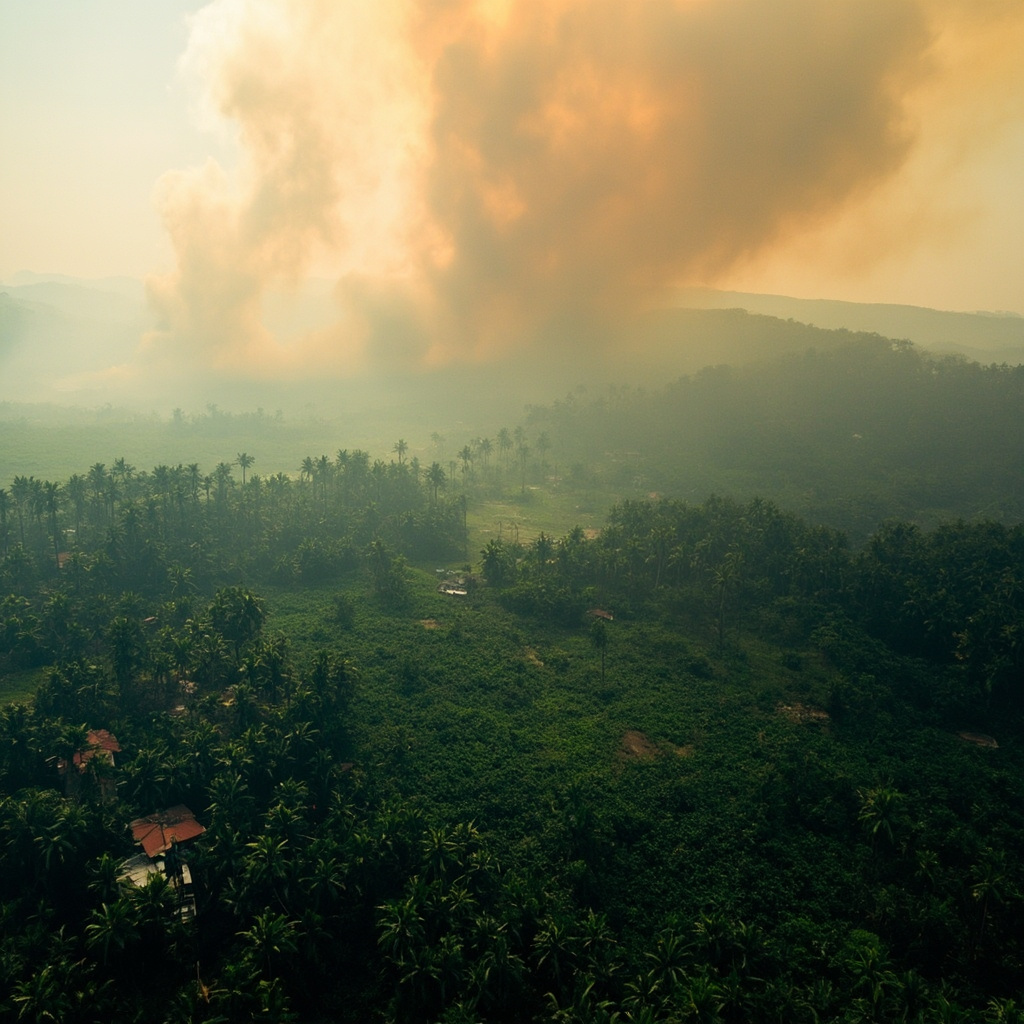
Indonesia's aggressive pivot to palm oil-based biofuels is delivering major economic dividends while accelerating one of Southeast Asia's worst environmental crises. More than 200,000 hectares have already been scorched this year, and the most severe fire season since 2015 still lies ahead.
A firefighter from Indonesia's Regional Disaster Management Agency douses a forest fire at Sungai Rambutan village in Ogan Ilir, South Sumatra, as toxic haze has shrouded parts of Indonesia and Malaysia for weeks. Jakarta is struggling to contain blazes that have razed large tracts of Borneo and Sumatra.
The driver is a government mandate requiring a 50% biofuel blend in diesel, used mainly in trucks and small back-up generators. Roughly one-fifth of global palm oil production this year will be burned in an Indonesian engine. The policy has helped one of the world's biggest oil importers ride out the effects of the Iran war. In his initial response to the conflict, President Prabowo Subianto accelerated the shift from 40% to the current 50% level. He said last month the decision ended diesel imports and is saving the country $9.5 billion a year.
But the same policy is raising the value of a commodity intimately linked to the pall of haze currently descending across tens of millions of people in Singapore, Malaysia, the Philippines and Indonesia itself. Electrifying the country's truck fleet would deliver the same energy security at far less cost to the environment and human health.
Burning forest to clear land for palm plantations is nothing new in Indonesia, and the resulting pollution has plagued the region for decades. Yet with more than 200,000 hectares burned by August and the worst weeks still ahead, this wildfire season could rival the catastrophe of 2015, when fires caused $16 billion of economic losses and more than 100,000 premature deaths. That episode prompted Jakarta to tighten its approach to forest protection. In Europe, it fuelled an anti-palm oil campaign that eventually pushed the European Union to stop classifying palm biodiesel as renewable, cutting consumption. Indonesia responded by gradually raising its blending mandate to today's level.
Palm oil presents a Jekyll-and-Hyde profile. From an established plantation, lifecycle emissions can be roughly half those of diesel. But when growers clear rainforest or drain peatland to plant it, emissions can be twice as high as fossil fuels. Whether Indonesia's biofuel push helps or harms the climate therefore depends overwhelmingly on where the extra feedstock comes from.
The government sees only the upside, arguing that rising demand can be met by improving yields on long-established plantations and planting on 'degraded land'. The data tells a different story. Every bit of Indonesia's palm oil production growth since 2015 has come from expanding the area under cultivation. Palm oil acreage is up 65%, while yields have actually fallen 7%.
The term 'degraded land' is also slippery. A 2024 study found that more than half of Indonesia's palm estate sat on land that had been old-growth forest in 1990. Most was not converted immediately to palm. Today's rainforest can become tomorrow's fire front, then degraded scrub, and eventually a 'sustainable' plantation. While international standards attempt to prevent that practice, Indonesia's domestic rules are far looser, and the passage of time can effectively launder deforestation. Local officials say almost all fires are caused by humans, and 80% of burnt land ends up as plantations.
Conditions this year are particularly combustible. The hot, dry weather brought by the current super-El Niño means infernos will burn longer and further. Crude oil has hit $100 a barrel and US diesel is at record levels, so land capable of growing a substitute is more valuable than ever. With tinder-dry undergrowth everywhere, the only upfront investment needed to clear it is a match.
President Prabowo's rhetoric, mixing ongoing promises of protection with a vow to open up millions of hectares of woodland for food and ethanol biofuel, muddies the anti-deforestation message. His plan to lift the blending rate to 60% as soon as next year adds a further accelerant: it would require about 23 million metric tons of palm oil a year, an increase of a third relative to current levels.
There is a better route to zero out diesel import dependence: eliminate truck engines altogether. The world's biggest fuel importer, China, has already bought roughly a million electric trucks, equivalent to about one-sixth of Indonesia's commercial vehicle fleet. The power to run them comes overwhelmingly from domestic sources.
Indonesia's islands of Java, Sumatra and Borneo are rich in generation opportunities, but they are being squandered. Putting just 10% of the palm estate under solar panels would generate enough electricity to power all of Southeast Asia, plus Japan. Only about a quarter of the country's hydroelectric potential is being exploited. Electric vehicles already account for nearly a quarter of car sales, but trucks and two-wheelers, hampered by inconsistent or non-existent policy support, are lagging badly.
Indonesia has found one way to escape imported diesel. China is demonstrating a better one, capable of preserving both the balance of payments and the landscape. Electrification can even reduce the noxious pollution from burning land and exhaust fumes, a plague reducing the health and life expectancy of millions across Southeast Asia. There is a grand bargain out there, if only Prabowo could seize it.
Source: Bloomberg