
Lang
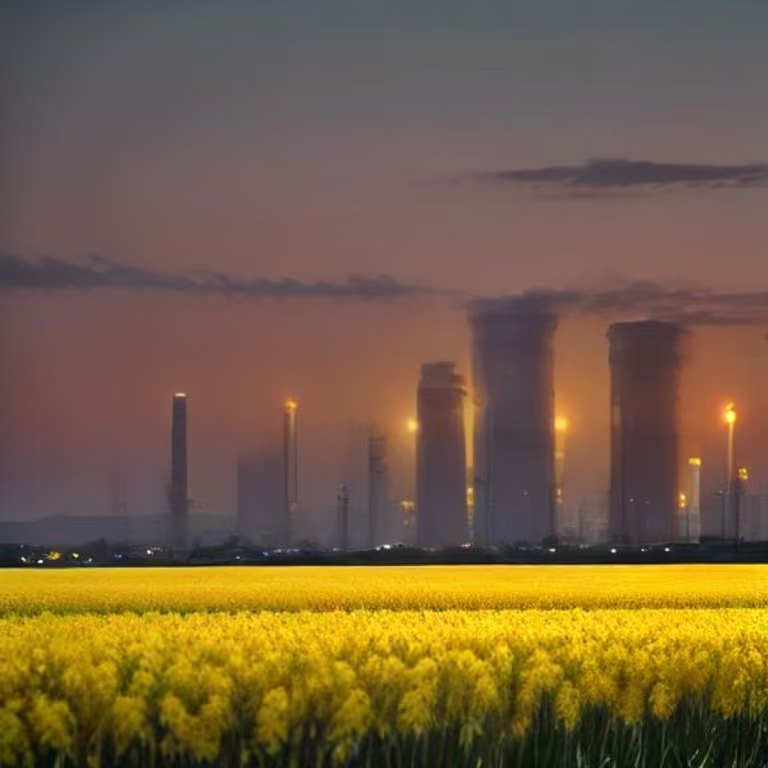
Canadian oil refineries are increasingly turning to canola as a key feedstock for renewable diesel, a transformation that is largely unnoticed by consumers at the gas pump. This versatile yellow flowering crop, traditionally used for cooking oil, is now being refined into a low carbon-intensity fuel, chemically identical to conventional petroleum-based diesel. The fuel industry is quietly adopting renewable diesel to meet stringent emissions targets, establishing the energy sector as the fastest-growing market for canola. This shift is significant, considering canola's immense value, which generated $3.7 billion in farm cash receipts for Canada during the first three months of the year.
Currently, ten of Canada's eighteen oil refineries have either completed or are in the process of adding co-processing equipment to produce renewable fuels alongside their existing operations. David Schick, a Western Canada vice-president at the Canadian Fuels Association, highlights the strategic advantage: 'A lot of our refineries are basically situated near, or almost on, canola fields. We have this feedstock that’s really good for making renewable fuels in close proximity to where we can convert them over into finished products.' Prairie farmers, like Jay Gerry from southeast Saskatchewan, have directly experienced this change. Gerry, whose family grew canola for food-grade oil three decades ago, notes that much of his crop now enters the fuels market. 'With renewable fuels and sustainable fuel policies around the world, we’ve seen an uptick in biodiesel demand,' he stated, farming 12,000 acres near Creelman, Sask.
The Canadian Canola Growers Association, a farmers' advocacy body, forecasts that the fuel industry will add an estimated $600 million in value at the farm gate during the 2025-2026 crop year. This translates to an average of an additional $27 per tonne of seed directly benefiting farmers. Canada has seen its canola oil consumption soar by nearly 60 per cent over the past five years, with the growers group attributing 500,000 tonnes of this increase to the burgeoning fuel industry. Gerry compares this trend to the 'tailwind' experienced by American corn farmers over a decade ago when their crops were utilized for ethanol production to blend with gasoline.
This trend is largely propelled by Canada's Clean Fuel Regulations, which mandate conventional fuel suppliers to reduce emissions annually, with targets set to gradually decrease from 2023 until they flatline in 2030. Schick explains the necessity: 'In order to get the carbon intensity down, you need to blend higher percentages of (renewable) fuel to do that.' The installation of co-processing units at existing refineries is a more time and capital-efficient approach than constructing new facilities. While many such upgrades occur discreetly, Imperial Oil Ltd.'s Strathcona, Alberta facility stands out. This $720-million co-processing and renewable diesel plant, one of Canada's largest, became operational after two and a half years of construction outside Edmonton, with a capacity to produce one billion litres of renewable diesel annually. It reportedly requires about 2.5 million tonnes of canola oil to achieve maximum output, though the company has not disclosed the facility's production figures since it came online in July 2025.
John Whelan, CEO of Imperial Oil, commented on the facility's early performance during the company's first-quarter earnings call on May 1. He noted, 'Our renewable diesel facility at Strathcona captured significant value compared to more costly imports during the first quarter, even as we continued to optimize around hydrogen availability.' Schick projects that the bio-based diesel market, which yielded approximately three billion litres in 2025, is poised to nearly double to around six billion litres by 2030, driven by federal regulations.
In September, Prime Minister Mark Carney announced government credits for every litre of biodiesel or renewable diesel produced, alongside a $370 million injection into the sector to offset U.S. subsidies. The American clean fuels credit system supports domestic production but excludes Canadian producers, who face higher costs. Canada's new tiered subsidy system, enacted at the beginning of the year, allows three major producers to claim up to $40 million annually, according to Colleen Lamothe, vice-president of Advanced Biofuels Canada. Further policy clarity is expected with targeted amendments to the Clean Fuels Regulation, as industry anticipates a draft in the coming weeks to provide investment signals and ensure a level playing field with U.S. competitors.
While aggressive climate policy is often associated with former Prime Minister Justin Trudeau, the low carbon fuel system actually originated under Stephen Harper's Conservative government in 2011, which mandated two per cent renewable content in diesel. Schick argues that the Liberal government's subsequent focus solely on decarbonization 'lost the narrative and importance around rural development, diversifying markets, innovation and supporting farmers in general.' Despite this, the sector remains highly dependent on public policy, making it vulnerable to governmental changes. Provinces also contribute, with British Columbia doubling its mandated renewable fuel content from four to eight per cent in February last year.
Since their debut in November 2023, renewable diesel facilities have made their product a preferred choice in Canada over biodiesel. While biodiesel is less refined, requires blending in small quantities, is cheaper to produce, and has slightly higher emissions, it is also more sensitive to cold weather. Canola oil, however, is a more expensive raw material than crude oil. Nevertheless, the ongoing global energy crisis and disruptions like the effective closure of the Strait of Hormuz have made this cash crop more attractive during the past several months by driving up crude prices. Canola stands out as the most abundant oilseed in North America, though other vegetable oils and animal fats can also be processed for energy.
Canadian canola farmers achieved a bumper harvest in 2025, yielding a record 21.8 million tonnes of canola seed from approximately 40,000 farmers. Last year, crush facilities processed 11.5 million tonnes of seed into 4.8 million tonnes of oil. This strong performance occurred despite trade challenges with China, a significant trading partner. China imposed 100 per cent import duties on Canadian canola oil and meal in March 2025, followed by an anti-dumping duty of nearly 76 per cent on canola seed in August of that year. A preliminary agreement has since seen Canada accept some Chinese EV imports, while China lifted levies on canola meal and reduced seed tariffs to 15 per cent as of March this year. Canola oil, however, still faces a 100 per cent import tax into China.
According to Statistics Canada, twenty-nine per cent of Canadian canola produced last year was exported for fuel to markets such as the U.S. and Europe, though specific figures for domestic fuel production in Canada for 2025 are not published. Canada aims to significantly increase domestic processing capacity, with crushers planning to expand from approximately 13 million tonnes last year to 15 million tonnes by the end of 2026. Cargill Ltd. recently opened a new crush facility near Regina, capable of processing one million tonnes of seed annually. Farmer Jay Gerry now hauls his canola seed an hour away to this Cargill facility, securing a five to ten per cent higher return than local grain elevators. Gerry, whose region produces over half of Canada's canola, notes, 'It does give us a crop that does pencil (in) profitably for 2026-27 so that’s always good news... We certainly need a higher price for the commodity we’re producing because the cost of producing that commodity has increased as well.'
Source: energynow.ca