 Advertise
Note: This article was AI-translated from Arabic and is currently under manual review. The author is not responsible for any translation errors. Please refer to the original Arabic text for the most accurate and authoritative information.
In the Spanish city of Jaén, globally known as the olive oil capital, two Arab friends, studying agricultural engineering and history, were strolling among the sprawling farms on a field study day.
Said said, looking at the blessed trees, "How did this tree become a symbol of Spain and its economy today? But I always wonder: where did the story of olive oil begin? Was it truly here, or somewhere else?"
Omar replied, "Perhaps olive cultivation generally began in the Mediterranean basin, specifically in the Levant, which is considered its original home. But ancient civilizations in the region played a significant role in its consumption and the development of its industry. And I've heard that Egypt, throughout its long history, has a close relationship with this liquid gold."
Said smiled and said, "Absolutely right. Before Europe led olive production, ancient civilizations interacted with this product. In Egypt, the Nile River played a crucial role in stability and agriculture, and cities in Upper Egypt flourished with trade and production throughout different eras, becoming part of this extended history."
"There's an ancient city called Panopolis, or Akhmim today, which serves as a living example of this economic and religious development and prosperity throughout the ages."
"What we study today in Spain is merely an extension of a long chain of shared human knowledge to which the banks of the Nile contributed."
Panopolis is considered one of the prominent ancient Egyptian cities and was the capital of the ninth nome of Upper Egypt. The city is located in the present-day Sohag Governorate, in the heart of Upper Egypt, geographically extending from south of Cairo to the First Cataract of the Nile River. This distinguished location historically granted Akhmim great strategic importance, as it was a key connecting point between the Nile Valley and trade caravan routes heading east towards the Red Sea ports.
The city was built on a fertile flood plain, formed by the annually renewed silt of the Nile River during the flood, which provided an ideal environment for stable agriculture. This environmental prosperity led to:
Akhmim's distinction was not limited to agriculture; rather, it was a vital trade center where caravan routes converged, making it a major hub for commercial and cultural exchange between Egypt and neighboring civilizations across the Sinai Peninsula and the Red Sea.
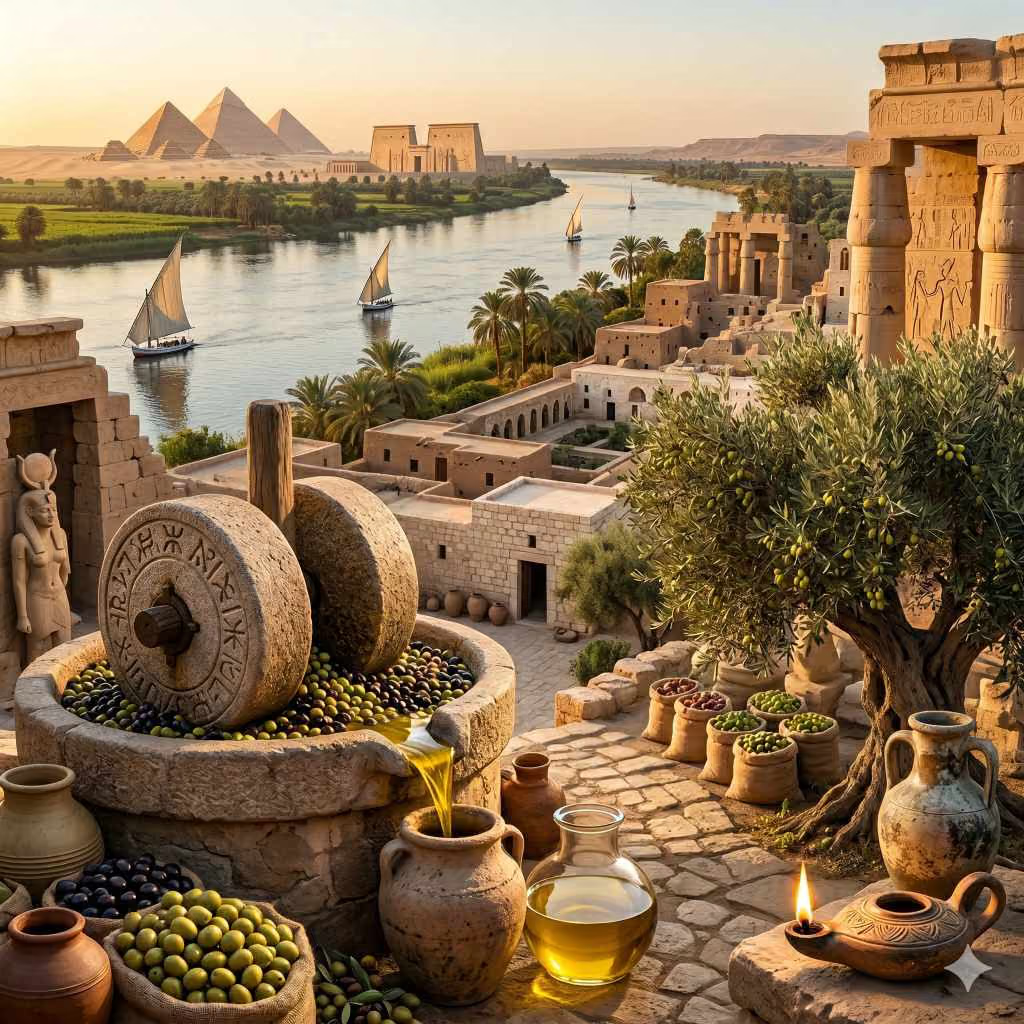
In the early Pharaonic eras, the climate of Upper Egypt and the Delta was not suitable for cultivating olives in large commercial quantities. Therefore, ancient Egyptians relied on other local oils for their daily lives and cooking, such as flaxseed oil (known locally as 'hot oil'), sesame oil, castor oil, and moringa oil (Ben oil).
As for olive oil, it was imported as a luxury, high-value commodity from the Levant. Its use was initially limited to kings and the elite, and in religious rituals for anointing and embalming mummies and lighting temples, in addition to medicinal and cosmetic uses. With the transition to the Late Period, and then the Ptolemaic and Roman eras, Egypt began to expand its local cultivation of olive trees, especially in areas with suitable climates such as the Faiyum region, the Oases, and the North Coast.
With the advent of the Coptic and Byzantine eras, the olive oil industry in Egypt witnessed a qualitative leap and significant development, specifically within the monastic monasteries that spread throughout Egypt, including the Akhmim region, which housed important historical monasteries (such as the White Monastery and the Red Monastery).
Monks relied on agriculture as a fundamental part of their spiritual and daily lives, successfully reclaiming land and cultivating grains, vineyards, and olive trees. Given the significant role of oil in church rituals (such as lighting and the production of holy oils like myrrh), advanced olive presses were established within monastery walls. Monks produced high-quality oil, drawing on inherited expertise, some of which was documented in their scientific manuscripts.
This industry saw greater organization under the patronage of church leaders throughout the ages. Historically, Coptic Popes (such as Pope Benjamin I in the 7th century AD and Pope Yusab in later eras) encouraged the development of monastic infrastructure and the allocation of areas equipped with modern presses for olive oil production, with the aim of achieving:
The surplus oil production from monasteries and surrounding farms extended beyond local consumption, becoming a prominent commercial product. Thanks to Akhmim's strategic location as a transportation hub, the oil was redistributed and exported through internal and external trade networks. This contributed to supporting the local economy and connecting Upper Egypt with major commercial centers both within and outside Egypt.
Olive oil had diverse uses in Egyptian society throughout the ages, including:
The story of Panopolis (Akhmim) and the historical context of olive production in Egypt illustrate how agriculture was intertwined with the development of civilization throughout the ages. While Spain today (specifically the city of Jaén) stands as the modern global capital of olive oil production, the roots of cultivating this blessed tree and crafting "liquid gold" stretch deep into the history of the Eastern Mediterranean and Egypt. Here, human ingenuity, the unique environment, and the timeless flow of the Nile River converged to forge a civilization and culture that has endured through time.