
Lang

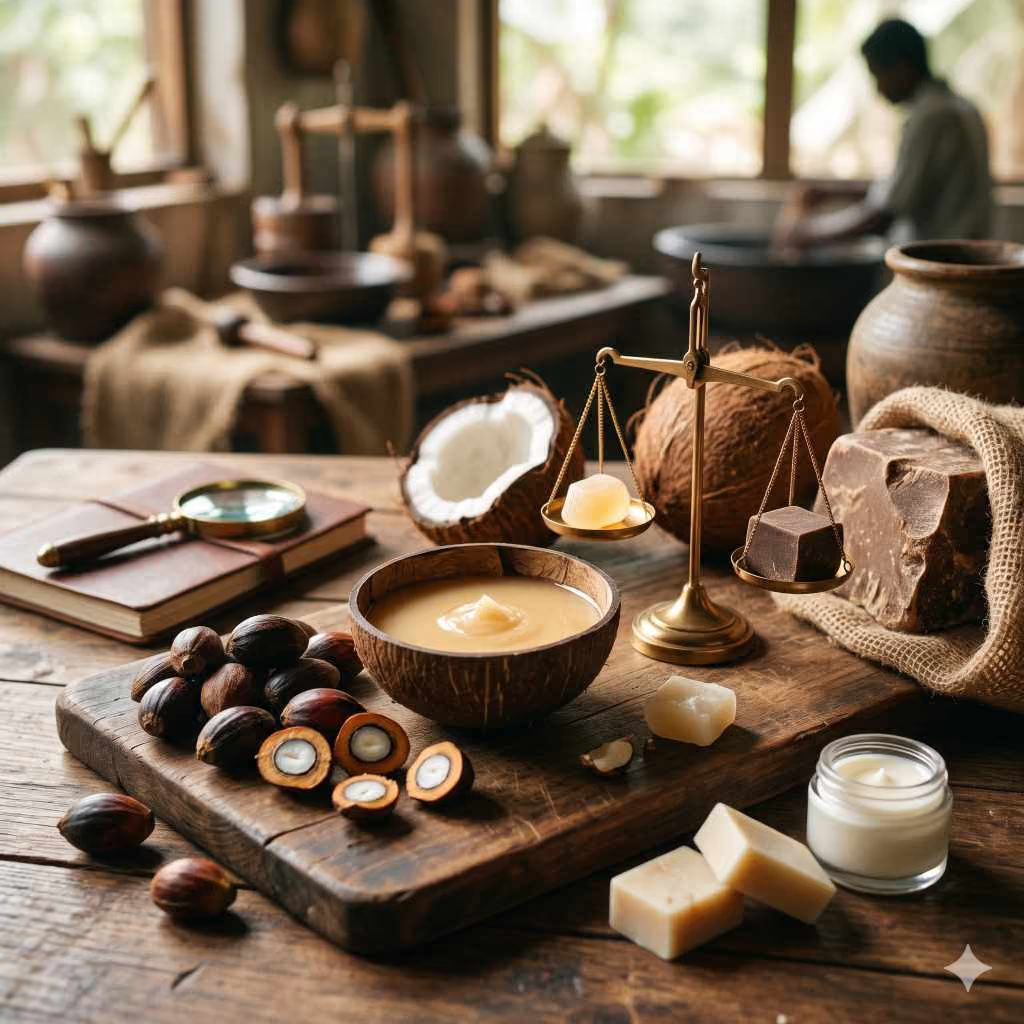
Note: This article was AI-translated from Arabic and is currently under manual review. The author is not responsible for any translation errors. Please refer to the original Arabic text for the most accurate and authoritative information.
An important discussion on cost reduction strategy between accountant Mahmoud Gamal and Dr. Hussein El-Sisi regarding alternatives to reduce production costs in the cosmetics industry.
Amid increasing economic challenges and rising raw material prices, cosmetics companies face significant pressure to maintain product quality while reducing costs. In this context, a professional dialogue took place between accountant Mahmoud Gamal, who works for a cosmetics company, and Dr. Hussein El-Sisi, an expert in oil industries, to seek practical and economical solutions.
Mahmoud Gamal began by saying: "Production costs have become a real challenge for the company, especially with the significant increase in the prices of coconut oil and cocoa butter, which are essential ingredients in most of our products. We urgently need an economical alternative that achieves the same efficiency without negatively impacting the quality of the final product."
Dr. Hussein smiled and said: "The solution already exists, and it might be closer than you think. Have you considered using Palm Kernel Oil and its derivatives?"
Dr. Hussein explained: "Palm kernel oil is a true treasure in the food and cosmetic industries, thanks to its unique properties and rich composition. It contains over 80% saturated fatty acids, yet its melting point ranges from 28 to 32 degrees Celsius, making it ideal for use in cosmetics. It also features a high concentration of Lauric Acid, reaching up to 48%, alongside myristic and palmitic acids, which gives it chemical properties similar to coconut oil, and even superior in some applications."
Dr. Hussein continued: "From a physical perspective, palm kernel oil is characterized by:
These specific qualities make it an excellent choice for use in creams, lotions, and soaps."
Dr. Hussein emphasized: "More importantly, palm kernel oil and its derivatives can replace several expensive materials in your factory:
Mahmoud replied with interest: "Does this mean we can reduce costs without sacrificing quality?" The doctor confidently replied: "In collaboration with your Research and Development (R&D) department, yes; in fact, you might achieve greater stability and a longer shelf life for the final product against rancidity, thanks to its stable saturated nature."
The doctor continued his presentation: "From a production standpoint, palm kernel contains about 45% to 48% oil, and it is extracted mechanically using a double screw press, or through solvent extraction.
Investing in this oil is highly profitable, especially when purchasing Refined, Bleached, and Deodorized Palm Kernel Oil (RBD PKO), which can be directly used in manufacturing without impurities. Additionally, the by-product of the extraction process (palm kernel cake) can be utilized in animal feed production.
Mahmoud concluded the discussion by saying: "It's clear that palm kernel oil presents a real opportunity to reduce costs and enhance production sustainability in our factory, and we will immediately begin coordinating with the lab to conduct experiments and formulate new compositions."
Dr. Hussein responded: "Success in today's industrial world depends on intelligently choosing alternatives, and palm kernel oil is one of the most important of these economical solutions."
Palm kernel oil represents a strategic choice for cosmetic companies striving to achieve the difficult balance between cost reduction and quality maintenance, thanks to its unique chemical composition, versatility, and cost-effectiveness compared to coconut oil and cocoa butter.
What do you think of this revised wording? And if you'd like to focus on a specific cosmetic product (such as solid soap or creams) to add as a practical example in the discussion, I can help you with that.