Advertise
Note: This article was AI-translated from Arabic and is currently under manual review. The author is not responsible for any translation errors. Please refer to the original Arabic text for the most accurate and authoritative information.
Imagine that you have gold in your hands... but not metallic gold, but yellow oily gold, grown in the land of Egypt and carrying in its drops the secret of health and the future food and industrial weapon. It is flax oil, the oil that combines the originality of agriculture, the genius of chemistry, and the rapid needs of the global market.
At a time when omega-3 fatty acids are the title of preventive health, and smart vegetable oils are a driver for the food, pharmaceutical and cosmetic industries, flax oil is emerging as a strategic opportunity for Egypt in agriculture, industry, and export.
* Flax oil is not just a product... but a national project: it contains in its composition the highest natural plant concentration of ALA (alpha linolenic acid), the basis for building brain and heart health.
- It is used in many food products, dietary supplements, natural paints, and pharmaceuticals.
- Egypt grows distinctive types of linen that can become new tributaries of the green economy and huge export opportunities in the markets of Europe and Asia.
If we are looking for a product that has a nutritional, economic and industrial value at the same time, flax oil is the gateway: a gateway to smart investment in the future, sustainable agriculture and better health for the world.
Is it time to invest in the treasure we own?
The journey of hot oil from heritage to a national project for health and industry, after we learned about Why do we revive the cultivation and manufacture of linen?
Flax oil is known in Egyptian heritage as the “hot oil”. This label has more than one explanation:
Scientifically: because it is rich in unsaturated fatty acids (especially linolenic acid or what is known as omega-3), which makes it quickly oxidized and gives a pungent taste similar to “heat”.
Agriculturally: When harvested, it may be mixed with another plant called “Hara”, adding a distinctive spicy flavor.
But behind this simple name lies a unique global product that combines nutrition, health, industry and investment, and represents a strategic opportunity for Egypt and the Arab world.
What are the different names for linseed oil?
In Arabic: spicy oil - flaxseed oil - flax oil.
• In English & Linseed Oil — Flaxseed Oil
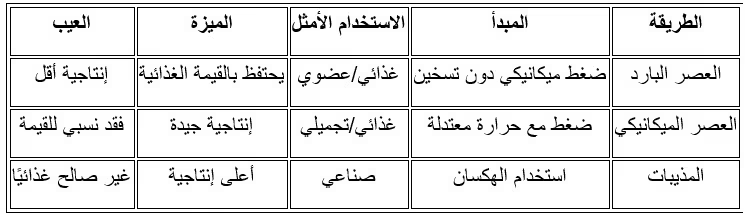
Flax oil (hot oil) is mainly characterized by its unique production method, which is based on cold pressing or pressing without the use of heat or chemical solvents. This careful method is necessary to preserve its precious nutritional composition, especially its very high and fragile content of omega-3 acids, which is easily damaged when exposed to heat. As a result, its production and storage process is subject to strict standards. It is packed in opaque packaging to prevent oxidation by light, and stored in a cool place. This makes it similar to high-quality cold-pressed virgin oils in that it is a specialized product that is not used for frying or cooking, but is added to cold dishes or consumed as a dietary supplement to obtain its health benefits, limiting its spread in traditional markets and limiting its presence to specialized health products.
Fatty acids:
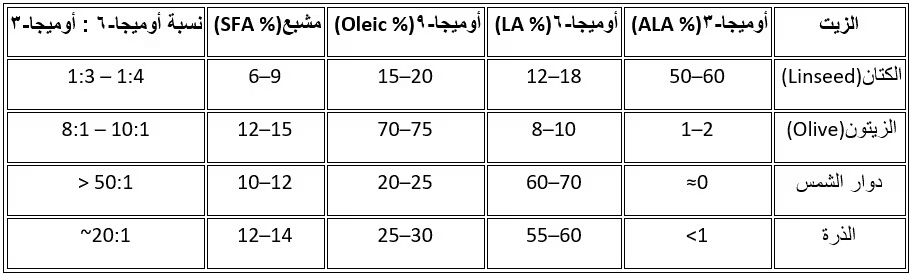
🔑 Result: Flax oil is the richest in omega-3 and has an ideal ratio of omega-6: omega-3.
In the world of nutrition, the ratio between omega 6 and omega 3 is the balance of health and inflammation in the body. While the ideal ratio aims to not exceed 4:1 (omega 6 to omega 3), the modern diet shows a glaring imbalance of up to 20:1 in favor of inflammatory omega 6 due to excessive vegetable oils and processed foods. Here, flax oil “liquid gold” stands out as an exceptional solution. It transfers the equation in favor of health with an amazing ratio of 1:4 in favor of omega-3, making it the most powerful natural weapon to restore balance, fight chronic inflammation, and effectively support heart and brain health.
Minor ingredients:

• Maintains heart health (lowering triglycerides and blood pressure).
• Supports brain function (nerve communication and memory).
• It acts as an anti-inflammatory (useful in rheumatoid and eczema).
• It protects against some types of cancer thanks to lignans and phenols.
• Nutritionally: cold-pressed virgin oil - dietary supplements - functional foods.
• Industrially: paints and varnishes - Linoleum - printing inks - Bio-Lubricants.
• Cosmetic: hair and skin products - skin treatment creams.
Why isn't linseed oil as prevalent in the supermarket as other oils?
Flax oil (spicy oil) is not widely sold in supermarkets, like other oils, for several main reasons, the most important of which is its unsuitability for cooking or frying because it contains a very high percentage of omega-3 (about 50-60%), which makes it quickly oxidized and forms harmful compounds when exposed to heat, which limits its primary use in cold dishes or as a dietary supplement. In addition, the cost of producing and storing it (as it requires special conditions to prevent its corruption) is higher than traditional oils, and the lack of mass demand is due to lack of awareness of its benefits compared to other oils such as olive or sunflower oil, despite its recent emergence in the market as a type of specialized oil with increased consumer interest in health products rich in omega-3.
• It contains protein (30-35%) and fiber → excellent feed for animals and poultry.
• Can be used as organic fertilizer or biofuel.
• Canada 🇨🇦 (the first in the world to produce dietary flax oil).
• Russia 🇷🇺 (the largest oil and fiber producer).
• China and India 🇨🇳🇮🇳 (extensive production for the local and global market).
• Europe (France, Germany) with specialized food markets.
• Egypt currently: very limited production (< 20 thousand feddans, ~25 thousand tons).

• Historically: the pharaohs used linen fibers in fabrics and oil in dietary rituals.
• Industrially: The Tanta Linen Factory was a symbol of a leading Egyptian industry.
• Currently: cultivated areas and production have declined sharply.
• In the future:
o Enhancing food security by providing omega-3 locally.
o Reducing the import of oils and feed.
o Supporting industries (paints, inks, fibers).
o Exporting to global markets (the Gulf and Europe).
• Challenges: limited spaces - poor awareness - strong competition - old industrial structure.
• Solutions:
1. Agricultural contracting with farmers.
2. Dual production lines (food+industrial).
3. The development of gain as a local protein feed.
4. Focus on exporting to distinctive markets.
5. Modernizing factories and applying Codex standards.
• The global market size is ~ 5 billion dollars in 2024.
•
🔑 Profitability depends on the production of high-quality oil with international certificates (Organic, GMP).
Flax oil or “hot oil” is more than just oil:
• A unique and healthy food source. A versatile industrial product. A strategic economic opportunity for Egypt if its agriculture and industry are revived.
Flax oil is not just a traditional agricultural product. It is an integrated investment opportunity that combines agriculture, manufacturing, nutrition and health. On the one hand, it represents a strategic resource for plant-based omega-3 production at a time of increasing global demand for natural and sustainable alternatives. On the other hand, it opens the door to high-value food, health and functional industries, in addition to its traditional industrial uses in paints, inks and linoleum. With the optimization of **protein gain** as local feed, the project is transformed into a successful model of circular economy.
For Egypt, reviving the cultivation and processing of flax means **reducing dependence on imports, enhancing food and fodder security, providing job opportunities, and increasing export capacity** in regional and global markets looking for clean and reliable products. It is an opportunity to turn the “absent power of flax” into a “developmental, economic and health engine” that will put Egypt in a leading position among the countries producing this vegetable gold.