 Advertise
Note: This article was AI-translated from Arabic and is currently under manual review. The author is not responsible for any translation errors. Please refer to the original Arabic text for the most accurate and authoritative information.
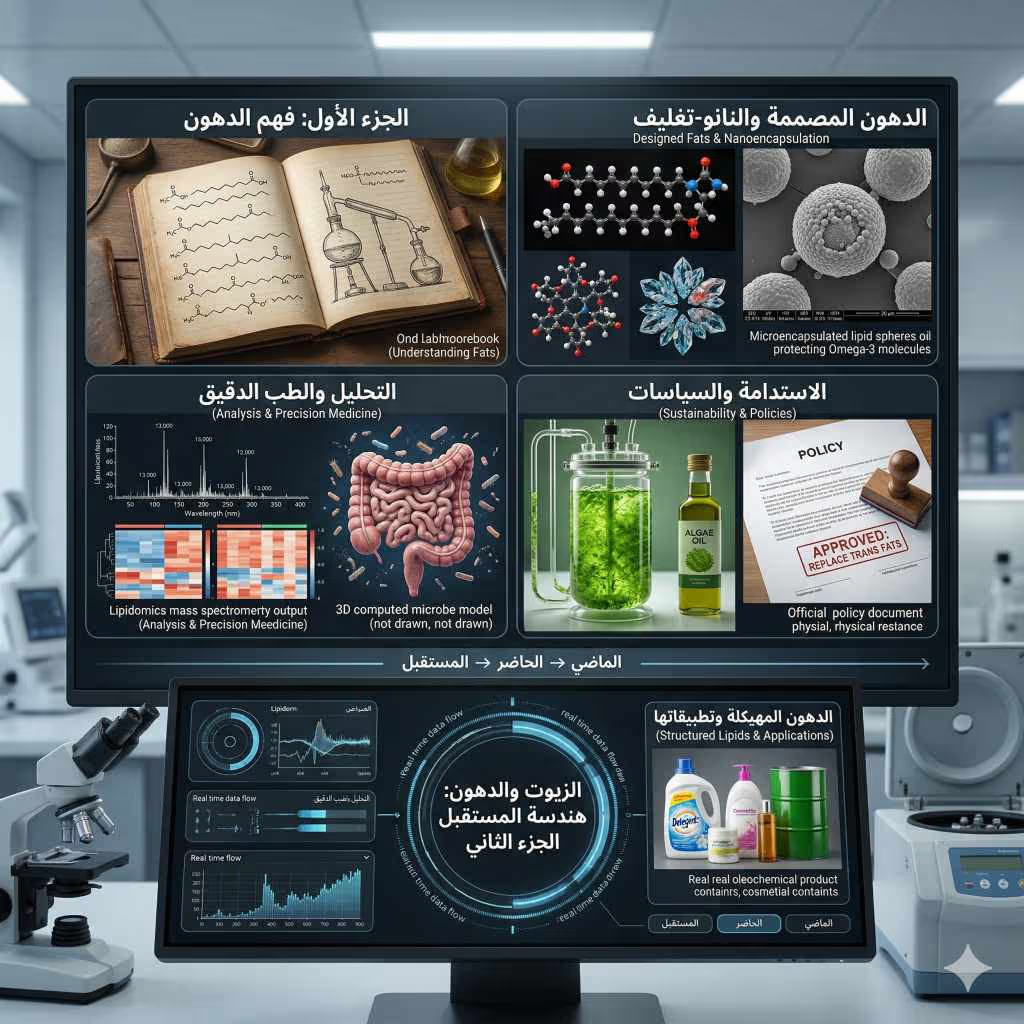
This is the second part of the series: "Oils and Fats — From Life's Secrets to Engineering the Future"If the first part revealed how fats transformed from a substance used to a substance understood, this second part uncovers how they evolved into a substance designed, analyzed, and managed, becoming a key to modern medicine and sustainable industry. To read the first part of the series: Oils and Fats: From Early Beginnings to the Dawn of Modern Lipid Science 👉
A reference article on oils and fats, reviewing the evolution of the science from understanding to design, analysis, and sustainability, covering functional lipids, nano-encapsulation, lipidomics, the microbiome, and the role of fats in health policies and the green economy.
Once science had understood fats, a new, bolder phase began: they were no longer just discovered, but designed, their molecular maps analyzed, and their health, regulatory, and industrial impacts managed. Here, oils and fats transform from a food substance into a scientific tool shaping precision medicine and contributing to a more sustainable economy.
If the first half of the oils and fats story revealed how humanity moved from using them to understanding their structure and functions, the second half uncovers a more advanced stage: directing this knowledge and formulating it into precise applications that serve health, food, industry, and sustainability.
Here, fats are no longer merely a substance to be studied or consumed; they have become a substance to be designed, their molecular maps analyzed, their relationship with the microbiome investigated, their roles in inflammation and immunity re-evaluated, and they are integrated into building a more efficient and sustainable green economy.
With the turn of the new millennium, lipid science entered a more ambitious phase. The goal was no longer merely to provide fat suitable for cooking or manufacturing, but to develop fats with pre-defined health and functional properties.
In this context, concepts such as structured lipids, diacylglycerols, phytosterols, and other compounds emerged, designed to influence cholesterol absorption, metabolic response, or body composition. Thus, it became clear that the future of lipid science lies not only in discovering what natural fats contain, but in designing lipid systems that serve precise health objectives.
With increasing consumer health awareness and growing regulatory pressure to limit trans and saturated fats in certain products, a clear trend emerged towards developing fat alternatives, both in traditional and modern food products.
These alternatives encompassed a wide spectrum of solutions, from low-energy fats to oleogels, modified emulsions, and plant-based fats designed to mimic the texture and sensory function of traditional fats. The market also saw an expansion in the use of modified vegetable oils and products based on structured proteins or carbohydrates to imitate the fatty sensation.
These alternatives have achieved varying degrees of success; some have met important industrial and health requirements, particularly in reducing undesirable fats and improving the nutritional profile of products, while certain challenges remain, especially in balancing texture, taste, stability, and cost.
At the market level, consumers have become more aware and influential in guiding these innovations, such that fat alternatives are no longer merely a technical option, but have become part of an ongoing dialogue between science, industry, and consumer preferences.
As food and pharmaceutical sciences advanced, a more precise question emerged: How do we maintain the efficacy of lipid compounds and improve their bioavailability?
This is where nanocoating technologies came to the forefront. These technologies involve encapsulating lipid compounds within micro-systems that protect them from oxidation, reduce their loss, and improve their absorption. In the case of Omega-3, these techniques have enabled the reduction of sensory issues, improved stability, and increased bioavailability.
Thus, lipid science shifted from selecting the right oil to designing its delivery method within the body.
One of the clearest lessons from the history of fats is that science alone is not enough unless it translates into public policy. For nearly two decades, evidence accumulated regarding the harms of industrial trans fats, and then countries and international organizations began translating this accumulation into regulations, legislation, and practical measures.
Along this path, clear pivotal milestones emerged:
Thus, fat safety became an example that science is not complete until it translates into regulation, legislation, and effective implementation.
Science entered a new, deeper phase: studying the complete "lipid map" within the body.
Lipidomics doesn't view fats as a single category, but rather as a complex network of molecules that change based on health, disease, and dietary patterns. This field has paved the way for precision medicine and personalized nutrition.
Understanding fats is no longer possible without understanding the gut microbiome. It has been proven that gut bacteria influence fat absorption and metabolism, as well as metabolic and inflammatory balance.
Thus, fats are now understood within a vital biological context, not merely as isolated molecules.
With the increasing demand for omega-3s, algae have emerged as a sustainable source for these fatty acids. Algae represent an important solution because they are:
The COVID-19 pandemic demonstrated that fats are involved in regulating inflammation and immunity, and that the balance between omega-3 and omega-6 derivatives plays a crucial role in biological response.
Oils are not limited to food; they are also used in a wide range of industries, including:
This makes them a part of the green economy and sustainable industry.
The science of fats has shifted from:
And fats became:
If the first article showed how oils and fats transformed from a substance that is used to a substance that is understood, then this article reveals how they transformed from a substance that is understood to a substance that is designed, analyzed, and managed.
Thus, the story of oils and fats is not just a story of food, but a story of science, health, industry, and sustainability. It is a reminder that wisdom lies not in rejecting or idolizing fats, but in understanding them, balancing them, and regulating their use.
Anyone who understands oils and fats with such depth not only understands food, but also approaches an understanding of life and the future.
Between the two parts, the complete picture of the science of oils and fats emerges: from a substance known to humans through experience, to a science that explains life, and then to a tool used to design the features of the future.
Thus, oils and fats are no longer merely a food component, but become a scientific language connecting the cell, health, industry, and sustainability—and one of the most profound and impactful keys to the future.
In the next installment, we delve into the figures who shaped this history, to read the biographies of the scientists who built the science of fats, transforming observation into knowledge, and knowledge into an impact that continues to this day.