Advertise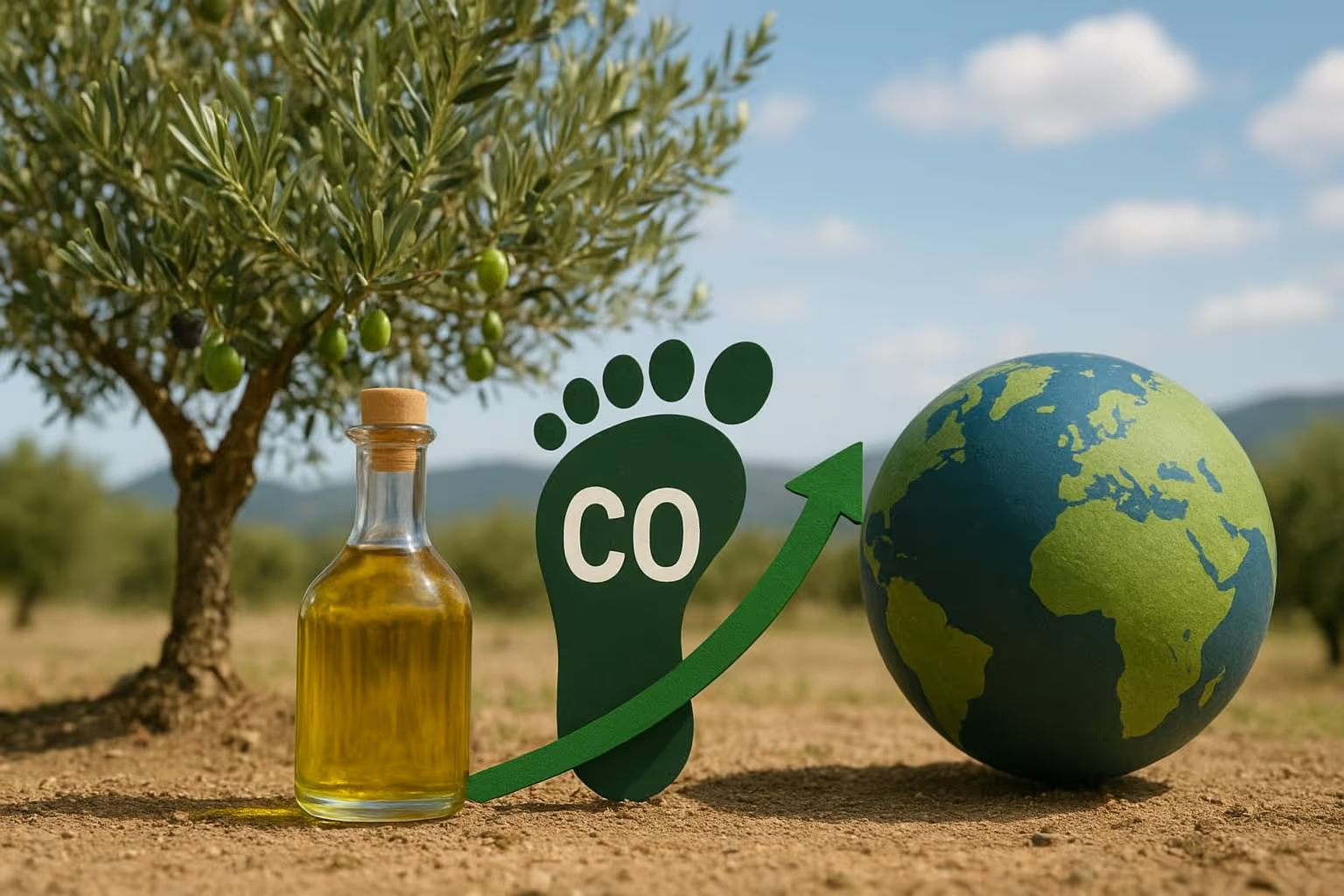
Note: This article was AI-translated from Arabic and is currently under manual review. The author is not responsible for any translation errors. Please refer to the original Arabic text for the most accurate and authoritative information.
Climate changes and global warming, resulting from the rapid development of industry and mining, have a significant impact on environmental pollution and climate. Global warming and rising temperatures occur, which in turn affects food security through its impact on trees, plants and even livestock.
Hence, the search was for ways to control carbon emissions as a measure of global warming. We all remember the ozone layer and the increase in temperatures on the planet. Therefore, in order to preserve the environment, ways are being explored to control global warming and carbon emissions by producing CARBON NEUTRAL ENERGY It enters the industrial fields. Companies are moving to produce, advertise and promote carbon-neutral products.
Carbon dioxide (CO2) is the most famous greenhouse gas that traps heat in the atmosphere. Other greenhouse gases can be measured using the global warming potential of carbon dioxide or “GWP” as a unit (called “carbon dioxide equivalent” or Co2e). This has a negative impact on the environment.
Achieving “carbon neutrality” means we get rid of carbon dioxide equivalent emissions.
The increase in the cultivation of olive trees is important not only for their production of olives and olive oil and the expected economic and investment return, but also for their ability to work As a carbon sink. It absorbs a great deal of carbon dioxide, thus improving the environment, acting as a barrier against environmental pollution and global warming, and acting as an outlet for the planet.
One of the distinguishing features that distinguish extra virgin olive oil from other cooking oils is the ability of the olive tree to act as a carbon sink. This means that olive trees absorb more carbon from the atmosphere than they release, making them a valuable tool in combating climate change.
It is the total greenhouse gases resulting from industrial, service, or personal emissions. They are measured in an effort to reduce the negative effects of those emissions.
In most cases, the total carbon footprint cannot be calculated exactly due to insufficient knowledge and data on the complex interactions between contributing processes, including the impact of natural processes that store or release carbon dioxide into the atmosphere. For this reason, a definition can be made The carbon footprint As follows:
It is a measure of the total amount of carbon dioxide (CO2) and methane (CH4) emissions of a defined community, system or activity, taking into account all relevant sources, sinks and reservoirs within the spatial and temporal limits of the community, system or activity studied. It is calculated as a carbon dioxide equivalent using the relevant probability of global warming for 100 years.
It is a certificate that distinguishes one product from another and shows leadership in the market. Through SCS's new certification standard for carbon-neutral entities, buildings, products, and services, or the internationally recognized “carbon neutral” standard (PAS 2060), companies can certify that they have successfully deactivated their carbon footprint.
SCS offers full-service options for achieving carbon neutrality, which include determining a product's carbon footprint and guidance on purchasing verified carbon offsets from reliable sources that align with your company's mission. In addition, SCS is a certified evaluator under the Carbon Neutral Protocol for those companies looking to obtain certification under the Carbon Neutral Certification Standard.