 Advertise
.avif)
Note: This article was AI-translated from Arabic and is currently under manual review. The author is not responsible for any translation errors. Please refer to the original Arabic text for the most accurate and authoritative information.
A simplified article explaining the types of lamb fat, its chemical composition, and the role of intramuscular fat in tenderness, juiciness, and flavor, presented clearly for both specialists and non-specialists.
What gives some cuts of lamb greater tenderness, more distinct juiciness, and deeper flavor than others? And why are some lamb cuts richer in mouthfeel and aroma, while others seem less impactful, even though they come from the same animal?
The answer lies not in the meat alone, but in the composition, distribution, and function of lamb fat. Lamb fat is not merely "grease" or "suet" with uniform mass and function; rather, it is a complex biological system that varies according to its anatomical location, chemical nature, physiological role, and impact on meat quality and sensory characteristics.
Therefore, understanding the types of lamb fat is not a marginal topic in meat science, but a fundamental key to understanding tenderness, juiciness, flavor, and nutritional value. This article delves into the basics: What is lamb fat? How does it differ? What is its general composition? And why does this variation directly affect meat quality?
It is a simplified scientific introduction to a world where lipid science, meat chemistry, nutrition, culinary arts, and carcass quality intersect.
In everyday use, all lamb fat is reduced to a single word: "fat." However, this simplification obscures an important scientific truth; sheep fat is not a single tissue, nor does it perform a single function, nor is it identical in location, composition, behavior during cooking, or even in its effect on nutritional and sensory quality.
The fat stored in the tail differs from visceral fat, and intramuscular fat differs from subcutaneous fat, and bone marrow is not merely a simple extension of the other fatty tissues. This is where the value of scientific understanding begins: when we move from a general overview to the precise anatomy of lamb fat, connecting the type of fat to its function and its impact on meat quality.
Meat and nutrition sciences categorize types of lamb fat based on location and function, not merely appearance. Among the most important types are:
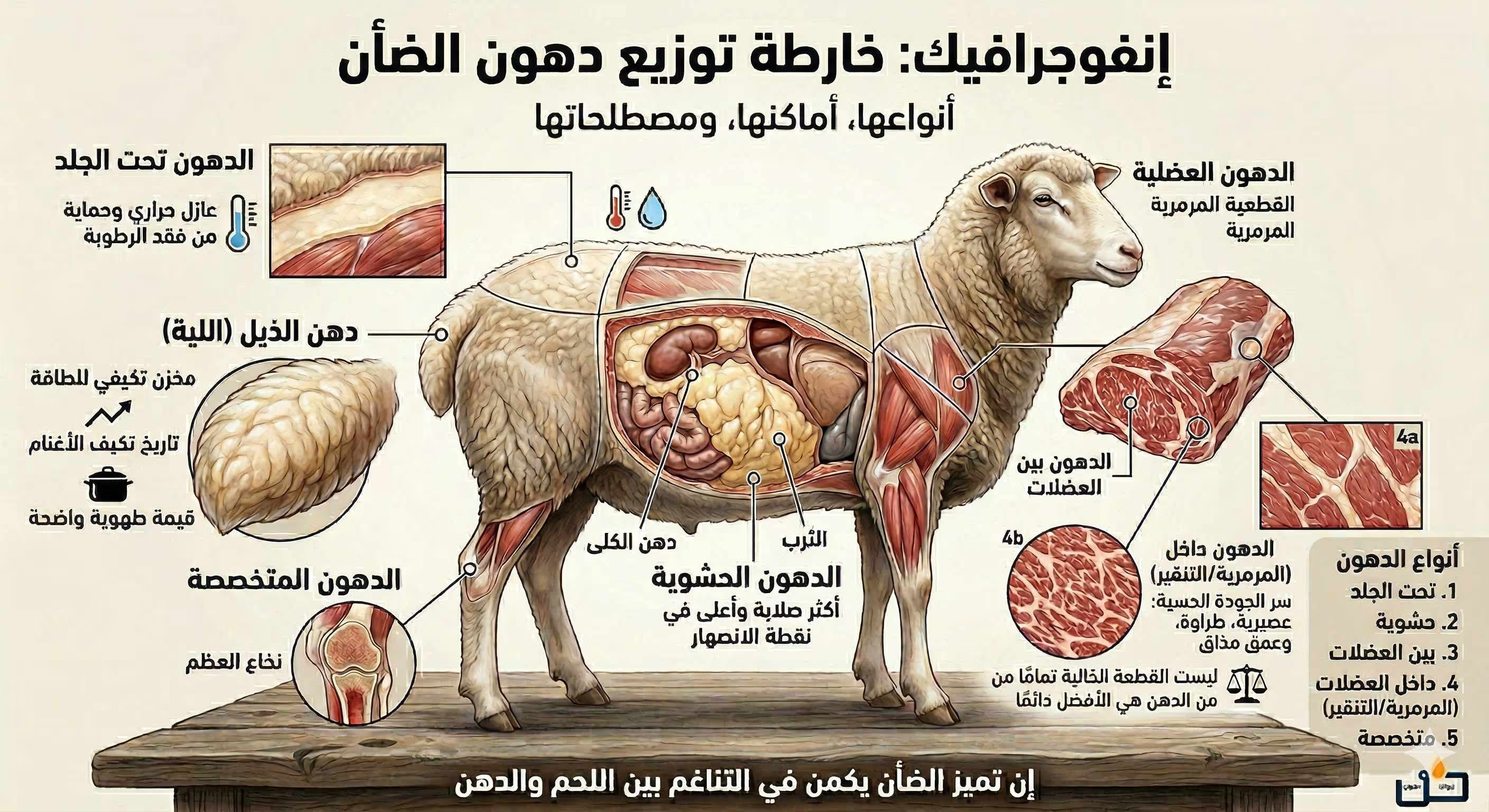
This classification isn't merely an academic exercise; it's fundamental to understanding tenderness, juiciness, melting point, how the cut behaves during cooking, and its ultimate value on the plate.
At its core, lamb fat is primarily composed of triglycerides, which are the largest component of adipose tissue. Regarding fatty acids, three main components dominate the profile:
Oleic acid often takes center stage in much of lamb fat, with a significant presence of palmitic and stearic acids. Other acids are present in smaller quantities but are nutritionally and scientifically important, such as:
Note: The composition of lamb fat is not a rigid template; rather, it is significantly influenced by: fat location, breed, age, sex, feed quality, pasture, health status, environment, and stress level before slaughter.
The value of lamb fat extends beyond triglycerides alone, encompassing what are known as minor components, which are highly influential in stability, flavor, storage quality, and flavor development. Key among these are:
Tail fat, or "Al-Liyah" in fat-tailed breeds, holds a special place in Arab culinary awareness. Scientifically, it is an adaptive energy store reflecting the history of sheep's adaptation to arid environments. It has clear culinary value, imparting depth of flavor and richness of texture, but its nutritional interpretation must be linked to the quality of its fatty acids and the overall consumption context.
Visceral fat (such as kidney fat and omentum) differs from subcutaneous fat; it is more connected to biological processes and is often firmer with a higher melting point. It is a scientific fact that this tissue is dynamic and changes, starting in newborn lambs with characteristics similar to heat-generating brown fat, then transforming into mature white fat as they grow.
While tail fat is the most recognized, intramuscular fat is crucial for eating quality and is known as Marbling. This type is responsible for:
The fundamental scientific truth: A completely lean cut isn't always the best; the delicate balance between muscle fibers and intramuscular fat is the secret to the quality sought by chefs and connoisseurs.
One of lamb's most distinctive qualities is this unique harmony. When fat is distributed precisely within and around the muscles, it enriches the flavor and imparts depth and warmth to the aroma. Lamb's excellence isn't solely about the quantity of fat, but rather its harmonious integration with the meat in terms of structure, aroma, taste, and its role on the plate.
Lamb fat is not merely a minor detail; it's a central element that explains the differences perceived by taste and confirmed by science. The secret to excellence lies in intelligent balance, where fat becomes a structural and sensory component, not just excess bulk.
we will move from the chemistry of composition to the logic of application:
There, the full picture emerges... from the structure of fat... to the function of the cut... to the broader production and nutritional perspective.