International olive oil expert and judge, and member of the Scientific Society – Alexandria University.
Publication Date:
January 2, 2026
·
—
Note: This article was AI-translated from Arabic and is currently under manual review. The author is not responsible for any translation errors. Please refer to the original Arabic text for the most accurate and authoritative information.
After years of effort and hard work cultivating olives, and with his trees finally beginning to bear fruit, Hajj Sayed Abu Talib — the farm owner — found himself at a loss. He needed to see the fruit of his labor pay off. He sat listening to olive-press suppliers and asking around among neighbors and project owners who already used them, but the more he listened the more confused he became. He follows the best agricultural practices and pays attention to every detail in pursuit of high-quality olive oil — and one of the most important steps in that pursuit is choosing the right press. So what should he do?
Hajj Sayed asked me to come out to the farm so we could talk it through and reach a clear answer on which press to choose, away from the sweet talk of the press salesmen.
What does history tell us about press efficiency?
The efficiency of an olive press lies in its ability to reduce the percentage of oil left behind in the "pomace" (the solid residue from extraction). This efficiency varies by press type:
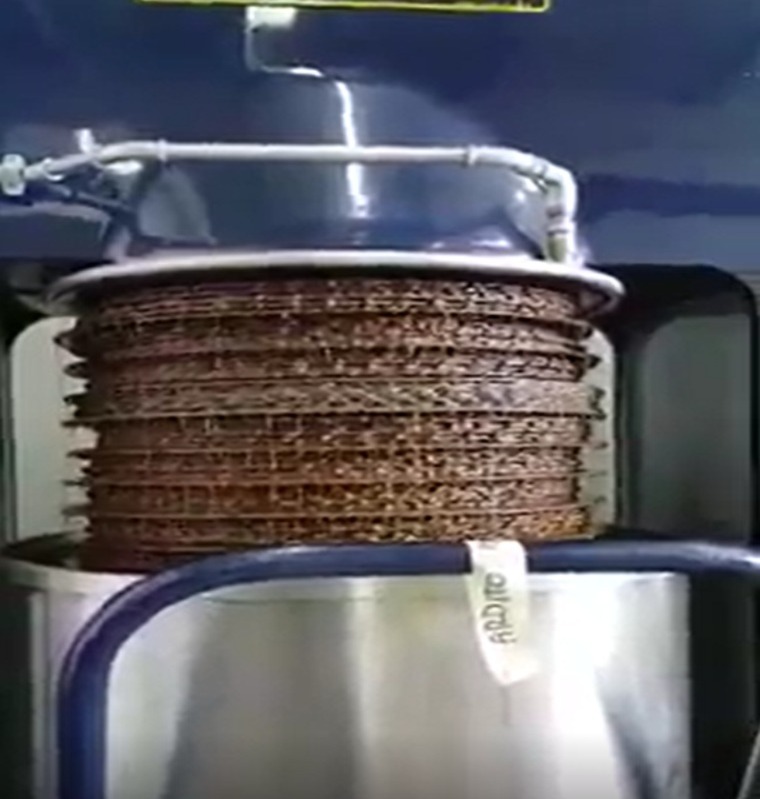
Hydraulic presses (the traditional system): These use mechanical pressure to extract the oil and leave a larger amount of oil behind in the pomace. You can watch a video here.
Hydraulic presses
Centrifugal extractors (the modern system): These rely on centrifugal force to separate the oil from the solids, which results in a higher oil extraction yield than the traditional presses. The oil produced is also of higher quality, and these systems are recommended when purchasing, compared to hydraulic presses. You can watch a video here.
Centrifugal extractors
Criteria for choosing the right press
When making a purchase decision, focus on the following criteria:
Pressing efficiency: The press's theoretical throughput should match its actual throughput in practice. You need a press that can handle the farm's total seasonal yield in such a way that what is harvested each day can be pressed the same day.
Oil loss in the pomace: The amount of oil left behind in the pomace should not exceed the theoretical loss (on either a wet or dry basis). This figure is heavily influenced by the type of press, the efficiency of the crushing step, the performance of the malaxers, and the malaxing temperature.
Preserving quality: A two-phase (2-Phase) decanter centrifugal extractor is preferred, in order to avoid losing the "polyphenols" (the healthy antioxidants) from the oil, and to minimize the need to add water to the paste before the separation step in the decanter.
Tips to increase extraction efficiency
To get the best results from your press, follow these tips:
Control temperature and time: In the "cold pressing" process, the paste temperature inside the malaxer should be between 28 and 32 °C. (Note: the temperature rises by an additional 3 °C or so inside the decanter due to friction heat.)
Use advanced techniques: Relying on centrifugal technology reduces oil loss and raises the quality of the final product.
Optimize the crushing process: The olive crushing step should be optimized to release the oil more effectively. Stainless-steel mills with 6-mesh sieves are preferred, with the right settings selected for the olive variety.
After this long session with Hajj Sayed Abu Talib, he turned to me and said: "So at the end of the day, which press would you recommend I buy?"
And what could I say after all of that?
We'll save that for another session with Hajj Sayed, where we'll explore the latest science in extracting high-quality olive oil.
 Advertise