 Advertise
Note: This article was AI-translated from Arabic and is currently under manual review. The author is not responsible for any translation errors. Please refer to the original Arabic text for the most accurate and authoritative information.
During my recent visit to Spain and my meeting with my friend, Mr. Juan VillarA prominent development research consultant, our talk touched on recent developments and discoveries in the world of olive oil. What caught my attention was his mention of a new study that made a “paradigm shift” in this field, which made me curious to learn more.
Mr. Villar told me: “Let’s go together to the University of La Rioja (University of La Rioja) in Logroño to meet your fellow countryman and discuss what you want to know.” The pleasant surprise was that behind this pioneering study was an Egyptian researcher who received his PhD from the University’s Department of Chemistry. Dr. Taha Muhanna Hussein Abdel Latif.
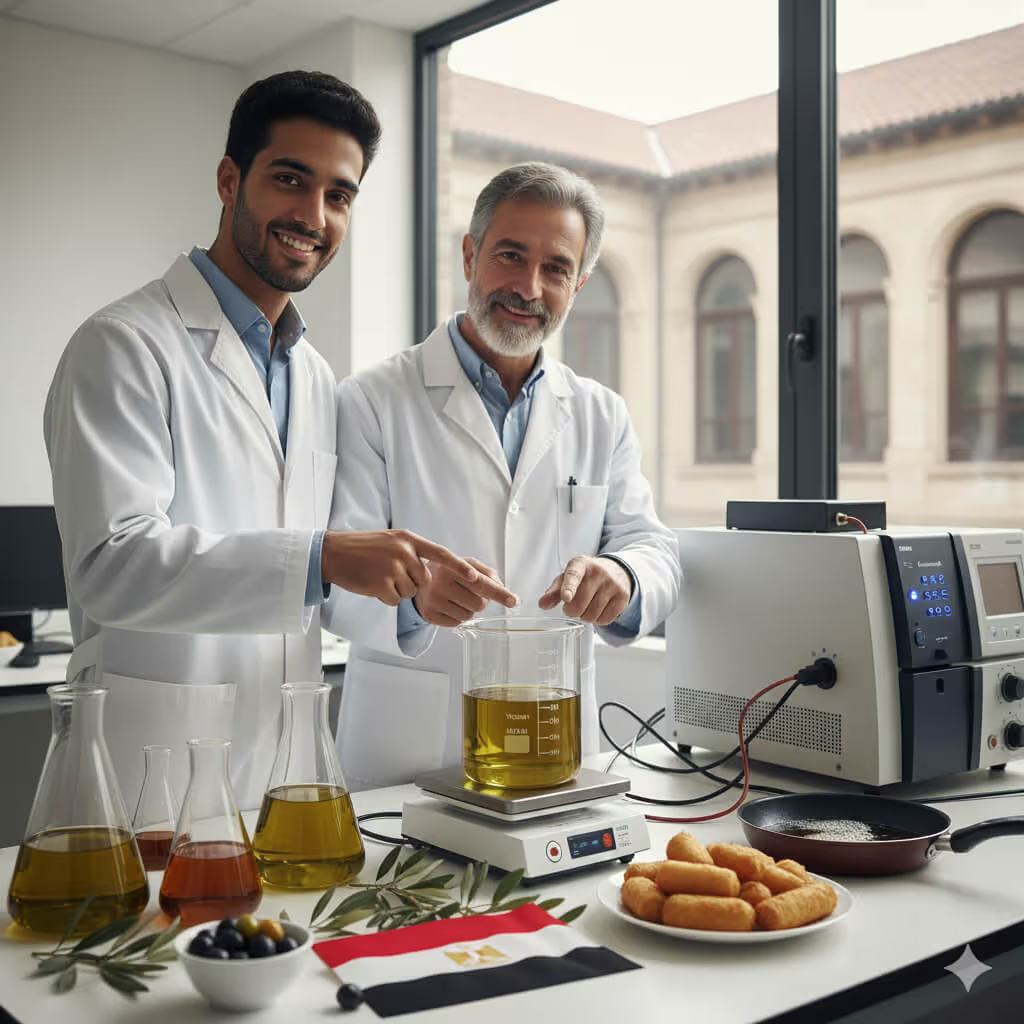
The focus of the PhD thesis was entitled “The stability of extra virgin olive oil and other edible oils under the pressure of deep frying and storage”, about designing an innovative way to enhance extra virgin olive oil (EVOO), which contains low levels of natural antioxidants.
In his innovation, Dr. Taha relied on the integration of “external polyphenols”, the most important of which is a compound Hydroxytyrosol (Hydroxytyrosol). This secondary compound, extracted from the leaves and fruits of the olive tree, is known worldwide for its amazing health benefits, including its cardioprotective effects, anti-inflammatory and anti-cancer properties.
When I asked the researcher to explain the practical impact of this study, he explained that the results represent an unprecedented achievement in using extra virgin olive oil in deep frying safely.
The results confirmed that olive oil fortified with hydroxytyrosol (HTyr) maintains its sensory properties and chemical stability for up to 3 hours of continuous frying at 170°C. This makes it the most resistant and healthiest oil for cooking processes, increasing its added value both for direct home consumption and in the food industry.
The University of La Rioja indicates that one of the main challenges addressed by the research is the low solubility of phenolic compounds in oils. The study succeeded in effectively dissolving hydroxytyrosol and its derivatives, achieving concentrations of up to 650 ppm in olive oil.
This was achieved through an innovative approach based on Near infrared (NIR) spectroscopy With chemometry, it is a precise technique that allows the detection and quantification of polyphenols, providing an effective tool to prevent fraud and ensure the quality of oils.
Experiments analyzed the evolution of oil during frying for periods of up to 48 hours. The results showed the following:
This achievement not only improves oil performance and strength, but also contributes to reducing oil waste resulting from frying and saving raw materials, thus promoting environmental sustainability.
Dr. Taha Muhanna Hussein Abdel Latif’s thesis is a highly influential scientific and technological contribution that opens new horizons for designing “Functional Foods” (Functional Foods) that are more stable and healthy, thus confirming the status of olive oil as the most balanced and safe healthy fat.
We wish continued success to every Arab researcher who contributes to enriching science and revealing more secrets of “liquid gold”.