 Advertise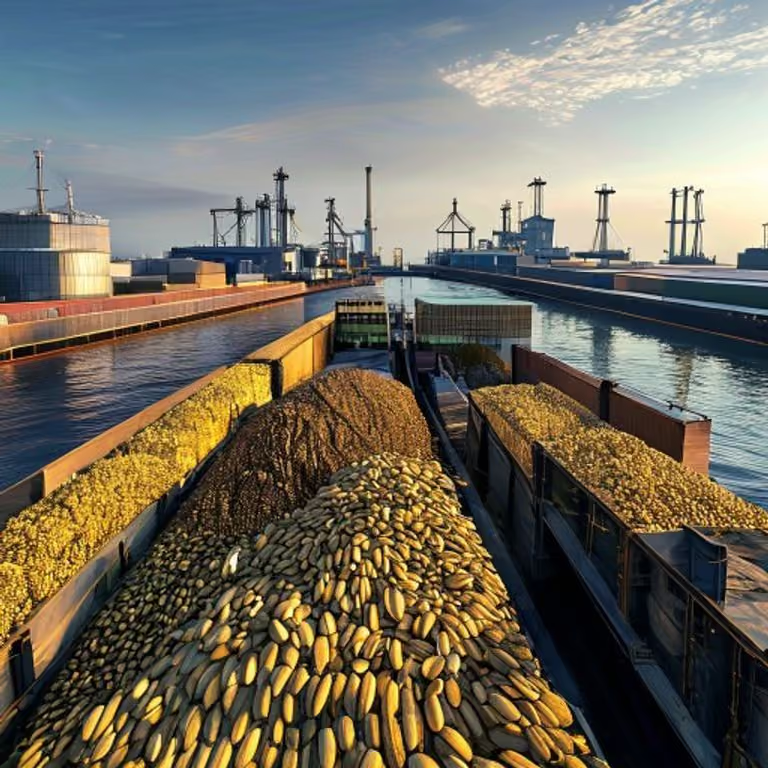
The impending activation of the free trade agreement between Turkey and Ukraine is poised to significantly reshape the economic landscape of the Black Sea region. An analysis published by the English-language Turkish website 'Türkiye Today', and reported by BTA, highlights the substantial potential effects as the agreement's entry into force is now only a matter of time.
Concluded in 2022, the accord is nearing full implementation. The Ukrainian parliament ratified the agreement on July 14 with 236 votes in favor, surpassing the required 226-vote threshold. This followed the Turkish parliament's own ratification action taken in 2024. The final procedural step before the agreement officially commences involves the mutual exchange of the instruments of ratification between the two governments.
For both nations, this free trade agreement establishes a new foundational framework for bilateral commerce. 'Türkiye Today''s analysis details that it will progressively eliminate import tariffs across a diverse range of goods, fostering a more open and integrated market.
Specifically, Turkey is committed to immediately removing tariffs on 93.4 percent of industrial products and 7.6 percent of agricultural goods originating from Ukraine. Following a transitional period spanning three to seven years, tariff liberalization will further extend to an additional 1.5 percent of Ukrainian industrial products and 28.5 percent of its agricultural goods.
In reciprocal fashion, Ukraine will immediately abolish tariffs on 56 percent of Turkish industrial products and 11.5 percent of agricultural goods. Over a subsequent period ranging from two to ten years, Ukraine will gradually phase out tariffs on an additional 43.2 percent of industrial products and 53.7 percent of agricultural goods from Turkey.
Recent economic indicators underscore robust growth in bilateral relations. Trade between the two countries reached an impressive 7.9 billion US dollars in 2025, according to the latest data. Notably, Ukrainian exports to Turkey have seen a substantial 23 percent year-on-year increase, totaling 2.7 billion US dollars.
The 'Türkiye Today' analysis projects that the most profound impact of the agreement will be felt in the trade of agricultural commodities, particularly within the grain and food processing sectors. Currently, approximately 77 percent of Ukraine's exports to Turkey comprise unprocessed grain and sunflower oil—raw materials traditionally imported by Turkish enterprises for domestic processing.
Critically, the new free trade agreement is designed to fundamentally alter this traditional model. By dismantling tariff barriers for higher value-added products, including processed foods, feed concentrates, and goods derived from the deep processing of grain and oilseeds, it unlocks new avenues for Ukrainian producers. This shift allows them to directly export finished products to the Turkish market, moving beyond the mere supply of raw materials, as 'Türkiye Today' highlights in its review.
Furthermore, the agreement is expected to stimulate the formation of joint Ukrainian-Turkish ventures in the food industry. Such collaborations could strategically combine Turkish technological expertise, investment capital, and industrial capacities with Ukraine's rich agricultural resources. The aim would be to produce higher value-added goods destined for export to EU markets, thereby fortifying regional supply chains and enhancing the overall competitiveness of both economies, as further noted by 'Türkiye Today'.
The agreement also carries significant geopolitical weight. From a broader perspective, it effectively establishes a free trade zone connecting the two largest economies in the Black Sea region. 'Türkiye Today' emphasizes that this strategic alignment will grant Turkish companies considerable long-term advantages over competitors in other regional markets, simultaneously bolstering Turkey's standing as one of Ukraine's principal strategic and economic partners.
Source: fakti.bg