 Advertise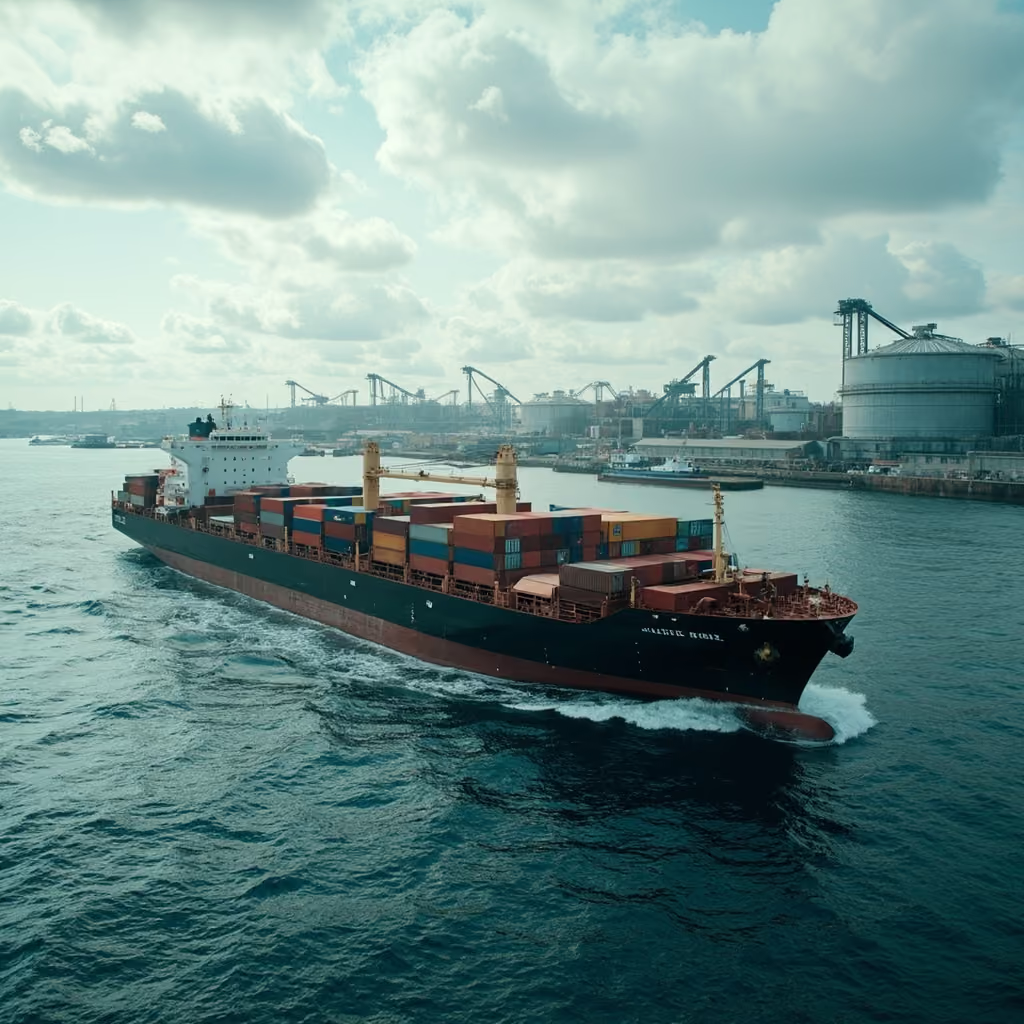
Russia's sunflower oil exports are anticipated to experience significant reductions in July and August this year, with a projected year-on-year drop of 14.3% and 40% respectively, as persistent logistical challenges continue to impede shipments. Disruptions, particularly affecting ports in the Sea of Azov and Black Sea, have brought export operations to a near standstill, as reported by 'Kommersant'.
Andrey Sizov, Director at SovEcon, forecasts that Russia will export approximately 180,000 tons of sunflower oil in July. This volume represents a substantial 53.9% decrease from June and is 14.3% lower than the export levels recorded a year earlier. Looking ahead to August, exports are expected to decline further to 150,000 tons, marking a sharp 40% year-on-year reduction. Other market participants also concur that a significant decrease in exports across all vegetable oils is likely.
The primary cause for this downturn, according to Mikhail Maltsev, Executive Director of Russia's Oil and Fat Union, is severe logistics constraints. Shipments via the Sea of Azov ports have virtually ceased, while shipowners remain hesitant to operate in the Black Sea due to heightened security risks. The Center for Price Indices has also highlighted a considerable reduction in the region's overall export capacity.
Shipping restrictions intensified throughout July following an increase in Ukrainian drone and uncrewed surface vessel attacks targeting merchant ships and port infrastructure. On July 30, Russia's Southern Transport Prosecutor's Office confirmed damage to infrastructure at the Port of Taman after a drone strike. Demetra Holding, a co-owner of the grain terminal at Taman, chose not to comment on the incident, while EFKO Group, which manages a vegetable oil terminal there, advised referring to official statements from local authorities.
Dmitry Rylko, Director General of the Institute for Agricultural Market Studies (IKAR), noted that historically, more than half of Russia's vegetable oil exports were dispatched through the Sea of Azov and Black Sea ports. An additional 40% was channeled through the Baltic and Caspian Seas, reaching destinations such as Iran, Belarus, Central Asia, and China. However, Rylko cautioned that diverting these substantial export volumes to alternative routes presents considerable difficulties.
Market participants observe that the current period aligns with a seasonal lull, suggesting that the full impact of these disruptions has not yet peaked. Export activity is expected to rebound and accelerate once processing of the new harvest commences in early September. At present, exporters are predominantly exploring the Baltic and Caspian ports as viable alternative shipping options.
Maltsev suggested that the Caspian Sea and Iran could offer an alternative corridor, including the possibility of trucking cargo to a port on the Gulf of Oman for onward shipment to India. Conversely, Sizov expressed skepticism regarding the Iranian route's ability to handle significant export volumes. He argued that the necessity for triple transshipment makes the logistics prohibitively expensive, compounded by the limited capacity of both Russian and Iranian Caspian ports.
Sizov proposed that a more pragmatic solution might involve reorienting a portion of exports towards container shipments utilizing flexi tanks. He estimates that approximately 10% of Russia's vegetable oil exports currently employ this method. Roman Sokolov, Director of the Center for Price Indices, further pointed out that shipments destined for India could also be managed through the St. Petersburg Oil Terminal, which has already successfully completed several sunflower oil export operations.
Source: UkrAgroConsult