 Advertise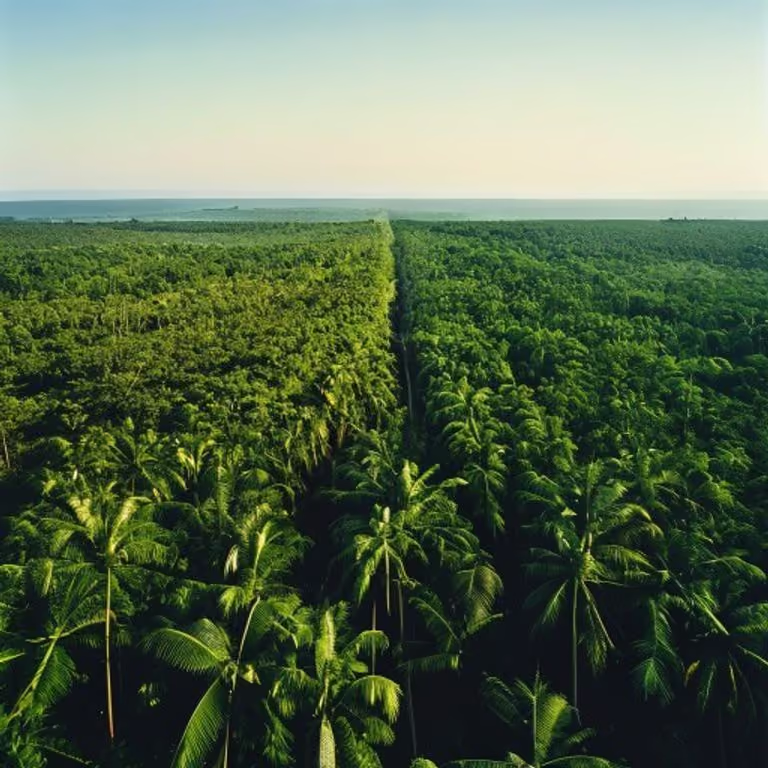
Palm oil production contributed to nearly 10% of global deforestation between 2001 and 2015, resulting in the loss of millions of hectares of forest, according to a recent analysis by Farmonaut. This highlights the significant environmental challenge posed by deforestation, which profoundly affects tropical landscapes, vital ecosystems, and the livelihoods of local communities.
Among the numerous factors driving land-use change, the expansion of palm oil cultivation is particularly noteworthy for its widespread consequences on forest cover, biodiversity, and carbon sequestration. As the worldwide demand for palm oil continues to rise, the critical balance between achieving high agricultural yields and land efficiency versus the irreversible ecological losses becomes increasingly evident.
Understanding the specific proportion of deforestation attributable to palm oil is crucial for contextualizing how land-use decisions impact forests, ecosystems, and future conservation efforts. While palm oil boasts some of the highest yields per hectare in the edible oil sector, the conversion of natural forests into plantations often incurs ecological and climate costs that far exceed immediate production benefits.
Quantitative studies and satellite monitoring assessments reveal that while palm oil is not the sole cause of tropical deforestation globally, its regional impact is highly concentrated, particularly within the world's biodiversity hotspots. It is important to note that palm oil does not account for the majority of global deforestation; its share varies by region. However, in areas where it becomes a primary driver, the associated ecological consequences are disproportionately severe. For instance, palm oil expansion is directly implicated in threatening over 193 critically endangered species, underscoring the urgent biodiversity loss linked to unsustainable land practices. These estimates are worldwide (2001–2020) and sourced from Global Forest Watch, WWF, and IUCN.
At its core, the connection between deforestation and palm oil lies in the transformation of forested areas – especially peatlands and tropical rainforests – into oil palm plantations. This conversion typically diminishes native forest cover, thereby eroding the essential ecological services these forests provide. It fundamentally alters forest ecosystems, fragments habitats, shifts hydrological patterns, and frequently sparks social conflicts over land and resource rights.
Several intertwined factors drive this widespread conversion, including the pursuit of high agricultural yields and economic incentives. Other contributing elements include weak governance structures and uncertainties surrounding land tenure.
To mitigate ecological harm, strategic landscape planning, which focuses new palm oil development on already degraded land rather than pristine native forests, remains an effective yet underutilized approach. The ecological ripple effects of deforestation driven by palm oil are extensive and severe, leading to immediate and irreversible disruptions of interconnected ecosystem functions when native forests and peatlands are cleared.
With increasing scrutiny regarding Environmental, Social, and Governance (ESG) criteria, companies and investors face mounting pressure to demonstrate credible and traceable sustainability throughout their supply chains, including palm oil sourcing and plantation development. Geospatial and satellite intelligence offer crucial oversight for responsible land management.
Farmonaut emphasizes that the future of palm oil depends not merely on agricultural productivity, but on humanity's capacity to balance ecological integrity with meeting global demand. This necessitates a fundamental reevaluation of land-use planning and forestry regulations to break the direct link between palm oil and ongoing deforestation. Satellite monitoring and geospatial analytics are indispensable for robust policy enforcement and ensuring compliance with zero-deforestation and sustainability standards across vast landscapes.
Farmonaut highlights that satellite technology and artificial intelligence significantly enhance the ability to manage and monitor land resources effectively. Their advanced remote sensing solutions utilize multispectral and hyperspectral data for comprehensive land use mapping, tracking forest cover changes, assessing carbon stocks, monitoring biodiversity, and facilitating robust sustainability reporting. This technology generates actionable intelligence that supports responsible development, reduces unnecessary land clearance, and empowers stakeholders to prioritize sustainability alongside productivity. Neglecting forest ecosystem values during early land selection can lead to costly delays, regulatory hurdles, and irreversible biodiversity loss; early-stage satellite analysis can identify low-conflict, low-impact sites from the outset.
Ultimately, balancing tropical land productivity with long-term ecosystem resilience and biodiversity conservation hinges on transparent mapping, continuous monitoring, and clear reporting. The interplay between deforestation and palm oil represents one of the 21st century's most pressing sustainability dilemmas. While palm oil's high yields make it an efficient crop, the conversion process frequently sacrifices critical forest habitats, ecosystem services, and regional biodiversity.
Addressing these negative impacts requires more than piecemeal policy adjustments; it demands a systemic transformation in how land use is planned, allocated, and monitored across tropical regions. Essential tools for ensuring palm oil sector productivity does not come at the irreversible cost of our forests' future include zero-deforestation commitments, landscape-level planning, reliable supply chain traceability, strong governance, and transparent monitoring measures.
Farmonaut's satellite-based intelligence assists resource managers, policymakers, and investors in making land development decisions that prioritize both operational efficiency and environmental stewardship. Their geospatial analytics enable more responsible exploration, reduce unnecessary clearance, and facilitate effective monitoring of land, carbon, and ecological change, providing credible, data-driven insights foundational to sustainable land management.
Source: Farmonaut