 Advertise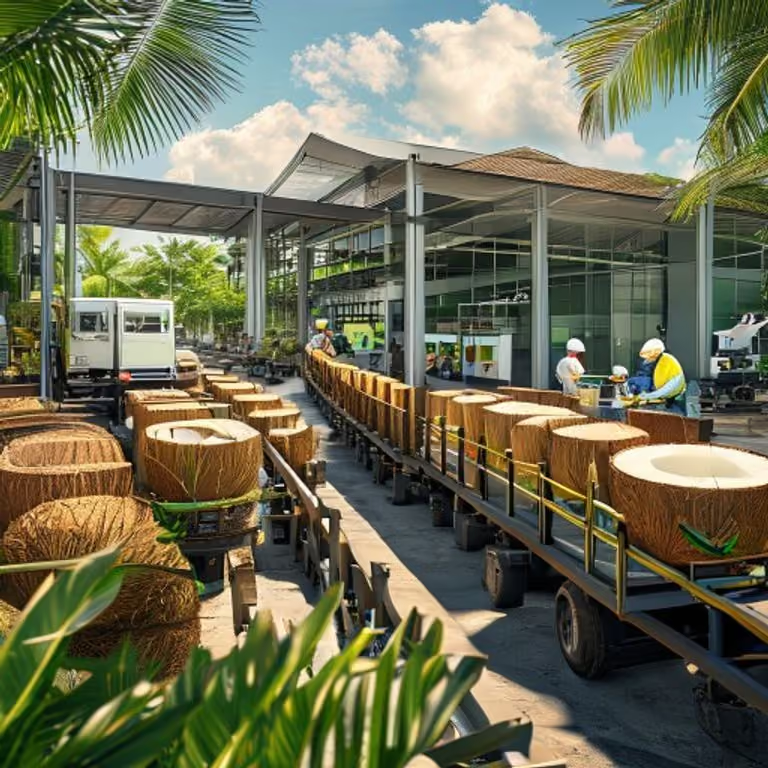
Indonesia is intensifying efforts to bolster its domestic coconut industry by focusing on downstream processing, a strategic move aimed at capitalizing on robust regional and global demand. This initiative comes as neighboring Malaysia continues to rely heavily on Indonesian coconut supplies, with approximately 80 percent of its national demand met by exports from Indonesia.
Agus Rosyid, an agricultural product quality inspector at the Indonesian Ministry of Agriculture's Directorate General of Plantation, emphasized that Malaysia's significant dependence offers a prime opportunity to strengthen Indonesia's internal coconut sector. He recalled a situation two years prior when Malaysia, facing a raw material shortage, specifically requested Indonesia not to impose an export ban, highlighting their concern for their own domestic industry.
Speaking at a recent discussion in Jakarta, Rosyid underscored the substantial potential for Indonesia to enhance the economic value of its coconut products. He identified derivative products such as coconut cream, coconut milk, coconut oil, virgin coconut oil (VCO), and various other processed items as having strong market prospects. Consequently, the Indonesian government is actively promoting a shift away from exporting raw coconuts towards the production of these higher-value goods, ensuring that more economic benefits are retained within the country.
Data from 2023, compiled by the International Coconut Community (ICC) and the Ministry of Agriculture, confirms Indonesia's position as the world's second-largest coconut producer, trailing only the Philippines. The nation's total production reached 2.87 million metric tons of copra equivalent across an estimated 3.34 million hectares of plantations, contributing approximately 24 percent of the global output.
Rosyid further detailed that around 98 percent of Indonesia's coconut plantations are managed by smallholders, encompassing an estimated 5.5 million farmers. ICC and ministry statistics also show that out of the total plantation area, about 2.55 million hectares—or 76.5 percent—consist of productive trees. The potential for value addition across the entire coconut value chain, from husk and shell to meat and water, is estimated at a staggering US$6.55 billion. In 2022, Indonesia's coconut product exports were valued at approximately US$2.11 billion, according to ICC data.
Despite this potential, the Ministry of Agriculture acknowledges a decline in national plantation area and production. This downturn is attributed to several factors, including the conversion of agricultural land to other commodities, pest infestations, and fluctuating farmgate prices. Additionally, national productivity remains relatively low, averaging around 1.1 metric tons per hectare, significantly below the estimated potential of 3.5 to 5 metric tons per hectare.
To enhance the competitiveness of this vital commodity, the government is preparing a comprehensive coconut downstreaming program. This initiative targets the development of 151,554 hectares of land by 2026, supported by a budget of approximately Rp427 billion, equivalent to about US$23.8 million. The program will be implemented across 28 provinces, concentrating on establishing production zones, ensuring a supply of high-yield seeds, boosting overall productivity, and strengthening the entire supply chain. The PT Natural Indococonut Organik (NICO) processing factory in Kupa-Kupa Village, North Halmahera, North Maluku, seen loaded with coconuts on August 1, 2025, exemplifies the type of infrastructure central to this development.
Source: ANTARA News