 Advertise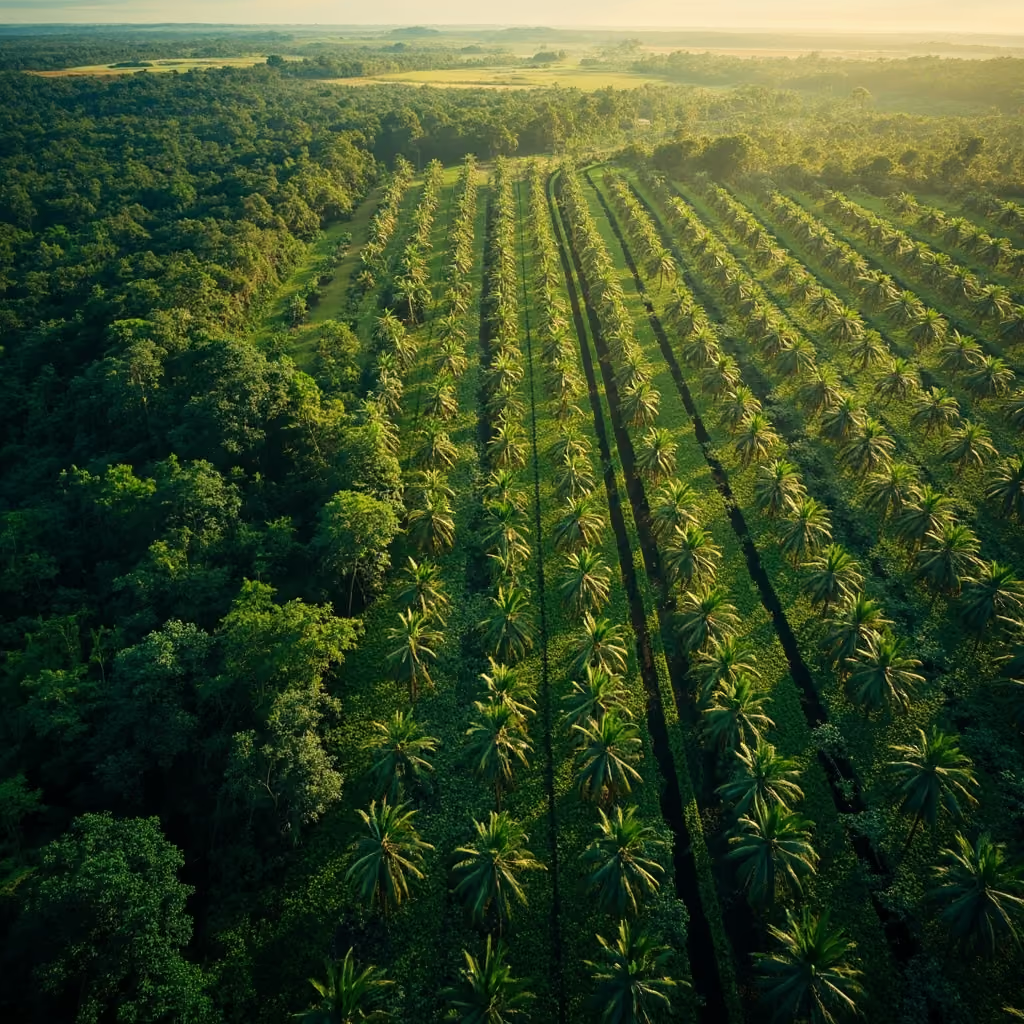
A new policy analysis led by researchers from Hasanuddin University in Indonesia concludes that neither gradual rehabilitation nor stricter state enforcement can fully resolve the challenges posed by oil palm cultivation within Indonesia's state forest zones, highlighting the need for more integrated forest governance.
The study was published on August 1, 2026 in Volume 189 of the journal Forest Policy and Economics and made available online on June 13, 2026. It was carried out by the Forest and Society Research Group (FSRG) at Hasanuddin University's Faculty of Forestry, under the lead of Professor Muhammad Alif K. Sahide.
Indonesia, the world's largest palm oil producer, has an estimated 3.4 million hectares of oil palm cultivated within state forest zones. As international demand for sustainably sourced palm oil has grown, the Indonesian government has rolled out a series of policies aimed at addressing cultivation in these areas.
One such instrument was the Strategi Jangka Benah (SJB), or Rehabilitation Period Strategy, rolled out between 2020 and 2021. Rather than removing existing plantations outright, SJB allowed oil palm cultivation to continue during a transitional period, during which farmers were expected to gradually convert monoculture plantations into mixed agroforestry systems. In early 2025, the policy direction shifted toward stricter enforcement with the issuance of Presidential Regulation No. 5/2025 (Perpres 5/2025), which introduced administrative penalties, the possibility of criminal enforcement against violations, and the state reclamation of forest land.
Professor Alif and his team examined how both approaches have struggled to reconcile forest restoration with the economic realities of smallholder farmers. They found that SJB faced significant implementation challenges because oil palm was deeply embedded in smallholder livelihoods, while the newer enforcement-oriented approach could generate further uncertainty around land and livelihoods.
Through engagement with stakeholders in Central Kalimantan and West Sulawesi — two provinces where SJB was implemented — the researchers identified a fundamental disconnect between the policy's ecological objectives and the economic conditions facing smallholders. SJB promoted a gradual shift from monoculture oil palm to agroforestry but offered few economic incentives for farmers to make the transition. With palm oil remaining profitable and alternative livelihoods limited, replacing productive plantations with slower-growing timber or food crops proved economically difficult.
Perpres 5/2025, the study notes, frames forest reclamation primarily through law enforcement and territorial control, while leaving the implications for smallholder livelihoods uncertain. The researchers warn that reclaimed land could become concentrated in the hands of state-owned enterprises or other actors with greater political, bureaucratic, or financial influence, potentially further marginalizing smallholders.
According to the research team, SJB and Perpres 5/2025 reflect a fragmented approach to forest governance. SJB prioritized gradual rehabilitation and social inclusion, while Perpres 5/2025 emphasizes law enforcement and state control. Neither policy, however, addresses the underlying drivers of forest conversion.
To break the cycle, the researchers call for a more integrated approach that protects forests while also addressing farmers' livelihoods, land rights, and economic needs. Recommended measures include clarifying who has legal rights to the land before imposing penalties, using social forestry programs to grant smallholders more secure land rights, involving local communities in forest restoration planning, and ensuring that they share in the benefits of restored land. The team also calls for better coordination between the agriculture, forestry, and energy ministries so that policies on farming, palm oil, biodiesel, and forest protection work toward common goals.
The study ultimately argues that forest restoration cannot be separated from the livelihoods and land rights of the communities dependent on these landscapes. Without addressing land rights and economic needs, new regulations risk creating additional uncertainty without resolving the underlying challenges.
As Professor Alif puts it: 'The challenge, then, is not merely to design better policies, but to build governance architectures that can navigate the inherent trade-offs between economic, social, and ecological goals in a transparent, accountable, and equitable manner.'
The original paper, titled 'Policy forum: Between incorporation and reappropriation – The unresolved dilemma of oil palm in Indonesia's forest zones', is available via DOI: 10.1016/j.forpol.2026.103835.
Source: EurekAlert!