 Advertise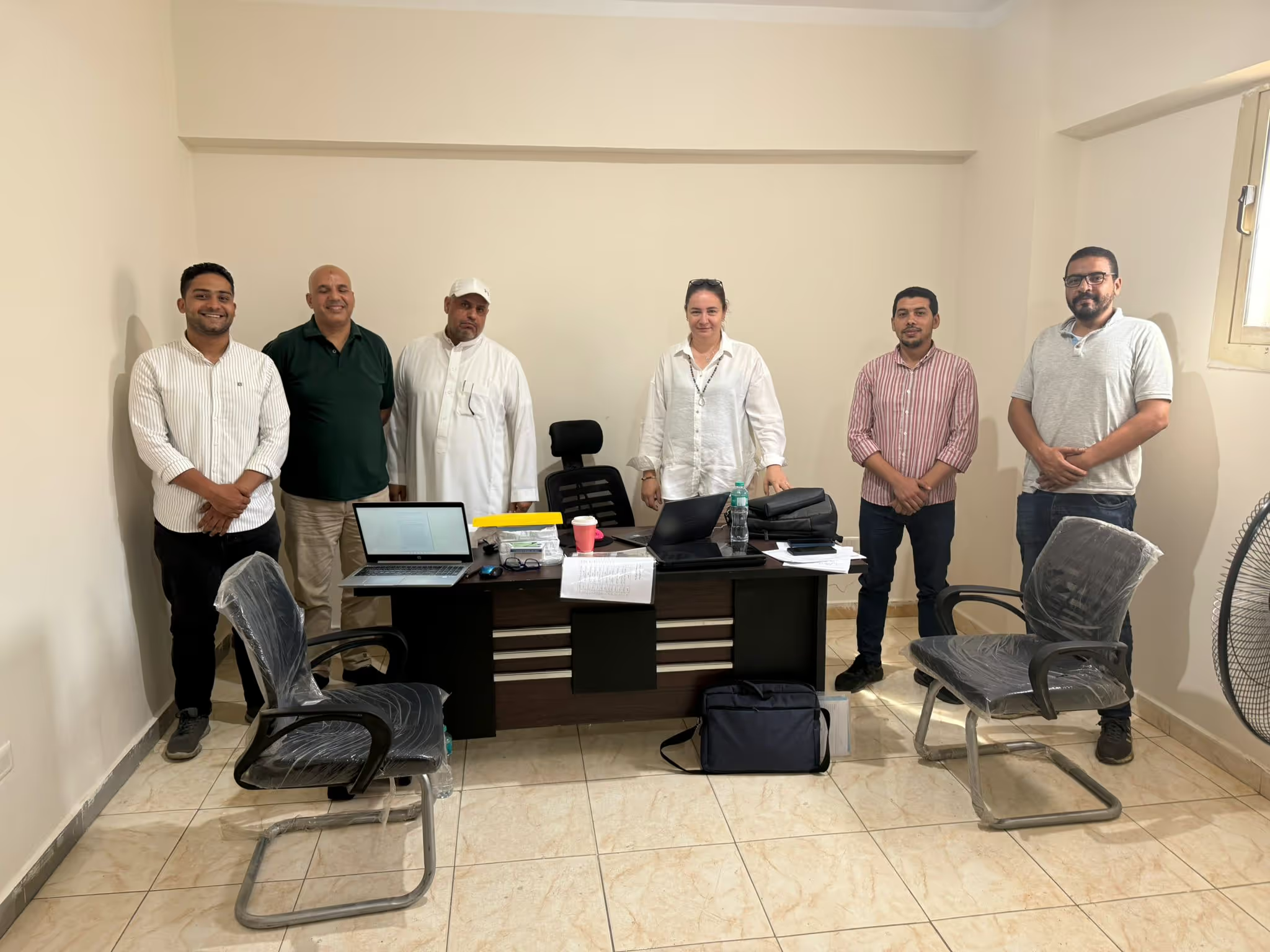
In order to align with global requirements, particularly European ones, and to safeguard the sustainability of feedstock sources in the biodiesel industry made from used cooking oil, Falehco Eco Energy has contracted TransCert to carry out a review and audit of the company in accordance with the requirements of the ISCC certificate, with the aim of obtaining that certification.
Falehco Eco Energy is an Egyptian company founded by Saudi investors with extensive experience in the contracting sector in Saudi Arabia. The plant forms part of the company's new strategy to diversify its investments and expand into clean technologies (renewable energy, water and the environment), with a particular focus on biodiesel (Fatty Acid Methyl Ester), which sits at the intersection of two clean-technology fields: recycling and renewable energy production.
BioRotterdam, a renewable energy consultancy, provided all the necessary advisory support to prepare Falehco Eco Energy and make it ready and qualified for certification.
The production of biodiesel from used cooking oil remains an emerging industry in Arab countries, despite its considerable scale globally—particularly in Europe, which is one of the largest biodiesel markets in the world.
The audit took place on Friday, 8 August 2025. Those present at the review and audit session included Engineer Sharifa, the accredited auditor for the certification; Mr Abdulrahman Al-Faleh, General Manager; Mr Basem Abdel Shafi, Chief Financial Officer; Mr Mohamed Al-Farra, Production Manager; Mr Mohamed Abdel Nasser, one of the plant operators; and Dr Ibrahim Farouk, Director of BioRotterdam Renewable Energy Consultancy, who oversaw the process of preparing and readying Falehco Eco Energy for ISCC certification. Minutes of the meeting were drawn up and signed by all attendees, as one of the audit requirements.
Mr Abdulrahman Al-Faleh, General Manager and one of the shareholders, stated that biodiesel production from used cooking oil in Egypt marks the company's first investment outside Saudi Arabia, part of its new strategy to diversify investments into fields beyond contracting. Renewable energy and biodiesel were chosen for several reasons, most notably the environmental benefits of the product.
Mr Basem Abdel Shafi, Chief Financial Officer, said this step is part of the company's drive towards global expansion since it began operations.
For her part, Engineer Sharifa, the certification auditor representing TransCert, noted that she observed clear organisation of roles and strong coordination within the team, along with high-quality compliance with certification requirements. She said the review process went smoothly, with cooperation from all parties involved in the company's operations.
Mr Mohamed Al-Farra, Production Manager, said obtaining ISCC certification represents a cornerstone for any company operating in biodiesel production, as it demonstrates to all stakeholders that the company produces in accordance with the requirements recommended by the ISCC certifying body, and that all its processes are carried out in a green, sustainable and environmentally friendly manner.
Youssef Ahmed, a Cairo University engineering student on internship, said Falehco gave him an ideal opportunity to learn about the biodiesel industry both scientifically and practically, as well as to explore other aspects of the industry that may not be covered in university curricula. He noted that the company responded to his request for a summer internship quickly and without hesitation, as part of its commitment to social responsibility and its keenness to give graduates the chance to discover new horizons that academic education may not offer.
Dr Ibrahim Farouk said the preparation process spanned more than two months, during which the requirements for the ISCC certification review were put in place. This included preparing Falehco Eco Energy's company files, as well as training its staff and employees to comply with certification requirements—particularly regarding ease of traceability of the biodiesel feedstock, namely used cooking oil (UCO), which must be unmixed with any animal-derived materials, and the custody chain. It also involved understanding the sustainability of resources, noting that the certification maintains a high level of integrity, applying the strictest process-safety standards and ensuring the certificate is issued reliably and objectively by all certifying bodies cooperating with the ISCC organisation worldwide. He added that a number of integrity assessments are coordinated randomly and on a risk basis, drawing on risk assessments, complaints, or reports of non-compliance or fraud, and that certified companies must report any quantities sold under the certificate promptly as part of the mandatory quantity reports submitted to the European Commission, with these quantities verified, certified and reviewed annually.
He concluded by saying that none of this would have been possible without the direct support of the company's owners and managers in reaching this level of readiness for the initial external audit.
It is worth noting that Mr Abdulrahman Al-Faleh said investing in Egypt is one of the company's key priorities, describing Egypt as "our second home," where "we feel psychological comfort, safety and stability, and feel that we are among our own people and loved ones." He added that Egypt's investment climate is highly encouraging for foreign, Arab and Gulf investment at all levels—legally, in terms of the ease of obtaining the licences and approvals needed for projects, as well as financially, in terms of the ease of opening bank accounts and securing funding and support for environmental projects. He also pointed to the free trade agreements between Egypt and a number of countries, which increase the chances of project success in Egypt, and noted the availability of a well-trained workforce at all administrative and operational levels—one that, he said, is often as committed to a project's success as the project's own owner.
Falehco Eco Energy aims to meet global market demand for renewable energy and biodiesel by supplying high-quality volumes through plants in several Arab countries, the first of which is this facility in Egypt. The company will also place special focus on manufacturing advanced products such as sustainable aviation fuel (SAF) using modern and innovative technology, as well as advanced biofuel HVO, all by leveraging green hydrogen technologies in the processing of used cooking oil.