 Advertise

Note: This article was AI-translated from Arabic and is currently under manual review. The author is not responsible for any translation errors. Please refer to the original Arabic text for the most accurate and authoritative information.
Have you ever wondered about the need of some food industries, such as cake and baked goods, for hard fats such as shortenings and margarine, and liquid fats such as oil cannot be used? This is what we will try to answer in the next lines.
• Softness and flexibility are essential in many fatty products, including butter, margarine and shortenings (shortenings), which give them unique physical properties. These materials are solid at room temperature, but when subjected to sufficient force to cause permanent deformation of this hardening, they acquire the properties of a viscous liquid. Such solids that acquire this physical property are called plastic solids. Thus, the precise scientific definition of thickeners is a hard material that has the property of softness and flexibility. It was carefully prepared using cooling, softening and mixing different types of fats and vegetable oils in a correct manner.
• When soft fat is mixed in the form of dough, it can spread in the form of slices or flakes, while under the same conditions, we find that liquid oils can only spread in the form of droplets or pellets. Naturally, fat slices can lubricate (lubricate) a larger surface area and are in the form of dough than round drops of oil. Therefore, they have a more spreading effect (shortening effect). In the process of mixing doughs, we find that soft fat - unlike liquid fat or other products - contains or traps large amounts of air. When making cake products or other products that contain a lot of sugar, the leavening effect of this air is absolutely necessary.
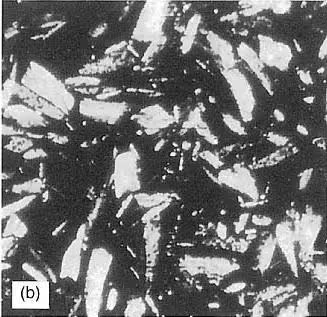
• The transient appearance of the compartments is soft, but under the microscope it appears to consist of a mass of very small crystals that trap a very large amount of oil inside it. These crystals are not connected to each other and are not a continuous structure, but each part (particle) is separate and unrelated. Under shear stresses, they can move independently of other crystals. Thus, fat has a distinct structural structure of hardness and ductility.
• There are three main conditions that must be met in order for the compartments to gain flexibility and suppleness, namely:
1. Fat must consist of two phases, one of which is the solid phase and the other is the liquid phase.
2. The solid phase must have sufficiently fine, distributed and diffuse particles, enabling the matrix of the liquid part and the solid part to be effectively held together by internal tensile forces.
3. The correct mixing of the proportions of oils to achieve the required balance between the solid phase and the liquid phase. Increasing either of them negatively affects the output.
• For example, a decrease in the solid phase ratio leads to the separation of liquid oil. On the contrary, an increase in the percentage of solid phase leads to the hardness or fragility of the product rather than the desired viscous texture.
• One of the important and influential factors is also the size of the crystal formed. It can even be considered a critical factor that must be taken into account. Fat exists as a solid three-dimensional liquid matrix in which liquid oil must be contained.
• When melted fat is cooled slowly, it forms large crystals with a slow growth rate. When the total surface area is insufficient to bind the liquid phase within the crystalline matrix, oil separation occurs.
• Therefore, the Shortening products are more solid as the size of the crystals are smaller. This can only happen in the case of rapid cooling, which results in small Beta Prime crystals, giving a large surface area sufficient to connect the liquid phase to the crystal network. Therefore, rapid cooling during the production of shorting products gives products that are more stable, more solid and have better elastic properties than those that are cooled slowly.
It is clear from the above that the quality of fat in the food industry is not random. Rather, it depends on complex physical properties such as ductility, crystal size, and distribution of solid and liquid phases. Understanding these factors helps to produce products with an ideal texture, high stability and desirable quality for the consumer. Therefore, compartments and margarine are not simply oil substitutes, but components that are carefully designed to meet precise industrial requirements.