 Advertise
Note: This article was AI-translated from Arabic and is currently under manual review. The author is not responsible for any translation errors. Please refer to the original Arabic text for the most accurate and authoritative information.
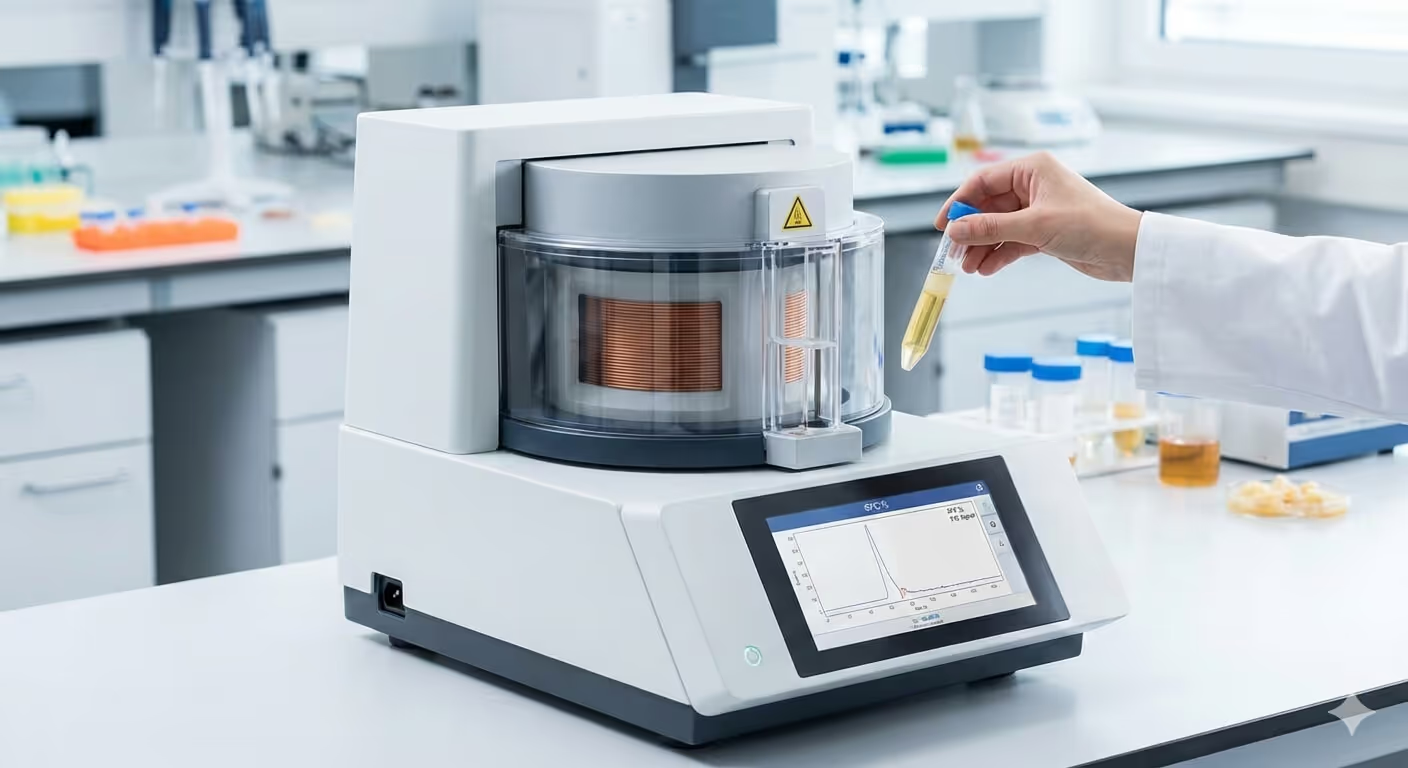
The low-resolution nuclear magnetic resonance (NMR) device (Low-Resolution NMR) The cornerstone of quality laboratories in ghee, margarine and shortening oils (Shortening) factories. Its importance lies in its ability to measure The percentage of solids in fat (Solid Fat Content - SFC) Within a few seconds, it is a physical feature that directly and decisively affects the quality of the final product in terms of:
Despite the rapid results, the physical principle by which the device works is somewhat complex. In the following lines, we provide a simple and accurate explanation of the components of the device and its working idea.
The NMR device used in this type of measurement consists of four main units that integrate each other:
1. Magnetic moment function (Nuclear Spin)
The device is based on the physics of some atoms. Nuclei that contain an odd number of protons (such as hydrogen) have a nuclear spin (Spin). This rotation results in a small magnetic field that makes the nucleus behave as if it were a precise magnet.
Because hydrogen atoms are a key component of organic chemistry (and oils and fats in particular), the device relies on a hydrogen proton, which has a clear magnetic field.
2. Magnetic field compatibility
When the sample is inserted into the device, hydrogen nuclei (micromagnets) are exposed to a strong magnetic field ($B$). They tend to align in a direction parallel to the field and begin to rotate around its axis ($z-axis $) with a specific frequency called “Larmor frequency” (Larmor frequency), which depends directly on the strength of the magnetic field.
3. Radio pulse and resonance
The device emits a powerful radio pulse with a frequency equal to that of “Larmor”, with enough energy to flip the magnetic output of the cores at a 90-degree angle to the level ($XY$). Here, the nuclei enter into a state of “resonance” and become synchronized in phase (Phase Coherence). All protons rotate in the same direction and moment, generating an oscillating magnetic field that stimulates an electrical current in the receiving coil.
4. Free fading (FID)
Once the pulse is stopped, the nuclei begin to gradually lose synchronization (Dephasing) and return to equilibrium along the main field. During this return, the resulting electrical current gradually decreases, and this signal is known as the “Fading Free Signal” (FID — Free Induction Decay).
The device distinguishes between solid and liquid states based on the speed of signal loss (relaxation time):
The device exploits this large variation in ($T_2$) values to separate solid and liquid part signals and calculate the SFC ratio accurately.
Device protection:
When the high-energy radio pulse is released, the device stops receiving signals for a very short period (usually no more than 10 microseconds) known as “dead time” (Dead Time). This pause is necessary to protect sensitive receiver circuits from damage or high power saturation.
Make up for the lost signal:
During the suppression time, the solid fat signal has already started to fade (due to the short time of $T_2$), which means that a large part of the “solid” data is in the unreadable area.
To solve this problem:
To ensure the accuracy of the results, the analysis is based on two main pillars:
1. Calibration:
2. Sample preparation (Sample Preparation):
The sample should be professionally prepared to ensure the crystallization of the fat in the stable crystalline form $\ beta-'$ (beta-prime):
ATTENTION: If this process is not done accurately, $\ alpha$ (low-melting) or $\ beta$ (high-melting) crystals may form due to the phenomenon of crystal polymorphism (Polymorphism), which changes the relaxation time ($T_2$) and gives inaccurate SFC results.