 Advertise
Note: This article was AI-translated from Arabic and is currently under manual review. The author is not responsible for any translation errors. Please refer to the original Arabic text for the most accurate and authoritative information.
Are you truly confident in what you know about the "Tree of Light"? It might seem like a provocative question... but it's the beginning of an astonishing journey of discovery!
Why did God specifically mention it in holy scriptures and describe it as the blessed tree? And why does modern science today stand "astounded" by a single fruit that hides thousands of secrets behind its thin skin?
Do you believe that the olives adorning your table are merely an "inferior variety" compared to those pressed for oil? Or are there precise "genetic arrangements" and miraculous divine craftsmanship that make each olive a unique story?
Since the dawn of time, humans have revered the olive; they experienced its benefits for their health, witnessed its miracles in their longevity, and adopted its branch as a symbol of peace. But have you ever asked yourself: what happens behind the scenes? How do particles of soil and drops of rain transform into "liquid gold" or a "table fruit" brimming with health?
In this unique article, we embark on a journey that exceeds expectations. I will not speak to you merely as an academic researcher, but as an expert in oils, fats, and their derivatives, and someone concerned with food safety, as we try to understand the meaning of the Quranic verse «similar yet distinct» to see how genes speak the language of miracles.
In this article, you will discover:
💡 "Don't read this article just for knowledge... Read it to understand the value of what you put on your table!" Join us in this series of solid scientific facts presented in an elevated literary style, which seeks to combine the light of faith with the precision of proof.
The Olive Tree... The Secret of the Fruit that Produces a 'Medicine' to be Drunk and a 'Food' to be Eaten
The verses of Surah Al-An'am highlight a striking cosmic truth in the plant kingdom: fruits may share a general identity, yet beneath this resemblance lie subtle differences that yield immense diversity in taste, function, and benefit.
This article offers a rigorous scientific interpretation, using the olive (Olea europaea) as a model to explain the concept of "Intraspecific variation" as understood by modern biology and genomic technologies. Here, we are not merely presenting information; rather, we are guided by the Quranic directive to "observe" and reflect comparatively on the stages of fruit development:
«Look at its fruit when it bears fruit and ripens» (Al-An'am: 99).
"...And through our specialized expertise in the chemistry of oils, fats, and food safety, we will reveal how this 'ripening' is not merely a temporal stage, but a chemical decision made by the fruit to transform either into nourishing food for our tables or a liquid medicine flowing with healing. The 'secret' that allows a single fruit to yield these two entirely distinct outcomes lies in a remarkable integration of genetic design and chemical transformation over time."
The olive is mentioned in the context of verses on plant diversity in Surah Al-An'am in two closely related forms (verses 99 and 141), with the repeated description "similar and dissimilar."
The methodological implication here is an invitation to comparative observation; it's not a fleeting glance, but rather a tracking of the fruit across the timeline (fruiting then ripening/maturation). This—in scientific terms—is the essence of "time series" studies, which reveal how the fruit's chemical and biological properties change, transforming it from a mere "plant form" into a "functional food."
Methodological Note: We are not attempting to "impose" evolving scientific theories onto the immutable Quranic text, nor do we claim that the verse dictates precise genomic details. Instead, we assert that the description of "similarity and difference" aligns with a universal biological truth, and that the divine command to "observe" establishes a mindset for scientific inquiry based on observation and comparison.
In biology and genetics, we use the term intraspecific variation to describe the measurable differences among cultivars of a single plant species. In olives, this variation is clearly evident in: size, color, taste, and fatty acid ratios.
These differences do not negate the "unity of identity" (as all are olives), but they create diverse characteristic profiles; thus, we find one variety suitable only for the table, and another valuable only when pressed for oil.
When the Quran mentions "its ripening," it refers to the stage of full maturity. Scientifically, this stage represents the most critical "chemical laboratory" in the fruit's life.
As food scientists, we know that harvest timing (the ripening stage) is not just a matter of "taste," but a crucial safety and quality criterion:
So, "ripening" is the key to transforming the fruit from a raw material into a safe and effective food.
Over more than 6000 years of olive tree domestication, farmers carried out a long-term "genetic selection" process, which led to the functional separation of varieties. The following table illustrates the most prominent scientific and technological differences between those "similar" in appearance and "different" in function:
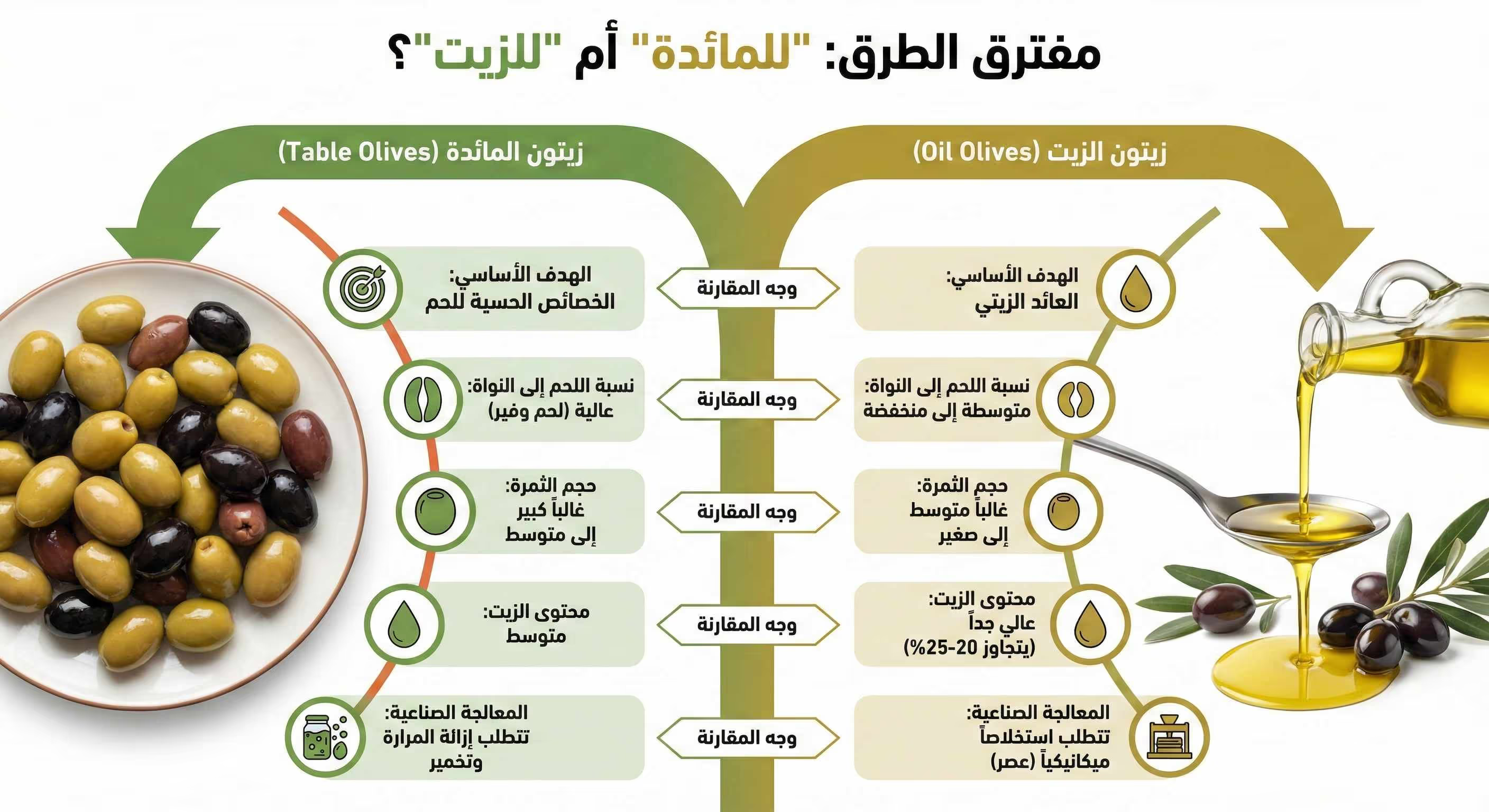
This variation highlights the precision of the Quranic expression "not alike"; the difference here is not cosmetic, but a structural difference that determines the fruit's destiny and its processing path.
When the noble verse invites us to "look" at its fruit, the first thing the eye perceives is "the color gradation", which is not just an aesthetic change, but a silent "chemical statement" that reveals what is happening deep within the fruit. The journey begins with a vibrant green color, where "chlorophylls" dominate, overseeing the building process and the formation of solid tissue, then the scene shifts to purple and then deep black with the appearance of "anthocyanin" pigments (Anthocyanins).
Here, "similarity and difference" manifest in their finest form; while most varieties "resemble" each other in this color gradation, they "differ" fundamentally in its timing and effect:
This color variation between varieties gives the producer and consumer a wide "palette of options," making a single tree a factory that produces diverse tastes and benefits, addressing the body's need for nourishment and its need for healing.
The reader might wonder: how do varieties differ despite having the same genome (species Olea europaea)?
Modern genetic studies (such as SNP analyses) reveal that the secret lies in subtle details, similar to "changing a single letter in a long sentence". These minor changes in the genetic code, in addition to what is called "Gene Expression"—i.e., when and how genes function—are responsible for making the 'Picual' variety rich in polyphenols, and the 'Arbequina' variety have a mild, fruity flavor. It's a shared "genetic dictionary" but a different "reading method."
When the Holy Quran directs us to observe the fruit at its "fruiting" and "ripening" stages, it instills in our consciousness a sophisticated epistemological approach: that truth and benefit are not revealed in a single snapshot, but through careful tracking of a vital process that unfolds over time and observation.
The balance between "similar and dissimilar" drives the enrichment of both science and faith. However, this vision extends beyond the laboratory, placing before us a strategic responsibility that compels all stakeholders in the value chain to work with a unified vision:
On a national level, as the Egyptian state plants millions of trees, it presents us with a historic opportunity to maximize our export value, whether in table olives, where we hold a global leading position, or in olive oil, where we strive to establish its superior quality domestically.
The future of olives lies in integrating authenticity derived from divine revelation with modernity dictated by science; so that it always remains: a sign seen by the eye, understood by the mind, instilling certainty in the heart, and fostering development in reality.