 Advertise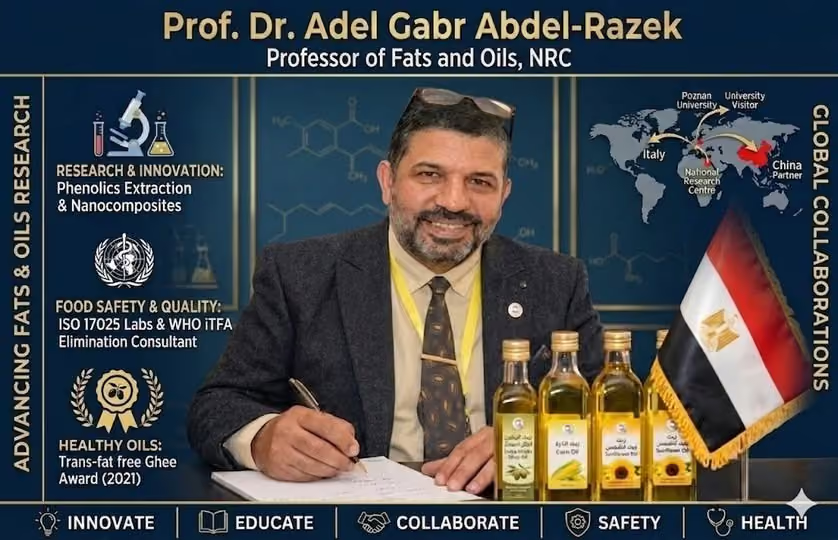

Note: This article was AI-translated from Arabic and is currently under manual review. The author is not responsible for any translation errors. Please refer to the original Arabic text for the most accurate and authoritative information.
For many years, margarine has been associated with controversy and misunderstanding, between health charges and perceptions that have taken root in the minds of consumers. But is what we know today the same as what was produced yesterday?
In this article, we take you on a simple scientific journey in which we reveal how the margarine industry has evolved from outdated traditional practices to safer and more disciplined modern techniques based on science, control and international standards.
Between the past and the present, we put the facts in place... to find out where margarine stands today, away from rumors, and close to conscious understanding and responsible choice.
Vegetable ghee is not all the same, and not all that is said about it is true... there is no mistake. There is a big difference between hydrogenated industrial ghee, which was produced in the past, and vegetable ghee, which is made using safe scientific and technological methods. This article simply explains the truth through academic and practical industrial experience, without intimidation... and without polishing.
Vegetable Ghee/Vanaspati is one of the most important processed fat products in the modern era. It has evolved from being a mere economic alternative to animal ghee to a highly complex fat system that is subject to careful control of its chemical composition (Triglyceride Profile), its natural structure, and its thermal and crystalline behavior. In light of global challenges related to food security, population growth, and increasing demand for zero-trans fats (Zero-Trans Fats), margarine has become a pivotal element in the global food processing system.
This article aims to provide an integrated scientific treatment for vegetable ghee that combines fat engineering, industrial application, nutritional assessment, and consumer education, while highlighting recent developments and applied innovations in this field.
Vegetable ghee is a single-phase fatty system consisting of a solid crystalline network inside which liquid oil is held, which gives it the property of plasticity; that is, retaining its shape while being able to form and flow when exposed to mechanical stress.
It is classified as:
The production and consumption of margarine is concentrated in:
This is related to the availability of tropical oils, economic considerations, and dietary habits.
Vegetable ghee is mainly based on tropical oils, especially palm oil. Smart blends can be made in different proportions between:
Industrial ghee (partial hydrogenation):In the past, the partial hydrogenation process was used to thicken liquid oils into solid fats, but it was a major source of trans fats. This technique was effective for producing low-cost solid fat, but it has proven a negative health link with increased risk of heart disease (note that partial hydrogenation has been banned globally and locally as of 2023).
The modern method of producing margarine (natural fractionation and internal esterification):The industry has turned to the application of natural fractionation mainly and on a large commercial scale, and the method of mutual esterification as non-widespread technical alternatives to control the physical properties of fats without producing trans fats, while improving the control of melting properties and plasticity depending on the dietary application.
The quality of margarine depends on the control of polymorphism (Polymorphism). The β-phase is preferred because it gives softness and portability to the individual. It is directed through:
Baladi ghee is known as a natural hardening phase (long slow cooling), which allows the rearrangement of fat crystals and achieve a homogeneous and stable texture. The industry is trying to simulate this effect in vegetable ghee through gradual cooling and long thermal conditioning programs to improve sensory stability and the final structure of the product.
These fats are specifically engineered for precise industrial applications by precisely controlling their behavior by designing a solid fat content curve (SFC Curve). Its main applications include:
Thus, fat is transformed from a basic ingredient into a technological tool that allows controlling the texture, consistency and final quality of the product.
Technological applications in the modern food industry require fats with different melting points to ensure:
This can only be achieved through advanced fat engineering and not through traditional fat alone.
Modern food industries require smart fats whose hardness varies depending on the temperature. It is specifically engineered to achieve three main functions:
This level of accuracy cannot be achieved using regular fats, but rather requires specialized engineering to design the right fat for each product.
The reason for the widespread use of palm oil in the manufacture of margarine lies in its unique advantages that combine the economic aspect, abundance and response to the requirements of the era, as follows:
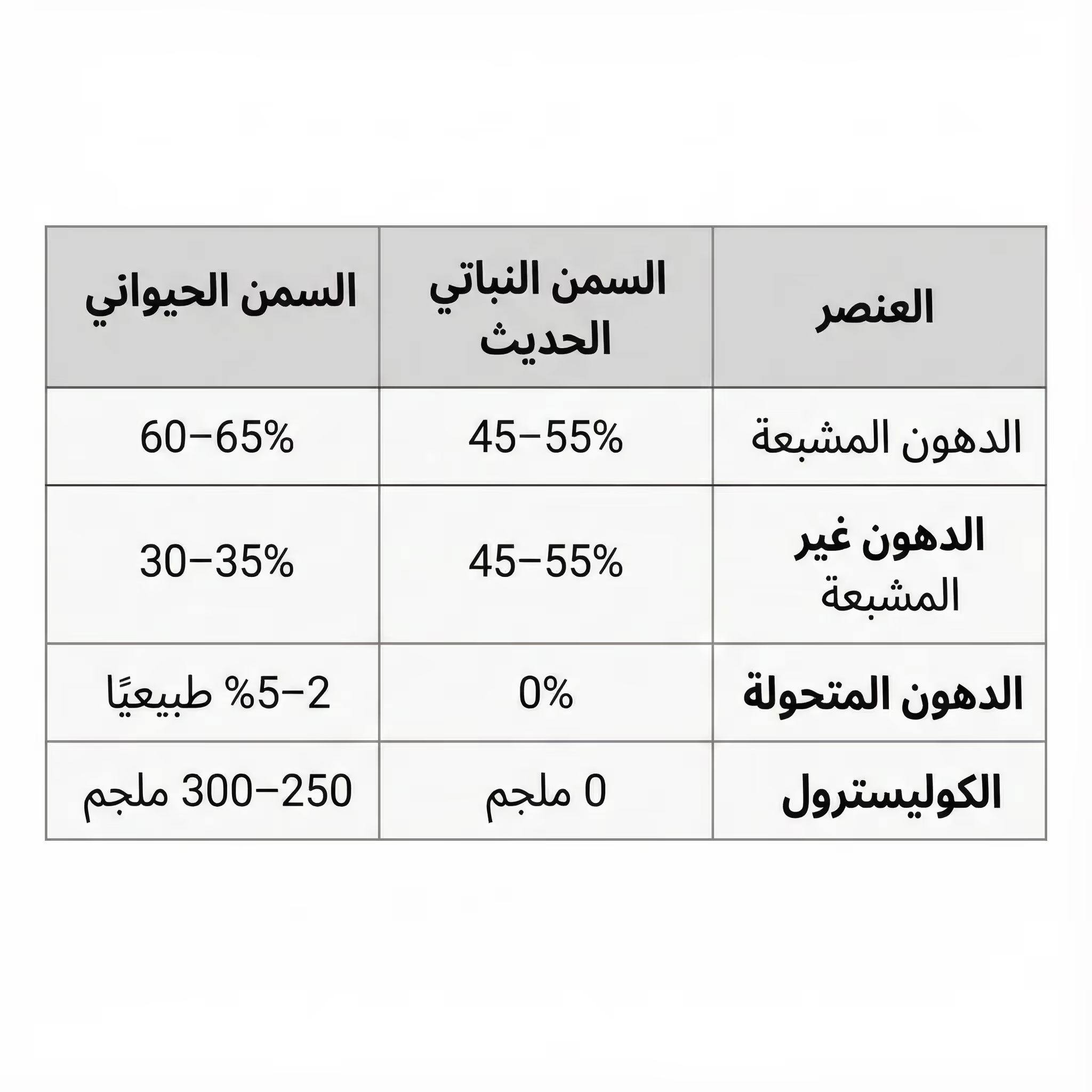
The table shows two complementary philosophies:
Conclusion: There is no perfect fat. The choice depends on the goal (taste/health/industry) with the need to moderate the overall consumption of fat.
To achieve a sensory convergence with animal ghee, flavor enhancers are added such as:
In calculated and safe doses. Natural antioxidants (tocopherols, plant extracts) or synthetic permitted BHA, BHT, TBHQ are also used to maintain quality and stability.
Health is not based on the type of fat alone, but on an integrated consumption strategy that combines:
These three pillars transform nutritional knowledge into a true daily practice.
Recent developments include:
Modern science has also expanded to include the relationship of lipids to health and diseases, the analysis of the synthesis of triglycerides, and the improvement of the cultivation of fat crops to improve their initial properties, reflecting broader dimensions of fat technology that include health, food, and the environment.
Modern vegetable ghee is produced in safe ways that mainly rely on palm oil, whether by using it alone or after being fortified with a natural part of it called stearin, which is the solid part that is separated by careful cooling control.
The process begins by heating the oil to melt and purify it, then gradually cooling it at calculated temperatures. Then, studied proportions of oil and stearin are remixed to obtain the consistent texture known to ghee, without causing any chemical change in fat composition. This method is based on heat treatment and cooling control only, without resorting to partial hydrogenation or the formation of trans fats, which makes the resulting ghee more compatible with modern health standards when complying with manufacturing controls.
In the final stages of manufacturing, food-grade taste and aroma enhancers — whether natural or natural — may be added in limited quantities in order to improve the sensory acceptance of the product without compromising its safety or quality. Manufacturing ends with final mixing and cooling processes to obtain a homogeneous, stable product suitable for various food uses.
Innovation in dietary fat technology embodies the transformative power of collaboration between scientific research and industrial application. It achieves applied research that has a real impact on the market and public health.
This model is clearly reflected in the research achievement led by Prof. Dr. Adel Gabr in cooperation with an integrated scientific team from the National Research Center, Alexandria University, and the Scientific Research City in Burj Al Arab, which won first place in the Egyptian Academy of Scientific Research and Technology Award - Egyptian Innovation Bank (EIB):
About two innovations:
This achievement is an ideal example for:
This success confirms that true innovation is achieved when specialized scientific expertise meets applied vision, creating added value for industry and public health together.
These innovations are an urgent call for industry leaders to invest in their implementation. Your partnerships with researchers and innovators are a three-win strategic move: raising consumer health value, enhancing production efficiency, and building a firm competitive advantage for the national product in the local and global markets.

This presentation repositions vegetable ghee in its modern scientific and organizational context, stressing that the historical problem has been linked to ancient manufacturing methods, mainly partial hydrogenation, whose health risks have been proven and have become banned and criminalized in accordance with the recommendations of the Codex Alimentarius Commission (Codex Alimentarius), the guidelines of the World Health Organization, and the subsequent legislation and strict control of competent national bodies such as the Standards and Quality Authority and the Food Safety Authority.
In contrast, the modern industry has evolved towards natural and safe alternatives for the production of margarine, based on techniques such as fractionation, enzymatic esterification, and oleogel systems, without the formation of trans fatty acids, while maintaining the required functional and sensory properties.
Therefore, vegetable ghee in its contemporary form has become a scientifically and legislatively regulated product. Its quality and health value are determined by the manufacturing method, adherence to international standards, and consumer awareness in order to achieve a realistic balance between health, quality, and nutritional sustainability.