 Advertise
Note: This article was AI-translated from Arabic and is currently under manual review. The author is not responsible for any translation errors. Please refer to the original Arabic text for the most accurate and authoritative information.
The words "saturated," "unsaturated," and "trans" have become staples of nutritional discourse, yet they are often used as definitive value judgments: these are bad fats, those are good, and the third must be avoided at all costs. However, the scientific picture is far more nuanced; these terms merely describe the chemical structure of fatty acids, whereas the actual health impact is determined by the specific type of fatty acid, its quantity, its dietary source, the nutrient replacing it, and the overall dietary pattern.
In the previous article, we explained that the properties of oils and fats are governed by four pillars: the fatty acid profile, triglyceride structure, minor components, and processing/storage conditions. We now explore the first pillar in detail by decoding four acronyms frequently encountered in lipid science: SFA, MUFA, PUFA, and TFA.
A fatty acid consists of a hydrocarbon chain terminating in a carboxyl group. Saturation refers to the nature of the chemical bonds connecting the carbon atoms:
Fatty acids are expressed in shorthand notation such as C18:1, where the first number indicates carbon atoms and the second indicates double bonds. Thus, C18:0 denotes an 18-carbon chain with no double bonds, while C18:2 indicates two double bonds.
The number of double bonds alone does not dictate everything; the position of the bond, its spatial configuration, and chain length are also critical factors influencing melting behavior, oxidative stability, and digestion.
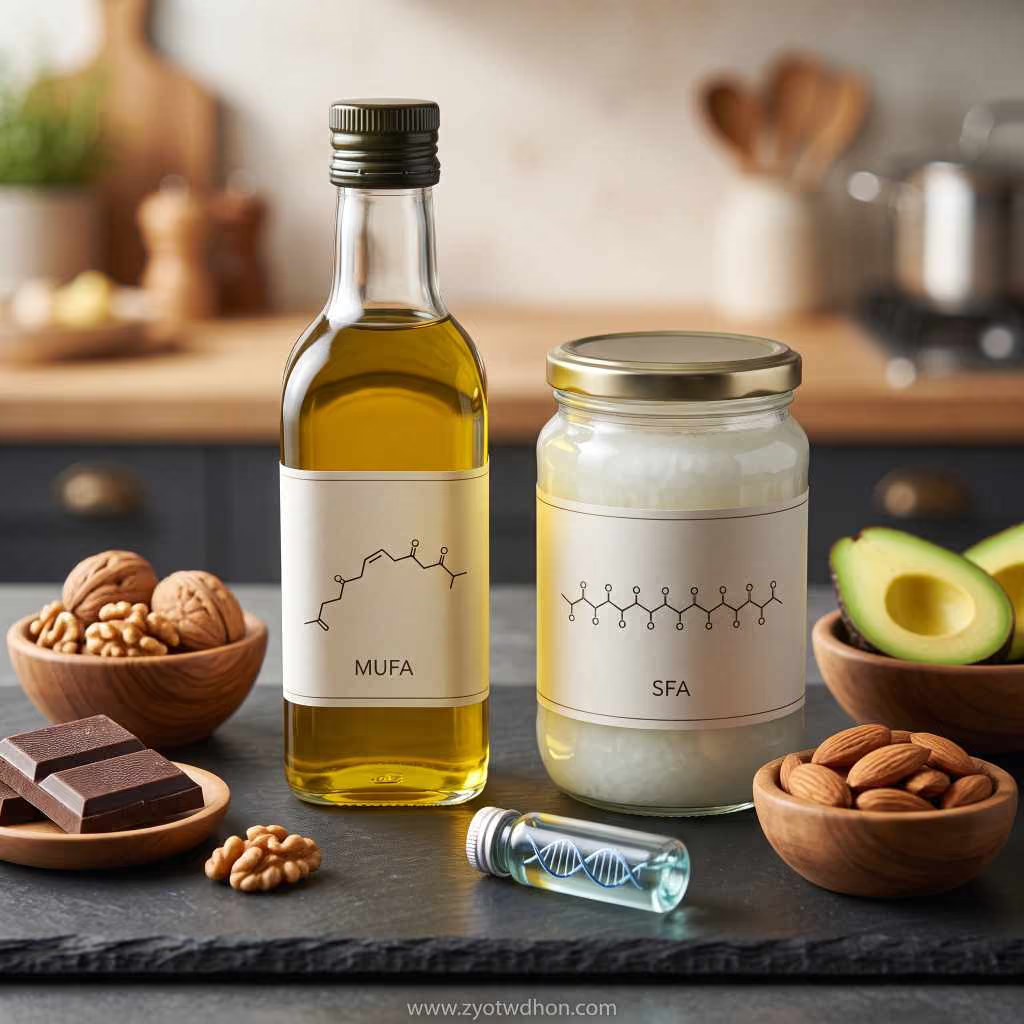
Saturated fatty acids (SFAs) contain no double bonds along their carbon chains.Key dietary examples include:
They occur in varying proportions across coconut oil, palm kernel oil, palm oil, dairy fat, meat, ghee, and butter.
The absence of double bonds allows the carbon chains to pack together tightly, causing SFAs to generally contribute to higher melting points and increased firmness. However, stating that all saturated fatty acids are solid at room temperature is inaccurate; physical state depends on chain length, triglyceride configuration, and the broader lipid matrix.
Furthermore, SFAs are not identical in their impact on blood lipids. Evidence shows that lauric, myristic, and palmitic acids raise LDL-C when replacing unsaturated fatty acids, whereas stearic acid exerts a relatively neutral effect on LDL-C.[1,2]Crucially, the health outcome of reducing SFAs depends on the replacement nutrient: swapping them for polyunsaturated fatty acids does not yield the same outcome as replacing them with refined carbohydrates.
Monounsaturated fatty acids (MUFAs) contain exactly one double bond.Oleic acid (C18:1n-9) is the most prominent member of this class and the dominant fatty acid in olive oil. It is also found in significant quantities in canola oil, avocado, macadamia nuts, and high-oleic oil varieties.
In natural food sources, the double bond typically adopts a cis configuration, introducing a bend or "kink" into the hydrocarbon chain that hinders close molecular packing. Consequently, oils rich in MUFAs are predominantly liquid at room temperature.
From a technological standpoint, MUFAs exhibit higher oxidative stability than PUFAs due to having only a single double bond. Nevertheless, this does not mean every MUFA-rich oil behaves identically; minor components, oil quality, heating parameters, and storage conditions remain vital variables.
Nutritionally, MUFAs—especially from plant sources—serve as an effective replacement for SFAs and TFAs. This benefit should be realized through dietary substitution rather than simply adding excess fat to an energy-dense diet.
Polyunsaturated fatty acids (PUFAs) contain two or more double bonds.They encompass two primary families:
Omega-6 fatty acids are abundant in sunflower, corn, soybean, and cottonseed oils, whereas ALA is found in flaxseeds, chia seeds, walnuts, and select canola and soybean oils. Fatty fish, marine oils, and algal oils provide direct dietary sources of EPA and DHA.
Not all PUFAs are dietary essentials; the two strictly essential fatty acids for humans are LA and ALA, which cannot be synthesized de novo by the human body. Conversely, EPA, DHA, and arachidonic acid (AA) can be obtained directly from food or synthesized in varying amounts from their respective precursors.
Multiple double bonds impart high fluidity to these fatty acids, but they also render them significantly more susceptible to oxidation. Therefore, oils rich in PUFAs require greater care during packaging, storage, and thermal application.
The difference lies not only in the number of double bonds, but in the geometric arrangement around those bonds.In the cis isomer, hydrogen atoms are situated on the same side of the double bond, producing a pronounced bend in the chain. In the trans isomer, hydrogen atoms reside on opposite sides, creating a straighter hydrocarbon chain that packs much like a saturated fatty acid.
This geometric distinction explains why fats containing elevated levels of trans fatty acids can be semi-solid or solid compared to oils rich in cis fatty acids, despite both being chemically unsaturated.
Trans fatty acids (TFAs) are unsaturated fatty acids containing one or more double bonds in the trans geometric configuration.They originate from two distinct sources:
TFAs elevate LDL-C while reducing HDL-C, and high intake is linked to an increased risk of coronary heart disease. Consequently, the World Health Organization recommends limiting total TFA intake to less than 1% of total daily energy, alongside the global elimination of industrially produced sources.[3]
It is essential to distinguish between partial hydrogenation and fully hydrogenated oils. While partial hydrogenation yields substantial levels of TFAs, complete hydrogenation saturates virtually all double bonds into single bonds, yielding a highly saturated fat with negligible TFA content.
The short answer is no.Fluidity and solidity merely reflect physical behavior and do not constitute a comprehensive nutritional evaluation. A plant origin does not guarantee low SFA content, nor does an animal source preclude the presence of MUFAs or PUFAs.
A sound nutritional assessment asks:
Fatty acids are classified into saturated, monounsaturated, polyunsaturated, and trans fats based on the number and spatial arrangement of their double bonds. However, these biochemical labels are not standalone verdicts on whole foods.
SFAs are not physiologically identical, MUFAs do not grant absolute oxidative immunity, not all PUFAs are essential, and TFAs vary by origin—even as public health guidelines emphasize reducing total intake and eliminating industrial sources.
The fundamental scientific takeaway is that the type of nutrient substitution, quantitative intake, and overall dietary context are just as decisive as the broad category name of the fat.
Having established the structural types of fatty acids, the next logical question arises: does the human body digest and transport them identically?In our fourth article, we trace the digestion and absorption of dietary lipids, contrasting the portal vein and lymphatic pathways, and explaining why coconut oil does not equate metabolically to pure MCT oil.