 Advertise
Note: This article was AI-translated from Arabic and is currently under manual review. The author is not responsible for any translation errors. Please refer to the original Arabic text for the most accurate and authoritative information.
Why does olive oil remain liquid at room temperature, while ghee stays solid? Why does one oil tolerate heating better, while another oxidizes rapidly despite both carrying the name "oil"?
The answer begins from inside the drop of oil itself. Oils and fats are not a single chemical substance, nor can they be simply reduced to being plant- or animal-based, liquid or solid. They are complex lipid systems whose characteristics are defined by the type of fatty acids present, their positional distribution within molecules, their associated minor compounds, and the extraction, refining, storage, and heating processes they undergo.
In this series, we trace the complete pathway for scientifically evaluating an oil or fat: from chemical composition to digestion and metabolism, through stability and processing, leading up to health guidelines and regulatory standards. The journey begins with the fundamental question: What are dietary oils and fats made of?
The term "oil" is typically used to describe fatty substances that are liquid at room temperature, whereas "fat" refers to solid or semi-solid substances. However, this distinction is physical and practical rather than a definitive chemical boundary.
Oils and fats primarily consist of the same type of lipid molecules, but variations in their composition lead to different melting points and textures. The higher the proportion of certain saturated fatty acids, or the more lipid molecules contain structures that facilitate packing and crystallization, the greater the tendency toward solidity. Conversely, cis double bonds introduce kinks into carbon chains, reducing the molecules' ability to pack closely and increasing fluidity.
Nevertheless, the percentage of saturated fatty acids alone is insufficient to explain texture; the type of triglycerides, crystallization behavior, and thermal history (cooling and heating) are also critical factors.
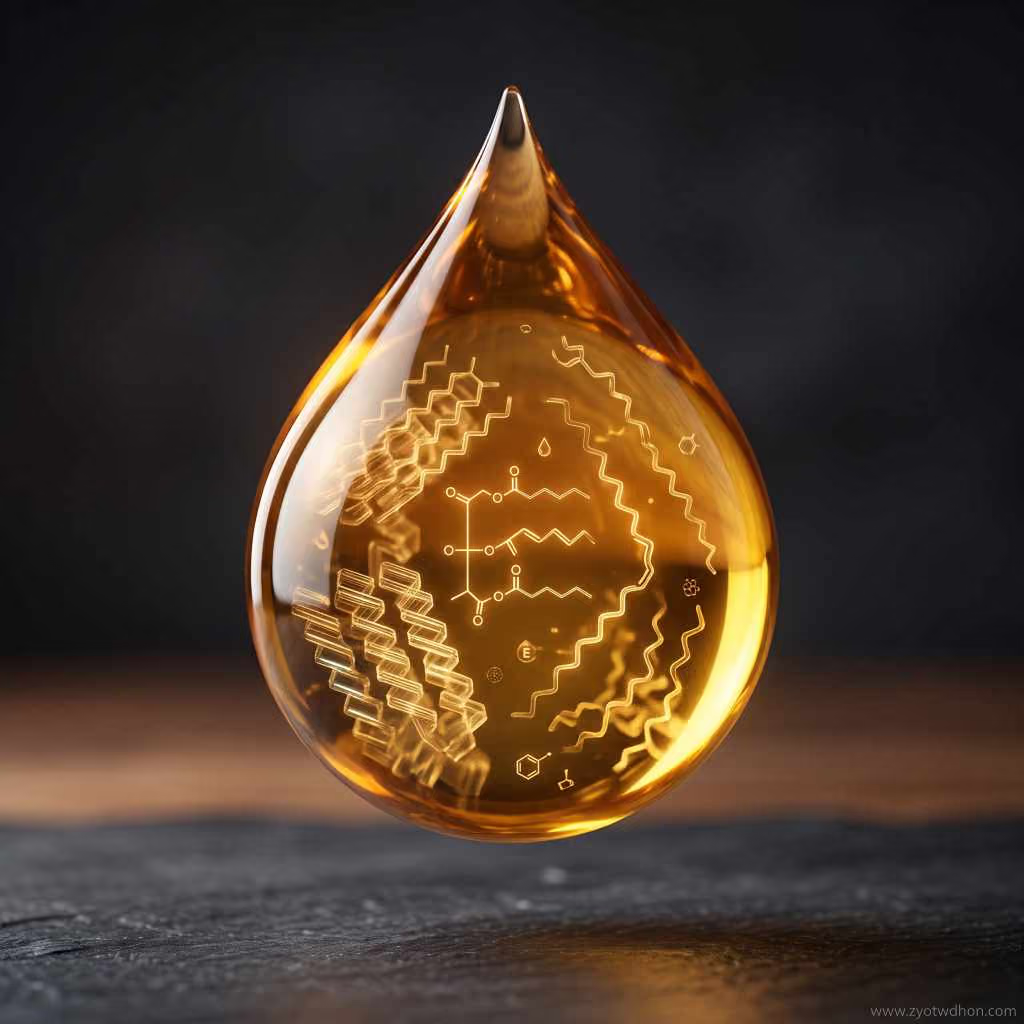
The vast majority of most oils and fats consist of triacylglycerols (TAGs), also known as triglycerides.
A TAG molecule consists of:
The three fatty acids do not have to be identical; a single molecule can contain a saturated, a monounsaturated, and a polyunsaturated fatty acid. Furthermore, these fatty acids can occupy distinct positions on the glycerol backbone, designated as sn-1, sn-2, and sn-3.
This positional distribution is not a mere theoretical detail; it can significantly influence digestion, absorption, melting, crystallization, and technological properties. Consequently, two oils may share identical total fatty acid profiles yet behave entirely differently due to differences in TAG structure or positional fatty acid distribution.[1]
Fatty acids are hydrocarbon chains terminating in a carboxyl group. They vary based on three key elements:
This variation establishes the classification into saturated, monounsaturated, polyunsaturated, and trans fatty acids.
These structural differences directly dictate melting points, oxidative susceptibility, behavior during digestion, and industrial performance. However, natural oils are rarely composed of a single class; olive oil, for example, is renowned for its high oleic acid content, yet it also contains saturated and polyunsaturated fatty acids alongside minor constituents. The same principle applies across all oils and fats.
Therefore, terms like "saturated oil" or "unsaturated oil" merely indicate the predominant class, not the total absence of others.
The answer is no. Alongside TAGs, oils and fats contain minor components that play major functional roles, including:
These components vary depending on the plant or animal source, cultivar, agronomic environment, maturity stage, extraction method, and refining and storage conditions.
Some compounds, such as tocopherols and select phenolics, contribute to oxidative stability. Conversely, certain trace metals or pigments can accelerate oxidative reactions under specific conditions.
Refining processes remove undesirable elements such as free fatty acids, impurities, pigments, and off-flavors, but they may simultaneously diminish a portion of beneficial natural compounds. Therefore, designating an oil simply as "crude" or "refined" is not an absolute health verdict; one must assess the quality of the feedstock, refining objectives, processing severity, and final product specifications.[2]
Fats provide approximately 9 kcal per gram, making them the most energy-dense macronutrient. Beyond providing energy, fats serve essential physiological functions:
This does not imply that higher fat intake automatically confers greater health benefits. The health impact depends on total quantity, fatty acid profile, food source, overall dietary pattern, and the macronutrient that fat replaces.
Before labeling an oil as "good" or "bad," five fundamental questions should be addressed:
An oil may be ideal for cold dressings but less suitable for prolonged heating. Another fat may offer desirable technological structure while requiring portion moderation. Two oils may appear identical on a standard nutrition label yet exhibit drastically different stability due to cultivar variations, refining conditions, or endogenous antioxidant levels.
Oil is not merely a greasy liquid, and solid fat is not chemically distinct; both consist predominantly of triglycerides. Fatty acid composition, minor components, and molecular arrangement define the differences we observe in fluidity, solidity, stability, and nutritional value.
Scientific evaluation begins here: we should not judge an oil solely by its name or source, but rather by understanding its full chemical composition and the processing factors shaping its properties.
If oils and fats share the same fundamental backbone, why do they differ so significantly in texture, thermal stability, and oxidative susceptibility? In the second episode, we explore the four core factors that define the chemical and functional fingerprint of every oil and fat.