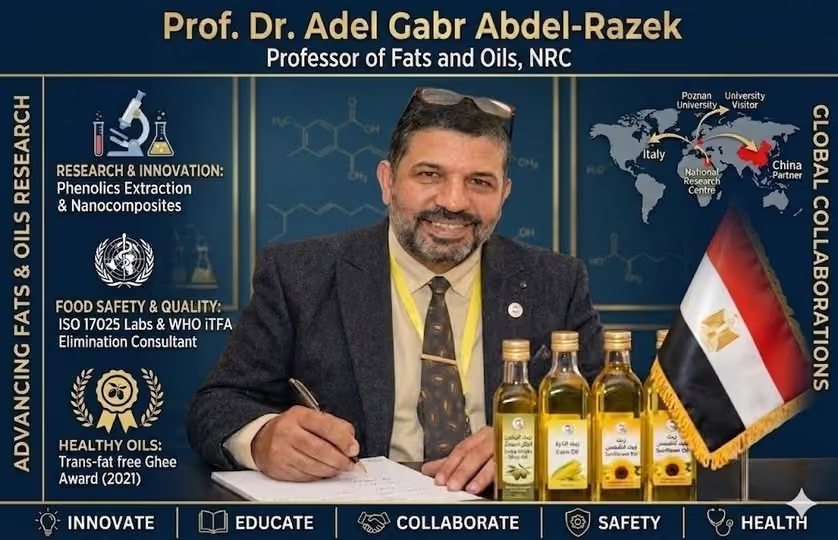
Professor of Oils and Fats at the National Research Centre; Vice-President of the Egyptian Food Safety Association; WHO National Consultant for the iTFA programme.
Publication Date:
February 2, 2026
·
—
Note: This article was AI-translated from Arabic and is currently under manual review. The author is not responsible for any translation errors. Please refer to the original Arabic text for the most accurate and authoritative information.
💡 Introduction: The Scientific Arsenal as a Bulwark for Economic Sovereignty
Facing a global market valued at over 13 billion dollars, and with estimates indicating that 20-30% of the oil traded globally suffers from quality or authenticity issues, inspection is no longer a mere routine procedure; it has transformed into a sovereign technological battle. Advanced laboratories are the first line of defense to protect the market value and geographical identity of Arab olive oil.
Firstly: Quality and Freshness Indicators (Basic Inspection)
This stage aims to evaluate the oil's "general health" and the efficiency of initial extraction processes.
🔍 Arabian Highlight: Arabian olive oil, extracted "cold," often registers acidity lower than 0.5%, placing it in the highest price categories globally.
🔬 Secondly: Precise Molecular Analysis (Identity and Purity Detection)
Here, the oil's "genetic fingerprint" is deciphered; no chemical manipulation can escape these sovereign instruments:
Fatty Acids (GC): The "smart filter" that detects adulteration with cheap oils (sunflower, soy) and confirms the unique profile of varieties like Sourani andAl-Shanqeeti.
Sterols (GC-FID): The "genetic fingerprint analysis" that precisely identifies the plant's identity and detects adulteration at levels as low as 2%.
Glycerides (HPLC): The "molecular gold standard" for detecting mixtures of premium and lower-value varieties (e.g., protecting Nabal oil) by measuring glycerides, especially $ECN 42$.
Waxes (Capillary GC): The "purity microscope" that ensures the oil is mechanically, not chemically, extracted from pomace.
Analyses that prove health superiority and support placing the product in the category of "Functional Food":
Advanced HPLC: for measuring polyphenols; these are antioxidants that give Arabic oil its therapeutic properties for heart health and immunity.
FTIR Spectrometer: "Instant Scanner"; provides a comprehensive spectral fingerprint in less than a minute for rapid screening at ports.
NMR Spectrometer: "Molecular Tomography"; the world's most powerful device for determining geographical origin (Terroir) and accurately distinguishing between olive oil from the mountains of Morocco and the plains of Andalusia.
Principle: Machines measure numbers, but humans evaluate "experience." Olive oil is only classified as "extra virgin" if it has zero defects and possesses positive attributes (fruity, pungent, pleasantly bitter).
Integration: Chemical Quality + Sensory Quality = Global Certificate of Authenticity.
📈 Strategic Summary: From Cost to Investment
The shift towards owning Arab reference laboratories is an investment in national sovereignty:
🏁 Conclusion
In the knowledge economy, sovereignty is not merely defined by borders; it is built in laboratories. Protecting "green gold" of the Arab world begins with deciphering its molecular code and culminates in establishing it as a global standard for quality and authenticity.
 Advertise