Advertise
Note: This article was AI-translated from Arabic and is currently under manual review. The author is not responsible for any translation errors. Please refer to the original Arabic text for the most accurate and authoritative information.
Can “one day” change the fate of a whole year's harvest?
It is not just a question but a scientific challenge that lives in the mind of every olive grower and expert. In the olive world, the difference between an exceptional oil and a normal oil may not exceed a few hours in the timing of the harvest.
Choosing the wrong day means losing both flavor, vital compounds, and market value. Choosing the right moment is the secret to the birth of “liquid gold” in its purest and most precious form.
In fact, every olive fruit has a precise equation between science and art, between physiological maturity and economic return.
This article takes you on a journey into the fruit itself — from the moment of fat formation (Lipogenesis) to the magical moment it is harvested — to discover when and how oil is transformed from an agricultural product into an integrated scientific and economic experience.
The timing of olive fruit harvesting is one of the determining factors in determining the quality, chemical and sensory composition of olive oil. Determining the optimal timing depends on understanding the physiological processes within the fruit, in particular lipogenesis, associated changes in color, moisture content, and the balance of bioactive compounds. This paper aims to clarify the scientific framework for determining the “optimal harvesting window” that achieves the highest possible quality without sacrificing economic return.
Determining when to harvest olives is not a traditional decision. It is a science and art that combines a deep physiological understanding of the olive fruit with careful economic management of the farm. The conscious producer does not focus only on the amount of oil, but seeks the golden moment in which sensory quality and economic quantity are balanced.
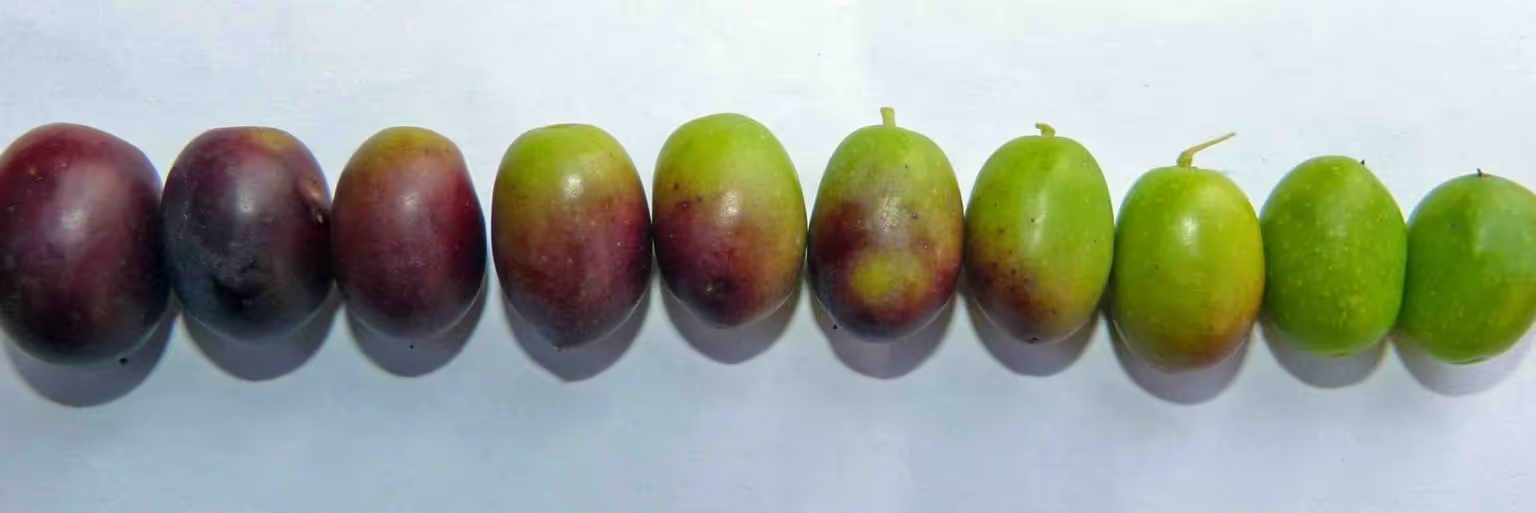
The process of fat formation usually starts in mid-August and continues until early October for 6 to 10 weeks. At this stage, the sugars produced by photosynthesis are converted into major fatty acids such as oleic, palmitic and linoleic acid. They are stored in the pulp cells in the form of triglycerides.
This process is accompanied by a set of characteristic changes:
Gradual increase in oil content until peak.
The color change (Véraison) from dark green to light green and then violet due to the breakdown of chlorophyll and the accumulation of anthocyanin.
Lower moisture content and increased dry matter.
The chemical structure has evolved, in which polyphenolic compounds responsible for flavor and antioxidant properties are formed, while chlorophyll gradually begins to break down.
Recent studies from the International Olive Council (IOC) and the Journal of the American Oil Chemists' Society show that peak quality does not coincide with peak quantity.
Early harvest (maturity index 0—2):
Quality: Very high. The oil has a strong green color and bitter and sharp fruity flavors due to the high content of polyphenols and antioxidants (such as olurobin).
The amount: low because the process of fat formation has not been completed, and the fruits are held together by branches, making harvesting more difficult and expensive.
Late harvest (maturity index 4—5):
Quality: relatively lower, due to lower antioxidants and degradation of polyphenols, golden color and flavor to smooth and less intense.
Amount: high due to complete fat formation, but at the expense of sensory characteristics and oxidative stability.
University of California-Davis (UC Davis Olive Center) and Spanish Agricultural Research Center (IFAPA) studies show that the best time to harvest is when:
The oil content is up to 80—90% of its maximum possible yield.
The Ripeness Index (Ripeness Index) is between 2.5 and 3.5, i.e. a combination of green fruits and those that have started turning purple.
The percentage of polyphenols remains high enough to ensure freshness and oxidative stability of the oil.
The results of this optimal phase are:
Fruity flavors balanced between bitterness and sharpness.
High antioxidant content.
An acceptable economic return without compromising quality.
📊 The effect of harvest timing on oil properties

Periodic laboratory analysis:
Measuring the ratio of oil to dry matter in regular fruit samples to determine whether the plateau phase has been reached.
How to calculate the olive fruit maturity index (Maturity Index — MI or Ripeness Index-RI)
To convert the visual maturity observation into an accurate scientific measurement tool that can be used to determine the timing of harvest, the following steps are followed: sample collection
100 olives are randomly collected from all parts of the tree (top, bottom, four sides) to ensure an accurate representation of the state of the entire orchard.
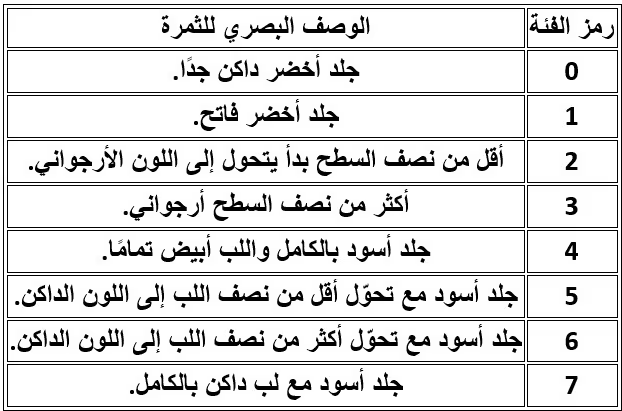
Classification of fruits by color (Color Stage Classification)
Fruits are classified into eight main categories that describe the stages of color development from green to black, as shown in the following table:
Application of the arithmetic formula for the maturity index
The Maturity Index (MI) is calculated using the following formula:
MI = [(N×0) + (N×1) + (N×2) + (N×3) + (N×4) + (N×5) + (N×6) + (N×7)]/100
Where: *N—N* represents the number of fruits in each color category.
Interpret index values and make a harvest decision

Considerations specific to varieties and regions
• The ideal range varies depending on the variety and environmental conditions.
o Picual: the best range is between 3.0 - 4.0.
o Erbaquina: the best range is between 4.0 - 5.0.
• Climatic factors (heat, humidity, lighting) may speed up or slow down the coloring process, so it is recommended to standardize the measurement method periodically throughout the season.
Practical notes and recommendations
• The maturity index should be treated as an auxiliary tool within a set of criteria including analysis of fatty acids, moisture content, and health status of fruits.
• Regular weekly measurement during the ripening period is the best way to accurately determine the “ideal harvest moment”.
• Combining the results of this indicator with laboratory analytical data gives the product an objective quantitative picture that facilitates timely decision-making to achieve maximum quality and return possible.
With these steps, the harvest decision is transformed from a traditional estimate to an accurate scientific process that enhances oil quality, reduces variation between seasons, and gives farmers and factories a common digital language to make informed decisions based on realistic data.
Chemical analysis as the compass of maturity: fatty acids are an indication that does not lie
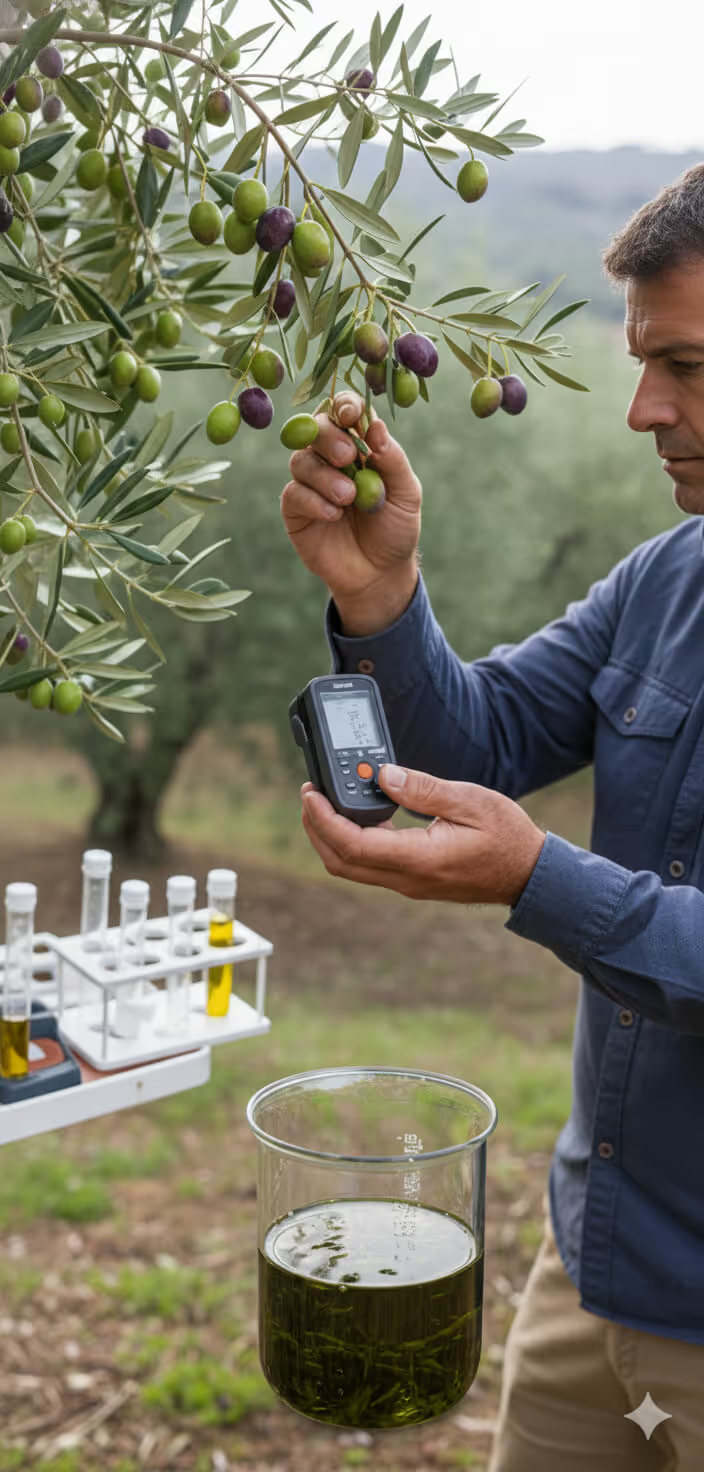
To transform the process of determining maturity from an estimate to an accurate science, the analysis of the acid composition of the oil stands out as one of the most powerful diagnostic tools. During the process of fat formation, not only does the percentage of oil increase, but the fatty acid profile changes qualitatively that accurately reflects the physiological state of the fruit. Here, linoleic acid (Linoleic Acid), a polyunsaturated fatty acid (Omega-6), becomes the most prominent and sensitive indicator to follow the path of maturation.
In the early stages (green fruits), the percentage of linoleic acid is relatively high. But as maturity progresses and the process of fat formation is completed, this percentage begins to decrease regularly and steadily. This decrease is due to the conversion of some linoleic acid to other fatty acids and to the tree's use of it as a substrate in subsequent metabolic processes. Therefore, tracking the reduction curve of this acid percentage by analyzing periodic samples gives us a clear indication of the progress of the fruit in its ripening stages.
In parallel, oleic acid (Oleic Acid) — the monounsaturated acid most abundant in olive oil — completes the picture. As linoleic decreases, the percentage of oleic generally rises until it peaks, which enhances the stability and health value of the oil. But the true peak of quality — the balance between flavor and stability — often comes just before oleic acid reaches its absolute highest percentage.
Thus, the optimal window for harvesting can be monitored chemically when we observe:
Starting to stabilize the linoleic acid decline curve after its sharp decline.
The percentage of oleic acid reaches a high and stable level before, in some varieties, it begins to drop very slightly with overripening.
This analysis, supported by indicators such as the percentage of polyphenols and oleuropein acid, transforms the harvest decision from a mere guess based on color to a strategic decision based on live chemical data, ensuring that the product is harvested at the moment when its “liquid gold” reaches its maximum balance between emotion and mind, between exceptional flavor and economic quantity.
Monitoring environmental factors:
Lower night temperatures increase oil accumulation.
Light watering before harvest improves accumulation, but excessive watering leads to poor flavor.
Balanced nutrition (especially potassium) supports oil formation and improves oil stability.
Yes, the optimal period varies between varieties and regions:
Early varieties such as Arbequina and Koroneiki mature before larger varieties such as Picual and Manzanilla.
In hot areas (Egypt, Jordan, Syria), ripening begins 2-3 weeks earlier than the European average.
In cold mountainous areas, ripening is delayed, but the sensory quality of the oil increases.
At an early harvest, the fruits are stiffer and the pulp is more sticky, which requires:
Adjust the kneading temperature (Malaxation Temperature) to facilitate oil extraction without damaging its ingredients.
Moderately increase mixing time.
Keep temperatures low to avoid loss of aromatic compounds and polyphenols.
Choosing when to collect olives is a delicate blend of science and art.
Science provides tools and criteria for measuring maturity and oil content, while art lies in reading the features of nature and the mood of the season.
The outstanding producer is the one who understands that a good oil is not produced by chance, but in that magical moment that combines knowledge, experience and passion.
Determining the optimal timing of olive collection is not just a seasonal agricultural procedure. It is a meeting point between the farm, the laboratory, the factory and the scientific research, representing the cornerstone in building an integrated and sustainable olive oil industry.
From the farm, success begins with adherence to the principles of accurate agricultural management and the use of scientific maturity indicators rather than relying only on visual experience.
In the laboratory, these efforts translate into accurate measurements of oil content, polyphenols and fatty acids to confirm optimal maturation.
In the factory, the pressing and storage conditions should be carefully adjusted to maintain the characteristics built by the tree.
Scientific research continues the cycle by developing tools to predict the physiological state of fruits, improving irrigation and feeding systems, and using spectroscopy and remote sensing (Remote Sensing) to identify the “ideal harvest window” more accurately.
Achieving the best quality with the highest economic return requires continuous institutional coordination between farmers, researchers, factories, and regulators to apply research results in the field and update technical and production practices periodically.
Establishing national programs for field monitoring and joint laboratory analysis to determine the optimal harvest timing for each region and variety.
Adopting standardized measurement protocols for crude oil quality and linking them to field maturity indicators.
Enhancing cooperation between research and contemporary centers to apply the results of studies on a large industrial scale.
Training farmers and technicians to use simple visual and chemical maturity measurement tools in the field.
Adopting digital transformation in olive agriculture through smart monitoring platforms that link farm data to laboratory analysis and industrial outputs.
With this integration of science, practice and conscious management, olive farms can transform from a traditional source of production to an advanced economic model that combines sustainability, quality, and profitability, and reflects the true face of olive wealth in the Arab world.