 Advertise
Note: This article was AI-translated from Arabic and is currently under manual review. The author is not responsible for any translation errors. Please refer to the original Arabic text for the most accurate and authoritative information.
When terminology gets confused, judgments become skewed. Many oil analysis results have been misunderstood, and numerous technical or commercial assessments have gone awry, due to the confusion between acid value, % acidity, and pH value.
Unfortunately, this confusion is not limited to non-specialists; it sometimes infiltrates laboratories and is frequently encountered by many involved with olive oil throughout the production, trade, and evaluation chain. This is because similar-sounding terms can create an illusion of closeness, while scientific reality dictates otherwise; each term has its specific meaning, independent unit, calculation method, and analytical significance that must not be confused.
This article therefore seeks to place each concept in its proper context and provide a clear scientific explanation that untangles this common confusion, giving the reader a more precise understanding of oil and fat analysis results, especially for olive oil, where the need for accuracy is heightened, and precise terminology becomes integral to sound judgment.
Key Takeaway:
Acid value is a titrimetric expression of the number of milligrams of potassium hydroxide (KOH) required to neutralize the free fatty acids present in 1 gram of oil or fat, expressed in mg KOH/g. Acidity, on the other hand, represents a translation of this result into a percentage calculated based on a specific reference acid, such as oleic, palmitic, or lauric acid. The pH value is not synonymous with either, as it is a measure of hydrogen ion activity in aqueous solutions, not a measure of the free fatty acid content in oil, and is fundamentally not used in the field of oils.
Acid value is the number of milligrams of potassium hydroxide (KOH) required to neutralize the free fatty acids present in 1 gram of oil or fat. Therefore, it expresses the titratable acidity intensity in the sample, and its unit is mg KOH/g.
Practically, a high acid value usually indicates increased hydrolysis of triglycerides and the release of free fatty acids, and is therefore used as an important indicator of raw material quality, storage conditions, and handling.
Percentage acidity is the same titration result, but converted into a weight percentage based on a single assumed reference acid. Therefore, the basis of expression must always be stated: Is the acidity calculated as oleic acid, palmitic acid, or lauric acid?
If acidity is stated as 1% without specifying the reference acid, the statement becomes scientifically incomplete; because the numerical value changes with the molar mass of the acid used to express the result.
The real reason is that the relationship between acid value and % acidity is not a single fixed relationship, but rather depends on the molar mass of the reference acid chosen to express the result. Therefore, the common approximation that acidity is half the acid value applies only approximately when acidity is calculated as oleic acid.
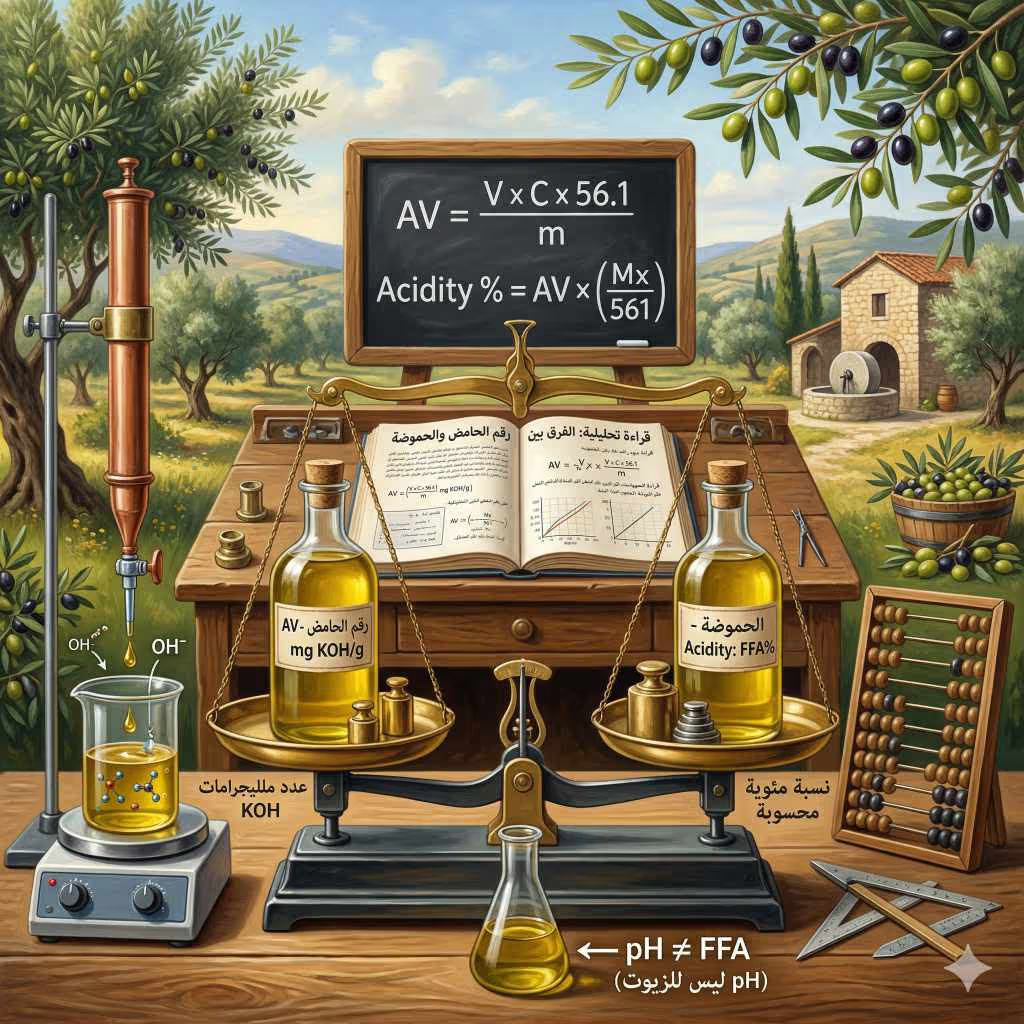
Acid Value = (V x C x 56.1) / mAcidity % as X = (V x C x Mx) / (10 x m)Acidity % as X = Acid Value x (Mx / 561)If the Acid Value = 4.00 mg KOH/g, then the acidity varies depending on the reference acid as follows:
| Reference Acid | Conversion factor from AV to Acidity % | Resulting acidity at AV = 4.00 |
|---|---|---|
| Oleic | Acidity % = AV x 0.5035 | 2.01% |
| Palmitic | Acidity % = AV x 0.4571 | 1.83% |
| Lauric | Acidity % = AV x 0.3571 | 1.43% |
This example alone proves that the same sample can yield more than one value for % acidity depending on the method of expression, while the Acid Value itself remains constant because it is the original titrimetric result.
Similarly, if the acidity is 1.00%, the corresponding Acid Value is approximately 1.99 if calculated as oleic, 2.19 if calculated as palmitic, and 2.80 if calculated as lauric.
In some oils, especially olive oil, commercial and legislative specifications often express free acidity on an oleic acid basis. Therefore, a phrase like 0.8% Acidity in olive oil does not mean that the Acid Value = 0.8. Instead, it means that the free acidity is calculated as oleic acid, a value approximately equivalent to 1.59 mg KOH/g as an Acid Value.
However, in other oils and fats, particularly those whose composition is dominated by a different type of fatty acid, it may be more accurate or scientifically customary to express acidity based on another, more suitable reference acid. This is where many errors arise in reading or interpreting analysis reports, either when Acid Value is confused with percentage acidity (Acidity % / FFA%), or when acidity is mentioned without specifying the reference acid on which it was calculated.
Important Note: Oil Acidity is Not pH Value
Another common source of confusion is mistaking oil acidity for pH, even though each has a completely different scientific meaning. pH value is a measure of hydrogen ion activity in aqueous media, and therefore is used to characterize solutions and liquids such as juices and aqueous solutions. It is not considered a direct standard description of the quality of oils and fats because oil is inherently a non-aqueous medium.
The term "oil acidity" in analysis reports refers to its free fatty acid content, which results from the hydrolysis of a portion of the glycerides. It is expressed either as the percentage of free fatty acids (FFA / Acidity %) based on a specific reference acid, or as the Acid Value in mg KOH/g. Consequently, using pH instead of these indicators to describe oils is a conceptual and analytical misunderstanding that should be avoided.
Acid Value is the original titrimetric result in mg KOH/g, whereas Acidity % is a conversion of this result into a percentage calculated based on a specific reference acid. Therefore, it is not always half of the Acid Value, but is only close to half when expressed as oleic acid.
| Reference Acid | Molar Mass | Conversion from acid number to Acidity % | Reverse conversion to acid number | Does acidity equal half of AV? |
|---|---|---|---|---|
| Oleic | 282.47 | Acidity % = AV x 0.5035 | AV = Acidity % x 1.987 | Approximately yes |
| Palmitic | 256.42 | Acidity % = AV x 0.4571 | AV = Acidity % x 2.188 | No |
| Lauric | 200.32 | Acidity % = AV x 0.3571 | AV = Acidity % x 2.801 | No |
Explanatory Note: The common saying "acidity equals half the acid value" stems from the widespread practice of expressing it in terms of oleic acid. However, this is not a universal rule for all oils and fats, nor for all methods of presenting results.