Founder of the platform, with more than 11 years of experience in marketing within the oils and fats industry.
I entered the palm oil industry in 1991. I was new as a young branch. I didn't get to know Academician Tan Sri Professor Emeritus Datuk Dr. Augustine Ong Soon Hock Only in the first decade of the 21st century, while I worked at the Malaysian Palm Oil Association (MPOA), where he was already a prominent figure. Later, during my tenure with IJM Plantations and the Malaysian Real Estate Owners Association (MEOA), our interactions increased. By then, I'd heard enough stories, read enough research papers, and seen enough of his legacy to realize: this was no ordinary world.
From a curious boy in Malacca, he rose to become the chemist who gave palm oil its scientific shield, its nutritional sound, and its global status. If I wanted to summarize it in a few words: he was the chemist who packed “light” in a bottle, the inventor who saw the oil as molecular gold, the patriot who defended Malaysia's golden crop, and the teacher who reminded us that ideas are the most important.
Sometimes I meet him at the Mass of St. Francis Xavier Church in Petaling Jaya — a quiet figure between the seats, whose wisdom is shrouded in humility. Other times, I see him at MOSTA seminars or workshops.
Now approaching his 91st year, Tan Sri Ong remains the same as ever: energetic, sharp minded, and still urging the industry to think beyond the cooking pan — towards biomaterials, renewable energy, and new horizons for palm oil. And always with his masterful style. I once heard a saying that expresses his spirit: “The fat one can eat has a limit!” It is a reminder that the future of palm oil may lie more in innovation than consumption.
In every meeting, I see not only a scientist, but a man of faith, a patriot, and a thinker who has never stopped asking questions. This is perhaps his greatest legacy: to show us that science at its best is not just a profession, but a mission.
From Tan Sri Ong I first heard about The mysterious sn-2 hypothesis. What was my reaction? “sn-2 what?” The name sounded more like a robot from the “Star Wars” series than a food concept. But as he explained, it was a simple and powerful idea: not all fats behave the same way. I left the meeting with the idea.
For decades, fats have been divided into two categories: “good” unsaturated fats (olive oil, fish oil) and “bad” saturated fats (butter, lard, coconut oil). Nutritionists, health articles, and even supermarket posters have embedded the same message in our minds: Saturated fat clogs your arteries.
According to this logic, palm oil, which contains 50% saturated fat, should have been driven to the food guillotine. And that's exactly what happened in the eighties. Palm oil has been labeled evil in the West — “The Tropical Oil Time Bomb”.
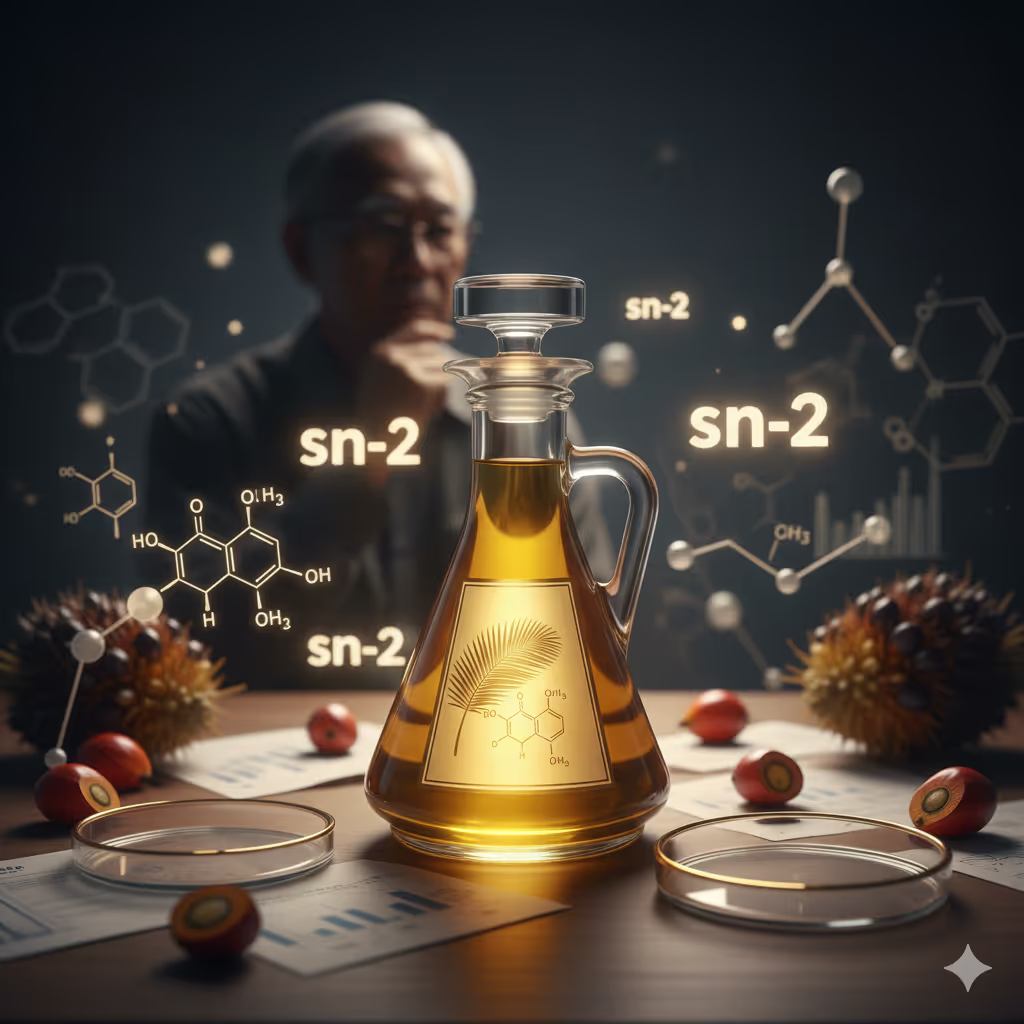
But here's where Tan Sri Ong added an exciting scientific twist in 2002, worthy of a Netflix drama series. He proposed the sn-2 hypothesis. Not all saturated fats are equal, nor do they all behave the same way inside your body.
A hypothesis has been granted sn-2 Palm oil is its scientific shield against decades of misunderstanding. Unfortunately, science tends to scare people with its complicated terms. If I mention the term “Specific space numbering” (which means sn) At a dinner party, I saw eyes staring into a vacuum faster than melting butter in a hot pan.
I often wonder how to best explain this so others can see its true value. Here's my attempt. Let's start with the basics.
The fat molecule, officially known as Triglyceride (triglyceride), built on a backbone with three holes - such as a three-legged bench or a three-seat bus. Each “seat” is called sn-1, andsn-2, andsn-3. On each bench sits a fatty acid, which can be either saturated or unsaturated.
When you eat fat, your body sends enzymes — These are small biochemical “scissors”. But these “scissors” are selective. It cuts the fatty acids on the outside seats (sn-1 and sn-3), while leaving the acid in the middle (sn-2) untouched. This residual fatty acid is in the site sn-2 It stays connected and done absorbed directly into the bloodstream. That means: What sits in the middle seat matters a lot more than the overall passenger list.
To better understand the matter, Imagine a bus ride. The bus (triglyceride molecule) has three seats. At the digestion station, the ticket inspector (enzyme) kicks passengers sitting on aisle seats (sn-1 and sn-3) out of the bus. Only the middle passenger (sn-2) remains to complete the journey directly to the VIP terminal, which is your bloodstream. Or imagine a cinema. Three friends are sitting: two on the aisle, one in the middle. The staff member comes and asks those sitting on the ends to leave, leaving the important friend in the middle to enjoy the movie. This is the fat that your body absorbs directly. Not a movie fan? Think of a sandwich It has three layers. The upper and lower layers are removed, but the middle layer is eaten whole. That middle bite is the most important. Regardless of the analogy you choose, the principle is the same: The sn-2 location is the VIP seat.
Why do analogies work? Not everyone wants to hear terms like “specific spatial numbering” and “glycerol backbone.” But everyone understands the bus ride, the cinema employee, or the sandwich. Analogies simplify complexity. She explains that the fat story isn't just about what you eat, but how your body processes it. In the case of palm oil, it shows why this golden oil deserves more recognition than it often gets.
Of course, science isn't content with smart analogies alone. Tan Sri Ong and his colleagues reviewed human trials, comparing palm olein (the liquid part of palm oil widely used as cooking oil) and oils rich in monounsaturated fats, such as olive oil.
The results? There were no statistically significant differences in cholesterol outcomes. Bad cholesterol (LDL) and good cholesterol (HDL) They acted in the same way Whether the first participants consumed palm or monounsaturated oils. The reason is that the middle position in the first two palm trees is more like olive oil than animal fat. The levels of unsaturation at the sn-2 site in both oils were nearly identical — around 90-100%. That middle seat was occupied with the same kind of “good” fat. So, despite the high overall saturation rate in palm oil, the first two part of it metabolically behaves like monounsaturated oils such as olive oil.
However, he remained Public perception is late. For most consumers, the word “saturated” was a stigma. The exact molecular seating arrangement details have not made it to diet books or newspaper headlines. The first two were labeled palm oil with the same brush as animal fat, while its behavior in the body was closer to olive oil. Paradoxically, while nutritionists hailed the Mediterranean diet for heart-friendly olive oil, the first two palmitic ones that showed similar lipid responses in trials were portrayed as the villain.
It gave a hypothesis sn-2 Palm oil is a scientific defense, revealing that fine molecular details can change global views on health, trade and equity. Thanks to Tan Sri Ong, palm oil has been redefined from evil to a misunderstood oil for him positive characteristics. His insight helped debunk myths, reshape dietetics, and give Malaysia's golden oil a fair shot. Global studies support the sn-2 hypothesis — it is not just a local idea.
However, Health is complicated — Cholesterol, heart disease and diet include many factors — so, the hypothesis sn-2 It's a solid flag, but it's only part of the picture. However, correcting the misconception is important. Millions of farmers rely on palm oil, and consumers deserve the facts: palm oil isn't the food villain it was once portrayed to be.
If palm oil were a person, it would be the controversial celebrity in the tropical world. The headlines follow him like photographers: one day is blamed for blocking arteries, the next day for deforestation and much more. He is scorned in shops and demonized in documentaries. However, this oil — golden, versatile, and amazingly productive — has quietly supported the livelihoods of millions throughout Southeast Asia. Behind his justice story stands one man.
Scientist, inventor, teacher, pioneer, defender of truth — Tan Sri Ong has been called many titles. But if Malaysia had a scientific icon and a sponsor who combined chemistry and courage, it would be him.
Ong was born in Melaka in 1934. His childhood had no impact on the global world he would become. It did not arise between laboratories and microscopes, but between coconut trees, insects and the endless chatter of birds. Nature was his first teacher, and curiosity was his constant subject.
At the St. Francis Institute, he excelled, and later at the University of Malaya in Singapore, he received honors First class In chemistry. That alone was rare at the time, but Tan Sri Ong also held the university's gold medal — proof of a mind that rejects inactivity. Like many brilliant Malaysians of his generation, he traveled abroad. At King's College London, he completed his PhD in organic chemistry, immersed in the complexities of molecules. Later, as the Fulbright Hayes Fellow at the Massachusetts Institute of Technology (MIT), he came into contact with the most prominent minds in the world.
He could easily have stayed there, to have a comfortable life in academia. But Ong has returned to his home country. He was convinced that science was not just a ladder for personal advancement, but a key to unlocking Malaysia's future. After returning to Malaysia in 1959, Ong joined the University of Malaya as a lecturer. In lecture halls, he was not only teaching; he was fueling enthusiasm. His students were leaving with a burning curiosity. His equations on the blackboard were not dry; they had the rhythm of philosophy. In the labs, he taught not only how to mix solutions, but how to blend imagination with discipline. Science has given a pulse. He insisted that chemistry is not abstract — it's bread, soap, health, and life itself.
In the sixties and seventies, palm oil was largely an ordinary commodity, but without the luster. Soybeans and sunflower dominated Western markets; palm oil was the weaker party.
But Tan Sri Ong saw it as something extraordinary. He looked at the molecular structure of the oil and saw the possibilities. He called it “molecular gold.” In 1974, he filed a British patent for separating the first two and stearin — a feat that opened the door to multiple uses of palm oil, from cooking oil to margarine. That was just one of the more than 20 patents he would later file around the world.
Tan Sri Ong's slogan was simple: Malaysia should not only grow palm oil; it should have the science of palm oil. In 1981, when oil prices were volatile and environmentalists were still marginal voices, he suggested converting palm oil into biodiesel. Back then, “green fuel” seemed like science fiction. Some laughed. Tan Sri Ong insisted. Today, palm-based biodiesel is a multi-billion dollar global industry. What seemed like a fantasy in his laboratory observations is now powering vehicles, including aircraft. If the oil palm had a fortune teller, it would have been Tan Sri Ong Ho.
Then came the fight that established his reputation as the first defender of Malaysian palm oil. Its leader was the late Minister, Tun Dr. Lim King Yayek.
In the eighties, it launched American Soybean Association (ASA), concerned by the growing global market share of palm oil, launched a campaign in the United States in which palm oil was described as the “villain of tropical oils” and a “time bomb for heart disease.” It was a perfect lesson in fomenting fear, wrapped in pseudoscience.
For Malaysia, whose economy and small farmers were heavily dependent on oil palm, this was no small skirmish. It was an economic war. Tan Sri Ong didn't blink. In his capacity Director General of the Malaysian Palm Oil Research Institute (PORIM), which is now the Malaysian Palm Oil Council (MPOB), mobilized data, collected scientists, and confronted U.S. lobbyists head-on. His calm was like that of monks; his arguments were the power of dragons.
In two years, the ASA campaign has quietly declined. By 1989, dietary studies around the world confirmed that palm olein is just as heart-friendly as olive oil. It has saved not only an industry, but the dignity of a nation.
For decades, vitamin E has had one star: Alpha-tocopherol, which is the type found in creams and supplements. But palm oil has another form that has been overlooked for a long time — tocotrienols. Where most people saw minor details, Tan Sri Ong saw a treasure.
Tocotrienols have been shown to be faster and more effective antioxidants. Its flexible structure has allowed it to slip into cell membranes easily, protecting it from damage more effectively than tocopherols. If tocopherol is the security guard of the mall in the world of antioxidants, then tocotrienols are the naval commandos.
The research he defended has shown its promising potential: lowering cholesterol naturally, protecting brain cells, slowing cancer growth, reducing stroke damage, and even protecting skin from aging. By highlighting tocotrienols, he reminded the world that palm oil isn't just a cooking oil — it's a pharmacy in a fruit.
But Tan Sri Ong didn't stop at his own research. In 1986, he founded Malaysian Invention and Design Association (MINDS). For him, science was not meant for monopoly but for sharing. He wanted Malaysia to be a nation of inventors, not imitators.
Under his leadership, MINDS has become a platform where schoolchildren with their strange devices and professors with their groundbreaking inventions meet on the same stage. Innovation was democratic for him. Ideas can sprout anywhere; they just need care.
MOSTA, which was founded in 1989 to develop oil and fat sciences, appointed Tan Sri Kweh as its founding leader in 1991.
Critics often say that oil palm destroys forests. What was Tan Sri Ong's response? Look at the numbers. The oil palm produces about 4 tons of oil per hectare per year — and it could be more, while other annual edible oil crops such as soybeans, rapeseed and sunflower produce less oil per hectare. One hectare of oil palm can replace 5 to 10 hectares of other crops. More oil, less land. Meeting global demand for edible oils with palm oil isn't destruction — it's salvation.
He also referred to Environmental advantage For oil palm. Factory wastewater, which used to be a methane nightmare, can now be treated to zero discharge. Palm-based cleaners break down faster than petroleum-based cleaners. In his words: “Why use dirty oil when we have clean oil here?”
In later years, Tan Sri Ong turned his keen mind to Trade policies. The EU, which imports palm oil by millions of tons, has started to worry about Glycidyl esters (GE) and 3-MCPD esters — They are by-products of processing. His opinion was practical: “We know how they form; we know how to remove them. The challenge is to make the solution affordable. The chemists, given the time, will solve it.” In other words: calm down and let science do its work.
Like many advocates, he was also clear about trade: Malaysia didn't want special treatment — just A level playing field. “We are not asking to build submarines. Just let's sell the palm oil we grow better than anyone else.”
By 2012, the accolades could no longer be ignored. Tan Sri Ong received the Merdeka Award for the outstanding contribution of the people of Malaysia to science, technology and innovation.
But for him, awards were stops, not end lines. In 2019, he published his book “In pursuit of scientific truth: ideas are the most important” — It was not a self-congratulation, but a deep reflection.
The story of palm oil isn't just economic — it A deep humanitarian aspect. Millions of small farmers rely on it; millions of others consume it every day, often unknowingly. As one of the most traded commodities in the world, it feeds, refuels and feeds far more than most people realize. At the center of its scientific defense, innovation and survival in the face of global smear campaigns is a boy from Malacca — curious, brilliant and unafraid to challenge lies.
Tan Sri Augustine Ong is more than just the “father of Malaysian palm oil.” He is the chemist who packed “light” in a bottle, the inventor who reimagined fat, and the patriot who stood firm against the giants. If Malaysia has a scientific icon — a modern alchemist who turned humble palm oil into molecular poetry and national pride — it is him.
So the next time you're frying a banana pie, cooking curry, or fueling a bus or plane, remember: in that golden drop lies more than just oil. It has a story of science, courage, and one brilliant chemist supported by many. A reminder that together, we can move forward. The world is shining brighter because Tan Sri Ong has never stopped asking questions.
Source: The Borneo Post