
Lang
Note: This article was AI-translated from Arabic and is currently under manual review. The author is not responsible for any translation errors. Please refer to the original Arabic text for the most accurate and authoritative information.
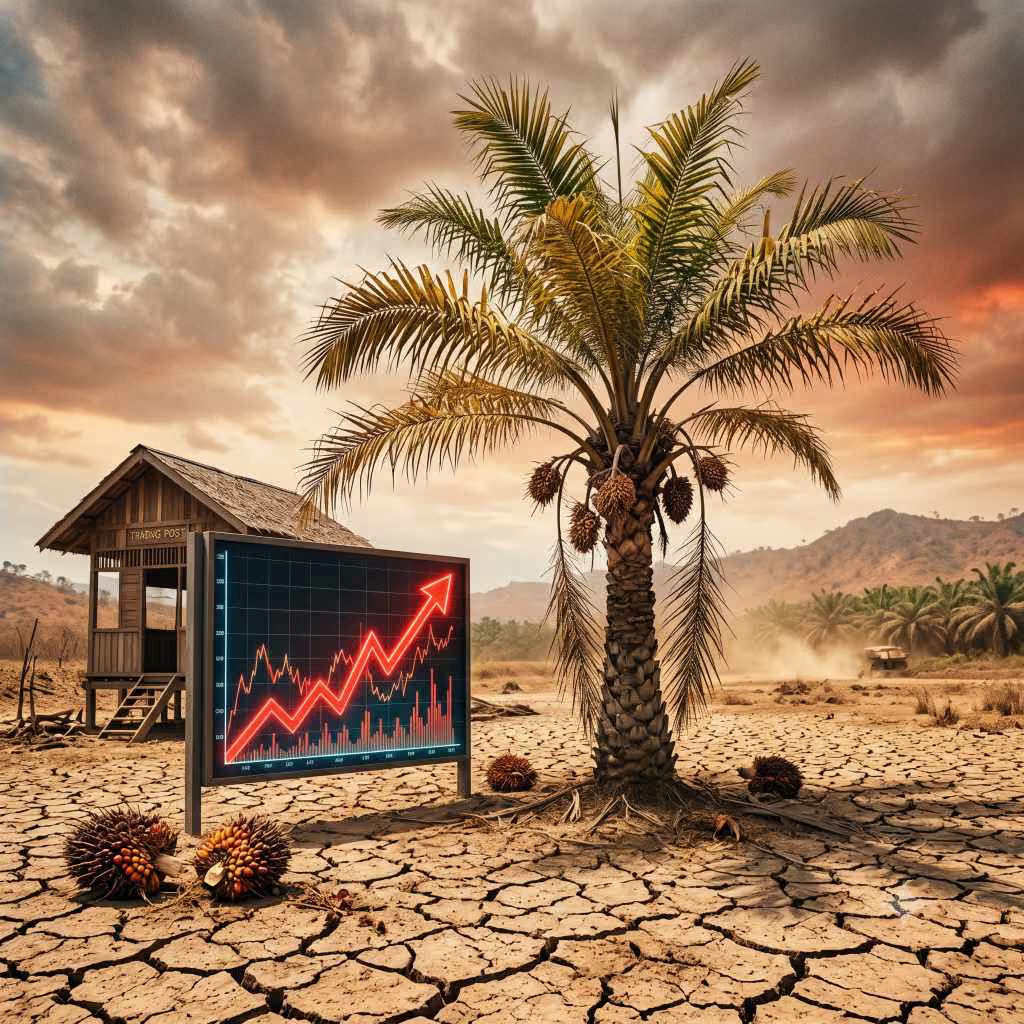
Article Summary: As global meteorological centers warn of a rapid return of the El Niño phenomenon, the attention of decision-makers in the oils and fats sector turns toward Southeast Asia. This report examines how the impending drought intertwines with new mandatory biodiesel programs, creating a "double squeeze" that threatens supplies and reprices palm oil in global markets.
Global vegetable oil and commodity markets are currently experiencing a state of anticipation and caution, coinciding with announcements from meteorological centers tracking rapid indicators of a returning El Niño phenomenon. The impact of this phenomenon extends far beyond abrupt environmental shifts; it represents one of the most critical economic drivers of Crude Palm Oil (CPO) prices on global exchanges.
In this report, we analyze the technical and economic mechanisms that link water movements in the tropical Pacific Ocean to the surging prices of palm oil futures.
El Niño, which translates from Spanish as "the little boy," is a natural, cyclical, and irregular climate pattern that recurs every two to seven years in the tropical Pacific Ocean.
Under normal conditions, trade winds blow from east to west, pushing warm surface waters toward Asia and Australia. During an El Niño event, these trade winds weaken or even reverse direction, allowing a massive band of warm water to move eastward toward the coast of South America. This thermal disruption alters atmospheric circulation patterns globally, triggering severe climatic anomalies that manifest as torrents and floods in some regions, and intense droughts in others.
El Niño gains paramount importance in the oils and fats sector due to the high concentration of production geography. Statistics indicate that Indonesia and Malaysia alone dominate approximately 85% of global palm oil supplies.
What multiplies the impact of any supply disruption in this specific geographic zone is the heavy weight of the crop in the global food and energy basket. Palm oil alone accounts for roughly 37% of the total global production of all vegetable oils, firmly positioning it as the world's most produced and consumed vegetable oil. When El Niño activates, it brings severe drought and a sharp decline in rainfall to Southeast Asia, placing more than a third of the world's vegetable oil supply directly in the line of danger.
From an agricultural and technical perspective, oil palm trees are highly sensitive to water availability; they require an even distribution of rainfall throughout the year to maintain high yields. When drought strikes, the trees enter a physiological state known scientifically as "Moisture Stress."
The most defining characteristic of this phenomenon is the "delayed effect." Palm oil production does not drop immediately at the onset of a drought; rather, the real impact manifests as a decline in crop yields 6 to 12 months later. Moisture stress leads to the abortion of inflorescences, shifts the sex ratio of the flowers toward masculinity (which reduces the female fruit-bearing bunches), and decreases the size of subsequent fruit bunches, ultimately resulting in a sharp and sustained deficit in global market supplies.
Biodiesel is a renewable fuel produced by chemically processing vegetable oils to blend them with conventional petroleum diesel. In Southeast Asia, crude palm oil serves as the primary and almost exclusive feedstock for this industry to support domestic energy security.
Government policies in producing nations are currently undergoing mandatory leaps to raise blending ratios (designated by the letter "B" followed by the percentage of vegetable oil in the mix), fundamentally altering market balances:
The Double Squeeze: When drought hits the crop and production falls, producing countries find themselves legally obligated by domestic mandates to fulfill these high blending ratios for the local energy sector first. Consequently, the entire crop deficit is transferred to and deducted from the "quotas allocated for foreign export." This mandatory retention deprives international markets of massive volumes, driving export prices to skyrocket.
The history of the oils and fats markets is replete with evidence demonstrating how El Niño reshapes the global price landscape:
Global commodity exchanges price El Niño based on future projections. The moment indicators confirm the onset of the phenomenon, traders, investors, and hedge funds price in a "Weather Risk Premium" into futures contracts, causing prices to spike preemptively before any physical shortage occurs on the ground.
Furthermore, El Niño shifts the competitive dynamics among competing vegetable oils. While the phenomenon strikes Southeast Asia with drought, it often brings favorable, heavy rainfall to soybean crops in South America. This divergence narrows the traditional price spread (premium) between soybean oil and palm oil, forcing major international buyers (such as India and China) to restructure their import shares and continuously substitute between oils based on shifting daily margins.
Current climate models for 2026 indicate a high probability of the ongoing El Niño cycle developing into a severe "Super El Niño." For decision-makers and investors in the oils and fats sector, tracking these meteorological shifts is no longer a scientific luxury, but a core tool for risk management and price hedging. Close monitoring of production and inventory figures, alongside the rapid expansion of government biofuel mandates, remains the primary anchor for anticipating price directions in an increasingly volatile global climate.