 Advertise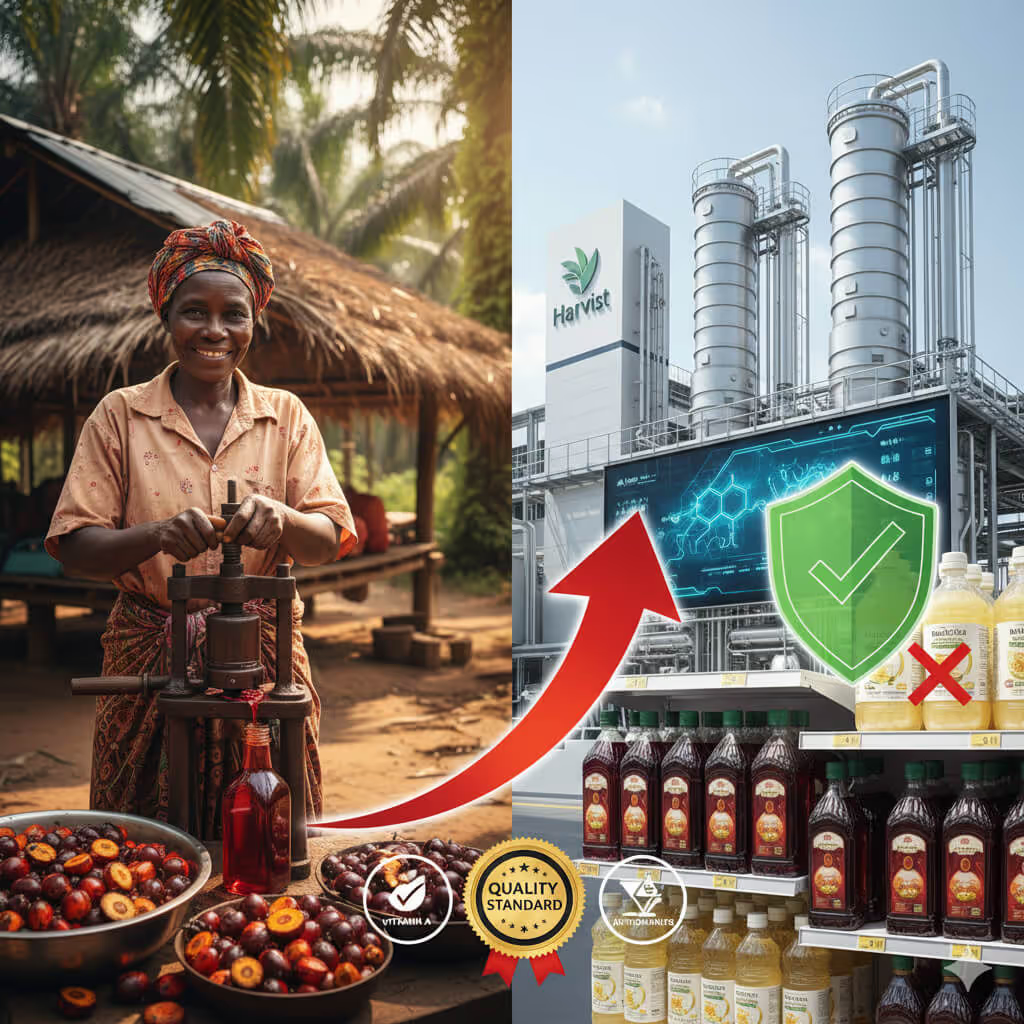
Note: This article was AI-translated from Arabic and is currently under manual review. The author is not responsible for any translation errors. Please refer to the original Arabic text for the most accurate and authoritative information.
Palm oil has supported civilizations for thousands of years, with the oldest recorded use dating back to 4000 BC.
In its raw, unrefined form, palm oil is a nutritional powerhouse, naturally rich in beta-carotene — the bright reddish orange pigment that gives raw palm oil its distinctive color. As a precursor to vitamin A, it plays a vital role in supporting visual health. It contains vitamin E, including tocopherols and tocotrienols — powerful antioxidants that help protect cells from oxidative stress; in addition to squalene and coenzyme Q10 — compounds linked to cell health, energy metabolism, and skin vitality.
In West and Central Africa — where the oil palm tree (Elaeis guineensis) originated — crude red palm oil is still traditionally produced in an artisanal manner. The fruits are cooked, juiced and packaged for direct sale and home use. This traditional form retains its full spectrum of beta-carotene and vitamin E. Its continued use may contribute to lower rates of lifestyle-related diseases when it is part of a vegan diet that is rich in whole and minimally processed foods.
However, this traditional oil, with its strong flavor and dark color, may not meet the sensory expectations of modern consumers. For contemporary kitchens, crude palm oil is usually refined, bleached, deodorized (RBD), and then fractionated to separate its liquid and solid ingredients. The result is refined palm olein — a light yellow liquid part that makes up the standard cooking oil in many parts of the world. Despite the loss of bright red color and some nutrients in this process, about half of the vitamin E content remains.
The Malaysian Palm Oil Authority (MPOB) patented a process to preserve the nutrients of red palm olein in 1999, which was later marketed by Carotino Sdn Bhd under the leadership of chemical engineer Yu. R. Onitane. The process uses short-path distillation — a technologically advanced method that gently retains heat-sensitive nutrients such as carotenoids and tocotrienols, while maintaining their effectiveness and reducing thermal degradation. This precision technology requires significant investment and operational expertise, contributing to the higher cost of red palm olein compared to traditional cooking oils.
The global rise of red palm oil
Carotino's red palm oil was launched in 2001, but consumption by local consumers in Malaysia was initially slow. The high price of the oil and its deep red color — unusual to many — have created sensory and psychological barriers. In contrast, the European and North American markets showed greater curiosity, especially among health-conscious consumers and culinary enthusiasts.
Over time, more Malaysian companies started producing red palm olein with short-track distillation. Although it is expensive to invest and operate in this way, it produces a product that has superior food safety.
The turning point came with the metabolic health revolution that started around 2010, marked by increasing public concern about obesity, diabetes, and chronic inflammation. This shift — fueled by research, wellness movements, and the rise of health influencers — has sparked renewed interest in functional foods. In areas where palm oil has been viewed with suspicion for a long time, red palm oil has emerged as a candidate, praised for its antioxidant profile and compared positively to olive oil and avocado oil.
In Malaysia, consumer attitudes are beginning to change in parallel. Interest in red palm oil has grown with widespread awareness of its health benefits, and its universal ratification has added credibility.
Smart Utilization and Dietary Supplement Markets
In Malaysia, companies have started extracting beta-carotene and tocotrienols from palm oil for use in supplements. Some biodiesel producers have also taken advantage of this opportunity: while processing crude palm oil for fuel, they extracted parts rich in carotene. This smart benefit has allowed the use of recovered nutrients — especially beta-carotene and vitamin E — in fortifying refined palm olein (RBD), creating an affordable version of red palm oil.
However, this approach has limitations. There is no multiplier effect — every ton of crude palm oil produces enough carotene to support just one ton of refined palm olein (RBD). While this method is cost-effective, it lacks the full spectrum of phytonutrients preserved in short-path distillation oils.
Regulatory pressure and concerns about ultra-processed foods
In response to the regulations of the European Food Safety Authority (EFSA), restrictions have been imposed on two harmful contaminants: 3-MCPD (2.5 ppm) and glycidyl esters (GE, 1 ppm), effective January 1, 2021. These compounds are genotoxic, as 3-MCPD is associated with male infertility and GE is linked to carcinogenicity. The Malaysian Palm Oil Board (MPOB) has followed this up, but implementation has been repeatedly delayed — from 2021 to 2023, then 2025, and now 2026.
Nowadays, many refined palm olein (RBD) products exceed these thresholds — 3MCPD levels are one to two times the limit, and GE levels are four to seven times higher. In contrast, red palm oil produced by short-path distillation shows significantly less pollution: only 5% of the 3MCPD limit and 20% of the GE limit, making it a cleaner choice.
As MPOB's general manager recently stated in The Edge, “There is no comprehensive extension of the 3-MCPDE license, but rather flexibility on a case-by-case basis” — indicating that full compliance is expected by 2026.
At the same time, fortifying refined palm olein (RBD) with extracted carotene places the product in the category of ultra-processed foods (UPF). In Europe and North America, concerns about ultra-processed foods are increasing, with increasing evidence linking them to metabolic disorders and poor health outcomes.
Standards and market visibility
Currently, there is no official standard for red palm oil under MPOB, PORAM, or Malaysian standards. This regulatory vacuum creates confusion for consumers and opens the door to misleading product claims — such as soybean or canola oils fortified with palm carotene that are marketed as “red soybeans” or “red canola.” Without clear definitions, the integrity of red palm oil is at risk of being tarnished.
In contrast, the original natural red palm olein, produced by short-path distillation, offers a clean, refined and nutrient-rich product. Although it requires a higher price, it earns its outstanding value through superior quality and safety. Think of it as the business class of cooking oils: limited availability, but raises the reputation of the entire category. Just as budget travelers may choose an airline known for its excellent offers, the presence of this leading product enhances the image and credibility of the palm oil sector.
Production remains limited and is likely to remain so, but its presence in itself sends a positive signal—that palm oil can meet the highest standards of health, safety and refining.
Malaysia's red palm oil scene
Today, only two short-path distillation (SPD) plants still operate in Malaysia: the flagship facility of Carotino Sdn Bhd, and a second plant operated in 2019 by Profes Lipids Sdn Bhd, built by the chemical engineer Wong Seong. The latter markets red palm oil produced with SPD technology under the Harvist brand.
Interestingly, Unitata Bhd — a subsidiary of United Plantations Bhd (KL:UTDPLT) — has been producing red palm oil since 1988, long before the adoption of SPD technology. Its product, Nutrolein golden palm oil, is derived from a specially bred palm oil strain with fruits that are exceptionally rich in carotenoids (provitamin A) and vitamin E compounds (tocopherols and tocotrienols). Through a gentle refining process, Unitata retains much of these nutrients, producing red palm oil with a quality profile comparable to SPD oils, although achieved in a different way.
While Nutrolein has traditionally been export-oriented, it is now emerging in local Malaysian markets, providing consumers with an excellent, nutrient-rich alternative that reflects decades of agricultural innovation and processing.
Conclusion: Protecting the Major
To protect the image and future of palm oil, it is essential to recognize natural red olein oil (SPD and its equivalent) as the leader in the sector — a symbol of what palm oil can be at its best. There is an urgent need for official red palm oil (RPO) standards to:
By setting clear standards, Malaysia can lead not only in production but in quality assurance and global credibility. The time to act is now.
Malaysia has science, heritage and opportunity. Let red palm oil shine — clean, reliable, and universal.
Kwa Kiat Singh is a Senior Assistant Lecturer at Monash University Malaysia, where he teaches the short course on the treatment of oils and fats.
Source: The Edge Malaysia