 Advertise
Note: This article was AI-translated from Arabic and is currently under manual review. The author is not responsible for any translation errors. Please refer to the original Arabic text for the most accurate and authoritative information.
Introduction
Frying oil is not merely a hot medium that gives food a golden color and a crispy texture; it is a chemical system that changes with every heating cycle, every meal fried in it, and every minute it is exposed to heat, oxygen, and moisture.
(A simplified scientific article for specialists and general consumers)
The mistake in handling frying oils often stems from a simple but misleading idea: that all vegetable oils are suitable for frying, and that an oil's suitability is determined solely by its color or smell. The scientific truth is that frying oil is a sensitive and complex substance, whose properties vary depending on its fatty acid composition, refining degree, smoke point, and resistance to oxidation.
Therefore, the first step in safe frying doesn't begin at the pan, but with choosing the oil itself. The right oil can withstand heat better, yield higher quality food, and degrade at a slower rate. Conversely, an unsuitable oil may oxidize quickly, change its smell, and become a source of undesirable compounds that affect food quality and safety.
Dietary oils and fats are primarily composed of Triglycerides (Triacylglycerols), which are molecules consisting of glycerol linked to three fatty acids. The variation in these fatty acids determines the oil's behavior during frying:
From this, we understand that describing an oil as "healthy" does not necessarily mean it is best for deep frying; an oil might be excellent for salads or cold use, but unsuitable for repeated frying.
The scientific choice of frying oil is based on two main criteria:
The smoke point is the temperature at which oil begins to emit visible smoke. The appearance of smoke indicates the start of oil component breakdown and the formation of volatile compounds that affect aroma, taste, and safety.
Since deep-frying temperatures are often between 160 and 180 degrees Celsius, the oil used must have a smoke point sufficiently higher than this range to provide a safety margin. However, the smoke point alone should not be relied upon; an oil might have a high smoke point but poor oxidative stability, causing it to degrade quickly with repeated use.
Oxidative stability is the oil's ability to resist reacting with oxygen during heating. This is a crucial criterion in frying because oil is exposed not only to heat but also to oxygen, moisture, and food residues.
Practical Summary: The best oil for frying is not necessarily the most expensive or most popular, but rather the one with the highest stability under heat, the greatest resistance to oxidation, and that is used within a controlled temperature range.
When food is placed in hot oil, it's not just a simple transfer of heat. Instead, an intertwined series of chemical reactions begins, the most important of which are:
Oxidation occurs when oil reacts with oxygen under the influence of heat. The process often begins with the formation of primary compounds like peroxides and hydroperoxides, which then break down into aldehydes, ketones, acids, and volatile compounds.
These compounds are responsible for rancid odors, unacceptable taste, and the deterioration of the sensory quality of fried food. The rate of oxidation increases with higher temperatures, longer heating times, higher proportions of unsaturated fatty acids, and the accumulation of food residues in the oil.
Hydrolysis results from the reaction of triglycerides with water released from food, especially in frozen or moist foods. This leads to the liberation of free fatty acids (FFAs), a reduction in the smoke point, and an increased likelihood of smoke and pungent odors.
Therefore, drying food before frying is not just a simple household practice, but a scientific one that reduces oil damage and slows down its deterioration.
Polymerization refers to the combination of degraded oil molecules to form large compounds. These compounds increase oil viscosity, darken its color, lead to persistent foaming, poor heat transfer, and increased oil absorption by food.
When the oil becomes heavy, cloudy, very dark, sluggish, and excessively foamy, it indicates that deterioration is no longer in its initial stages but has reached an advanced point, necessitating its discontinuation.
Relying solely on color and smell is insufficient. Some degradation products can accumulate before sensory signs become clearly apparent. Therefore, specialists use a set of complementary scientific indicators.
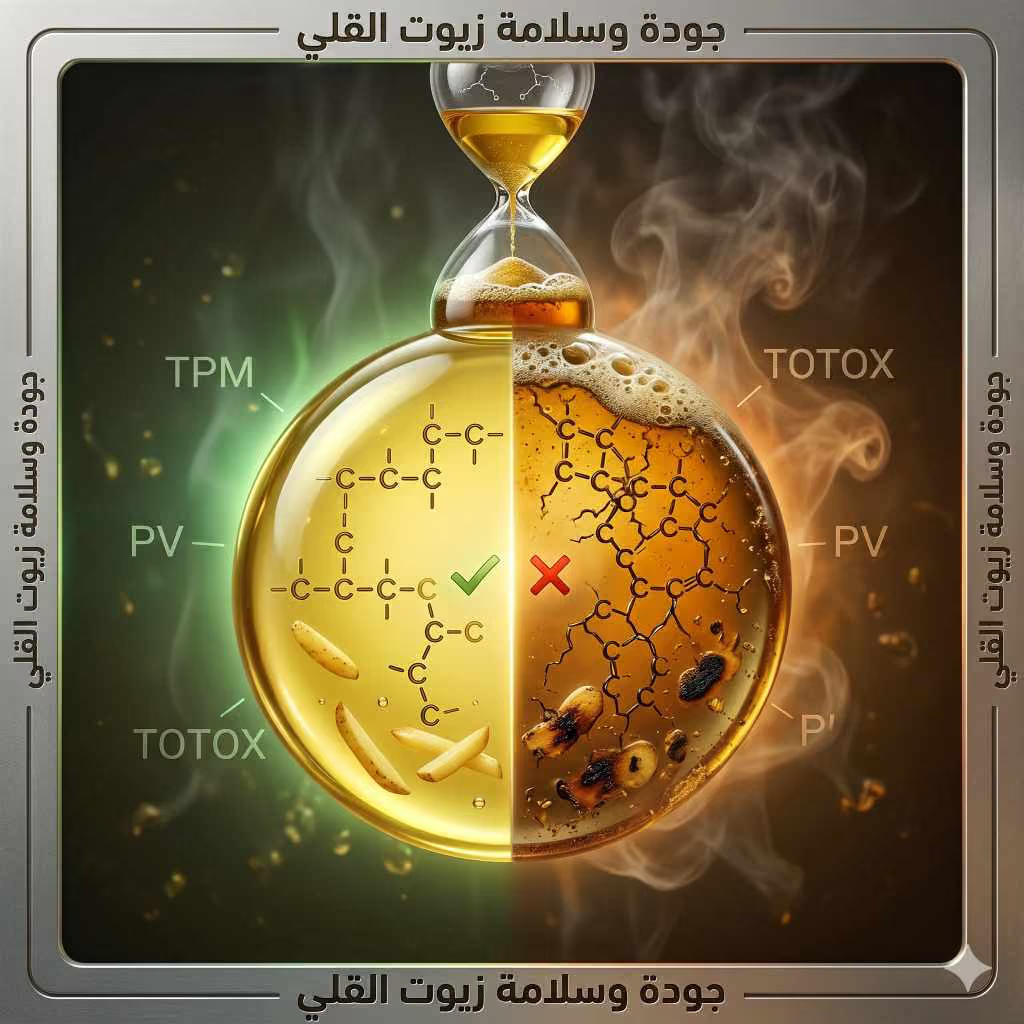
Total Polar Materials (TPM) is considered one of the most crucial and comprehensive indicators for evaluating used frying oil, as it reflects the accumulation of oxidation, hydrolysis, and polymerization products in a single metric.
| TPM Value | Oil Condition | Practical Action |
|---|---|---|
| Less than 18% | Good to very good | Can continue with monitoring |
| 18–23% | Acceptable with caution | Filtering and closer monitoring required |
| 23–24% | Close to the rejection limit | Prepare for replacement |
| 25% or more | Often unfit | Recommended to discard and not use |
Regulatory limits vary from country to country, but a range of 24–27% TPM is used in several international regulations or guidelines as a rejection limit or a strong warning for used frying oil.
Free fatty acids are a significant indicator of hydrolysis. Higher levels increase oil acidity, lower its smoke point, and raise the likelihood of smoke and undesirable flavors.
As a guideline, FFA in fresh refined oil is very low, and exceeding a range of 1% in used frying oil is a sign that warrants attention and monitoring, while higher values, particularly around 2–2.5%, may indicate a strong warning of the oil's unsuitability, though these values should not be relied upon exclusively.
Peroxide Value (PV) measures primary oxidation products, specifically peroxides and hydroperoxides. This value is highly useful for evaluating fresh or stored oils, as it reveals the onset of oxidation before rancidity becomes clearly evident.
However, in used frying oil, PV must be interpreted with caution, as peroxides are unstable at high temperatures and can rapidly decompose into secondary oxidation products. Consequently, a low peroxide value might be observed in degraded oil, not because it is of good quality, but because the primary oxidation products have broken down into other compounds.
Generally, limits such as 10 mEq O₂/kg for refined oils and15 mEq O₂/kg for virgin or cold-pressed oils are used as quality indicators for edible oils. However, these alone are not sufficient for a definitive assessment of used frying oil.
After estimating the peroxide value as an indicator of primary oxidation products, the p-Anisidine Value is determined to assess secondary oxidation products, particularly the aldehyde compounds resulting from peroxide decomposition.
This highlights the importance of combining both indicators: a low peroxide value might occur because peroxides have already decomposed, while a high p-Anisidine Value indicates the accumulation of aldehydes responsible for rancid odors and unacceptable flavors.
As a guideline, a lower p-Anisidine Value is preferable. A value exceeding 20 is a strong indicator of advanced secondary oxidation, especially if accompanied by an increase in TPM, the appearance of a rancid odor, or a deterioration in food flavor.
The Total Oxidation Value (TOTOX Value) provides a broader picture of the oil's oxidative state, as it combines both primary and secondary oxidation products according to the equation:
TOTOX = 2 × PV + p-Anisidine Value
| Indicator | Usually good oil | Warning and monitoring | Unacceptable or warrants rejection |
|---|---|---|---|
| PV | Less than 1–3 | 3–10 | More than 10 in refined oils, and more than 15 in virgin or cold-pressed oils |
| p-Anisidine | Less than 5 | 5–20 | More than 20, especially with signs of damage |
| TOTOX | Less than 10 | 10–26 | More than 26 as a strong indicator of advancing oxidation |
| TPM | Less than 18% | 18–23% | 24% or more usually warrants discarding the oil |
Despite the importance of PV, p-AnV, and TOTOX, TPM remains the most crucial practical indicator for assessing used frying oil, as it reflects the accumulation of various degradation products, including oxidation, polymerization, and hydrolysis.
It is clear from this that frying oil cannot be judged by sight alone, nor by smell alone, nor by a single numerical value. Good oil is the result of correct selection, appropriate composition, controlled temperature, and comprehensive scientific and sensory monitoring.
And in Part Two we move from the lab to the kitchen and restaurant: How can we tell if oil has gone bad? What are the most practical types of oils? What are the best conditions for frying and browning? And how can we extend the life of safe oil without compromising food quality or consumer health?
Key takeaway from Part One: Choosing the right oil is half the battle; the other half begins with understanding its behavior during heating and monitoring its degradation indicators before our senses deceive us.