Advertise
Note: This article was AI-translated from Arabic and is currently under manual review. The author is not responsible for any translation errors. Please refer to the original Arabic text for the most accurate and authoritative information.
❓ How can a small peanut — rich in protein and oil — turn from a food treasure into a real threat to human health?
This is the scientific challenge. Peanuts are among the richest crops in oils and proteins, but at the same time they are among the most sensitive to fungal pollution and production AflatoxinsThis is a silent poison that cannot be seen or smelled. However, it can cause serious damage to the liver and immune system, especially in children.
Although the risk is great, science has not been powerless. Recent research, including advanced studies, has revealed promising techniques to protect peanuts and their oil, including edible nanospheres and natural plant extracts that are able to reduce the formation of mycotoxins to distinct levels while maintaining the quality of grains and oils and preventing their rancidity.
This topic is particularly important for Egypt. Peanuts are a strategic crop that supports the national economy through exports and is involved in vital food industries, in addition to its role in improving soil fertility and providing job opportunities throughout the production and manufacturing chain. Therefore, good agricultural, manufacturing and storage transactions become a national responsibility that affects the reputation of the producer and the health of the consumer at the same time.
⬅️ In this article, we embark on a simple but profound scientific journey to understand the nutritional value of peanut oil and its products, the challenges posed by fungal pollution and food allergy, and the latest solutions and techniques to protect and preserve this food wealth for generations.
Peanuts are one of the most important oil and food crops. They are used globally as a major source of protein and high-quality oils. Peanuts in Egypt are a strategic crop that supports the national economy by exporting to many countries. Its oil and grains are included in important food industries such as sweets, oils, peanut butter, dakwa and healthy foods.
This crop also contributes to improving soil fertility and providing employment opportunities throughout the production chain from agriculture to manufacturing and marketing. Therefore, good agricultural, manufacturing and storage transactions become a national issue that affects the reputation of Egyptian products abroad and affects human health at home.
Peanuts contain 25— 30% proteinIt includes an important group of essential amino acids, which increases its value as a food that helps build muscle and cell health.
Its characteristics:
Peanut oil is a high-quality vegetable oil. Its seeds contain 45-50% oil with a rich composition of oleic acid (Omega-9), a fat that is beneficial to heart health and lower bad cholesterol. This oil is known for its excellent ability to resist oxidation, making it an ideal choice for cooking and industrial uses.
One of its most important practical characteristics is the high degree of smoking, which in refined oil reaches 230—235°C, allowing it to be used for deep frying and cooking at high temperatures without the formation of harmful compounds or irritating odors. It also has a mild taste that does not affect the flavor of the food, and its high stability during repeated use.
Peanut butter — or Al Dukwa As it is known in Sudan, it is one of the most nutritionally dense peanut products. It is mainly prepared from roasted and ground peanuts without significant additives.
It usually contains a form 25% protein and about 50% of healthy fats It is rich in oleic acid (Omega-9), along with fiber, vitamin E and antioxidant compounds that support heart health and immunity and help fight inflammation and malnutrition. The separation of the oil layer on the surface is a natural phenomenon that often indicates that it is free of synthetic stabilizers and hydrogenated oils.
It is known globally as Peanut ButterIn the Arab countries, it is called peanut butter or peanut butter, while in Sudan it has a special place called Al DukwaIt is used with bread, porridge and some popular dishes as a concentrated source of energy and protein. It is a favorite food for children, athletes and those who need high energy in a small amount of food.
Peanuts are very sensitive to infection with a fungus Aspergillus flavus Who produces Aflatoxins, which is a material:
Prevention methods:Good drying, storage in dry places, sorting affected grains, periodically monitoring toxin levels.
In 1960, thousands of turkey poultry died in Britain due to feed contaminated with peanuts infected with fungi... Hence the discovery of aflatoxins and the establishment of global food safety standards.
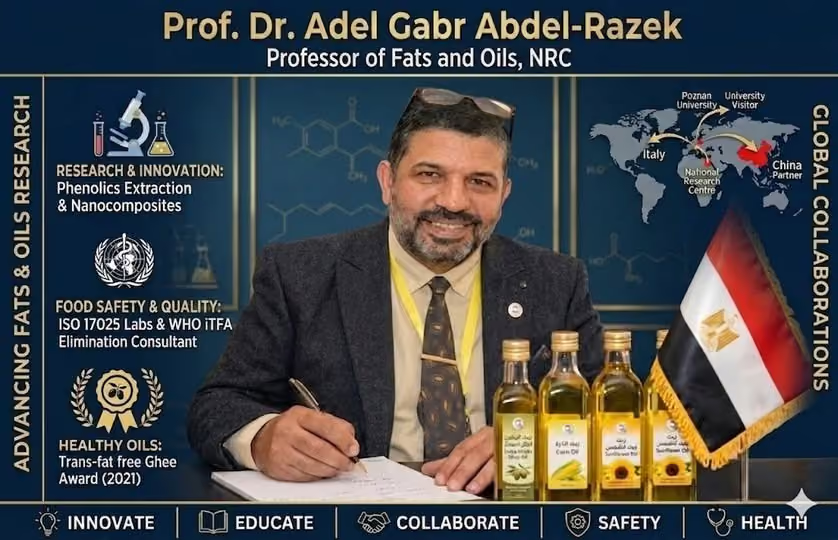
Dealing with peanut contamination by fungi and mycotoxins is no longer just traditional practices in the field and in the pantry, but has become an active field of scientific research and modern techniques. Research has shown — including studies in which the author of this article participated Dr. Adel Jabr Abdel Razek — Excellent results in protecting peanut seeds and peanut products based on:
This scientific progress is integrated with a system of internationally adopted protection and prevention procedures for the preservation of peanut seeds adopted by organizations such as FAO (FAO) and Codex Alimentarius, the most important of which are:
Thus, modern research solutions (nano-membranes and plant extracts) are integrated with good practices in agriculture, drying, storage and inspection to form an integrated protection system that ensures that peanuts remain a safe food wealth instead of becoming a serious health challenge.
Peanuts are among the most common food allergens in the world. Allergies are caused by a severe immune reaction to the proteins in the bean.
Does peanut oil cause allergies?
Allergy symptoms:
What should be done?
Current research confirms that peanuts and their oil are a food, health and economic wealth, but they are threatened by fungi and mycotoxins... Scientific research is the first line of defense to protect them.
Peanuts and their oil are a great food asset — but they are highly sensitive to risks. They combine protein and healthy fats that support growth and fight malnutrition. At the same time, they are threatened by the hidden fungal toxin aflatoxin and food allergy as a danger to some consumers.
Therefore, its maintenance is not an option, but a scientific and practical duty: controlled cultivation, drying and storage, modern techniques to reduce toxins, continuous laboratory testing, and consumer awareness... because peanut safety is part of food safety, economy and human health.