 Advertise

Note: This article was AI-translated from Arabic and is currently under manual review. The author is not responsible for any translation errors. Please refer to the original Arabic text for the most accurate and authoritative information.
Did you know that the secret to softness lies in the “impurities”?
Have you ever imagined that a chocolate bar that melts in your mouth softly, or a skin cream that gives you superior hydration, owe their functional properties to compounds that were once considered mere “impurities” inside raw vegetable oil?
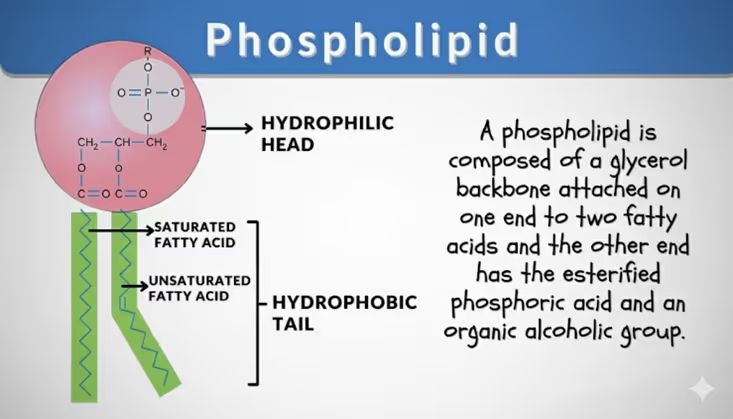
In the modern world of oil refining, the process is no longer limited to refining oil to obtain a pure food product, but has turned into an integrated system for extracting high-value ingredients, foremost among which is Lecithin (Lecithin), known scientifically as Phospholipids (Phospholipids).
In the world of modern industries, the value of raw materials is measured not only by what we see from them, but by what can be intelligently extracted from them. Lecithin is a vivid example of this; a natural compound that begins its journey within soybean oil, to become an essential element in the stability of chocolate, the softness of baked goods, and the efficiency of cosmetics.
Between science and practice, technology stands Remove the glue As the link that turned what used to be technological impurities into a real added value that serves both food and cosmetics, and redefines the concept of oil refining in the modern industry.
These compounds, which were synthetically known as Gums It is an obstacle to the stability and quality of oil as a strategic material with a high economic and technological value. This importance is particularly prominent in soybean oil due to its high content of phospholipids, making it the world's first industrial source for the production of dietary lecithin.
It indicates the approved industry references, such as AOCS undFAOHe pointed out that phospholipids are among the most influential non-glyceride ingredients on refining efficiency and final oil quality, as well as being an economic bridge linking the food oil industry, functional food industries, and pharmaceutical and cosmetic products.
Crude vegetable oils vary in their content of phospholipids (gummy) depending on the type of plant source and extraction method:
Commercially, lecithin is produced mainly from soybean oil due to its high economic feasibility and high content of phospholipids of a complex nature that gives it outstanding emulsifying properties. Although it can be produced from sunflower or rapeseed, soy lecithin remains the world's dominant product in the food and pharmaceutical industries.
The true quality journey of oil begins with a pivotal step known as Degumming. This phase is not just a preliminary technical procedure. It represents a strategic decision that determines the efficiency of subsequent refining operations, the quality of the final oil, and the possibility of maximizing the added value of the crude oil product. Through it, what is considered unwanted impurities inside the oil is separated from what can be turned into an independent high-value industrial product.
This technique, which is the most widespread in the industry, is based on exploiting the hydrophilic nature of water-soluble phospholipids (Hydratable Phospholipids — HP). It is the main source of food lecithin production globally. The process is carried out through precise operational steps that include:
The end result of this process is raw lecithin with a distinctive honey color. It is a natural emulsifier that is widely used in chocolate, sweets, baked goods, dairy products, in addition to pharmaceutical and cosmetic applications. This method is characterized by its simplicity, low cost, and environmentally friendly because it does not rely on harsh chemicals.
Despite the efficiency of water removal, it alone is not sufficient to achieve the required purity of the oil. Another class of phospholipids remains known as “insoluble in water” (Non-Hydratable Phospholipids — NHP). These compounds are linked to calcium and magnesium ions in the form of stable complexes that do not respond to water and represent a real challenge to refining operations.
Acid Degumming:To meet this challenge, deacidification is used as a complementary step, in which appropriate dietary acids such as phosphoric or citric acid are injected after aqueous removal. The acid acts as a chelating agent that unbinds the glue to minerals, turning them into a centrifugally detachable form. This treatment reduces the phosphorus content in the oil to levels ranging from 30—80 parts per million (ppm), which improves the efficiency of bleaching and subsequent refining. This phase does not aim to extract lecithin, but mainly aims to improve the quality of the oil.
Enzymatic removal represents the peak of development in degumming technology. Treatment has moved from physical and chemical separation to microstructural analysis of phospholipid molecules. The world's largest soybean oil plants have adopted this technology over the last two decades because it achieves a unique integration between quality, profitability and sustainability.

This enzyme system allows access to a phosphorus content of less than 5 ppm, which is the level required to move to modern physical refining, achieving high oxidative stability, preventing color regression, and reducing dependence on chemicals.
Wet gum resulting from “water degassing” is transformed into highly purified food lecithin through a series of physical and chemical processes aimed at raising the concentration of phospholipids and reducing moisture and impurities in accordance with Codex and AOCS international standards through the following stages:
1. Mechanical purification: Additional separation to remove neutral oil and solids stuck in wet gums to improve the color and texture of the final product.
2. Vacuum drying: Using thin film evaporators to reduce humidity from (30-50%) to less than 1% in order to prevent enzymatic degradation and ensure rheological and chromatic stability.
3. De-oiling: Extraction of the remaining triglycerides using acetone, raising the percentage of “undissolved substance in acetone” to more than 95%, to produce ultra-pure lecithin intended for sensitive pharmaceutical and food applications.
4. Bleaching and filtration: Color treatment with oxidizing agents such as H2O2 and fine filtration to obtain a transparent, neutral, and highly stable product in accordance with the requirements of the beauty industry.
5. Quality control and conformity: Subjecting the final product to thorough tests (acetone index, peroxide value, viscosity) to ensure compliance with international standards.
Conclusion: This system ensures the transformation of the “by-product” of the refining process into a high-value functional component, promoting economic efficiency and sustainability in the oil industry.
The value of lecithin does not stop at being a by-product of the refining process. Rather, its effect extends to be the “cornerstone” in the list of ingredients of thousands of products we use daily. The versatility of this ingredient is its superior ability to incorporate liquids that are not usually mixed (such as oil and water), making it a strategic material in the following sectors:
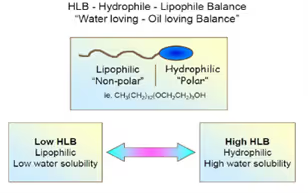
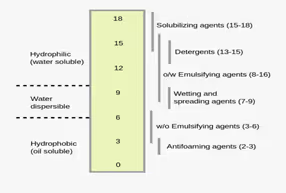
The water and fat affinity balance system (HLB) is the key measure that determines the efficiency of phospholipids as emulsifying agents. It expresses the relative strength of hydrophilic groups (Head) versus lipophilic groups (Tails).
• Special values: The HLB index of natural soy lecithin is usually between 4 to 9, making it tend to form “water-in-oil” (W/O) emulsions in its raw state. However, through enzymatic or chemical modifications (such as hydrogenated or phosphorylated lecithin), this value can be raised to 10 or 12.
• Applications by value:
o HLB Low (3-6): It is used in the chocolate industry to reduce viscosity, and in margarine (margarine) to prevent splashing during frying.
o HLB Average (7-9): Perfect for baked goods to improve fat distribution and gluten interaction.
o HLB High (10-12): It is used in instant drinks and cosmetics to create stable and super-smooth “oil in water” (O/W) emulsions.
This diversity of HLB values allows phospholipids to be flexible “engineering tools”, the appropriate type of which is selected based on the nature of the medium to be emulsified
Lecithin is not just a by-product of a refining process, but an applied model of how science and engineering can reshape value within an industry. Through a thorough understanding of the structure of phospholipids and the adaptation of separation and transformation techniques, a drop of crude oil becomes a platform for the production of high-impact functional ingredients whose applications extend from food to cosmetics.
Thus, degumming becomes more than an operational step, becoming a knowledge and industrial investment that achieves higher quality, better economic return, and a more efficient and sustainable industry.
In short: Lecithin is not just a by-product. It is proof that when science meets industry, it can turn “impurities” into drivers of growth and innovation.