 Advertise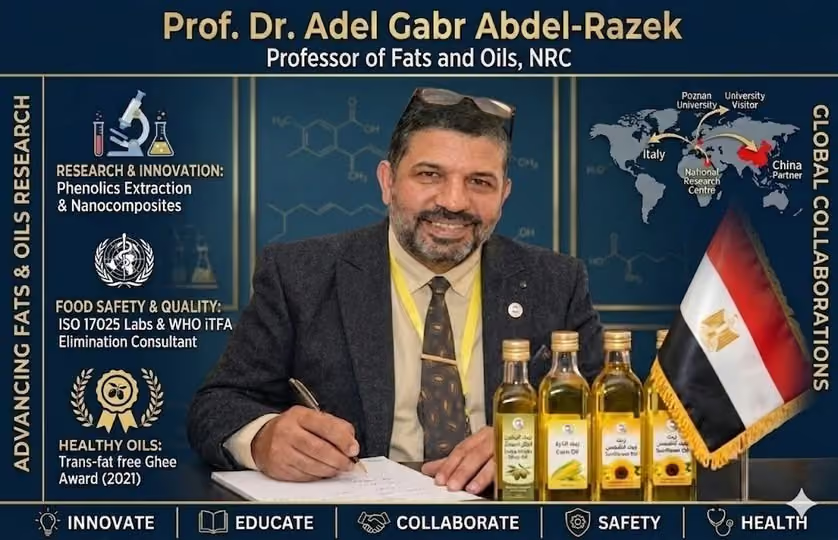

Note: This article was AI-translated from Arabic and is currently under manual review. The author is not responsible for any translation errors. Please refer to the original Arabic text for the most accurate and authoritative information.
Can one oil nourish the cells of the body from the inside and give the skin balance and health from the outside? At a time when the concepts of functional nutrition and smart skin care intersect, grape seed oil is one of the most unique non-traditional vegetable oils, not only with its composition rich in vital fatty acids and antioxidants, but also with its unique ability to work from inside the body through food and from outside through the skin to redefine the relationship between what we eat and what we see in the mirror of our health and skin.
This article takes you on an applied scientific journey to understand how grape seed oil is transformed into an integrated internal and external nutrient, and why it has become a key pillar in the modern food, pharmaceutical, and cosmetic industries.
In the context of the global transformation towards the circular economy (Circular Economy) and the optimization of resource utilization, agricultural and food waste has become one of the most important unexploited sources of added value. The grape industry (wine and juices) is one of the industries that generate the most waste of the era (Pomace), which includes peels, seeds and stems.
Grape seed has transformed from an environmental burden to a strategic raw material for the production of Grape Seed Oil (Grape Seed Oil), a highly nutritious and functional vegetable oil that is increasingly important in the food, pharmaceutical, and cosmetic industries, reflecting a successful practical model for industrial sustainability.
The extraction method is the determining factor in determining oil quality, chemical composition, and oxidative stability.
Scientific addition:Recent studies (2020—2023) show that grapeseed oil extracted with SFE has a 20— 30% higher antioxidant activity compared to solvent refined oil.

Scientific alert:The high percentage of linoleic gives the oil a high skin value, but increases its sensitivity to thermal and optical oxidation.

Due to its richness in unsaturated acids:
(a) Nutritionally:
b. Pharmaceutically:
c. Cosmetically:
Reliable production data:
The prospects of Arab investment:Egypt, Morocco, Tunisia, Lebanon, and Syria have great opportunities through:
Economic challenges:
Environmental and technical challenges:
Suggested solutions:The combination of the circular economy, renewable energy, and green technologies reduces these challenges in the medium term.
Grape seed oil is a clear example of transforming waste into wealth and a real scientific, industrial and economic opportunity, especially for Arab countries with diverse agricultural production. Investing in this oil means supporting sustainability and innovation and enhancing local added value.
Grape seed oil stands out as an advanced model for functional oils thanks to its smart chemical composition rich in linoleic acid, tocopherols and phytosterols, giving it a dual ability to support heart and cell health while at the same time providing excellent performance in skin care due to its light nature, fast absorption and resistance to oxidative stress.
At the industrial level, this oil embodies the concept of applied sustainability by transforming the waste of the era into a high-value product included in the functional food industries, pharmaceuticals, and therapeutic cosmetics. Between internal nutrition and external care, grapeseed oil proves that it is not just a vegetable oil, but an integrated solution that combines human health, industry efficiency and resource protection.
It confirms the results obtained from two scientific researches in which Dr. Adel Jabr, the author of this article, said that the real value of grape seed oil lies not only in its vital ingredients, but in its ability to integrate into an integrated, low-waste production system. This model is completed when the vision extends to the by-products of the grape industry, where stems and leaves can be converted into effective natural preservatives that improve food quality and extend its shelf life.
Thus, the circle is closed with full scientific awareness: grape seeds become “green gold”, and by-products are reformulated as natural sustainable solutions to reflect a system that starts with synthesis, goes through function, and ends with sustainability.