Professor of Oils and Fats at the National Research Centre; Vice-President of the Egyptian Food Safety Association; WHO National Consultant for the iTFA programme.
Publication Date:
January 2, 2026
·
—
Note: This article was AI-translated from Arabic and is currently under manual review. The author is not responsible for any translation errors. Please refer to the original Arabic text for the most accurate and authoritative information.
Fractionation
If you're planning a stronger product, or aspiring to enter markets that are more stringent in their health standards, retail technology is no longer a secondary option, but a strategic step.
Talking about trans fats is no longer a scientific luxury, but a health issue that affects every home and every food production line. With the tightening of international standards and the global trend towards safer food, retail has emerged as a smart solution that is reshaping the world of oils and providing food industries with safer and better natural alternatives, without sacrificing taste or performance.
Vegetable oil fractionation experiments began on a limited scale in the mid-twentieth century, but did not become an influential industrial tool until the seventies and eighties of the last century, with increasing reliance on tropical oils to meet the needs of industries for more stable and suitable oils for manufacturing. With the development of cooling and crystallization control techniques during the nineties and the beginning of the new millennium, retail has become an economic and technical pillar. It has been possible to produce fragmented fats for various applications such as baked goods, frying, and chocolate, while maximizing the use of every ton of oil and targeting wider segments of the market.
Fractionation is based on the separation of the solid components from the liquid in the oil through a purely physical process, without any chemical change in the composition. This mechanism allows you to obtain oils that are more stable and have an ideal texture for manufacturing, and are free of trans fats associated with the risk of heart disease and lipid disorders. With this formula, segmentation achieves a precise equation that combines industrial quality requirements on the one hand, and discipline to the standards of global health bodies and the expectations of conscious consumers on the other.
Today, retail is no longer just an operational phase within a factory, but a strategic decision to build healthy and competitive products that comply with safety and quality standards and are able to replace hydrogenated fats as a natural and safe alternative in various food applications.
🔬 What is segmentation technology and how does it work?
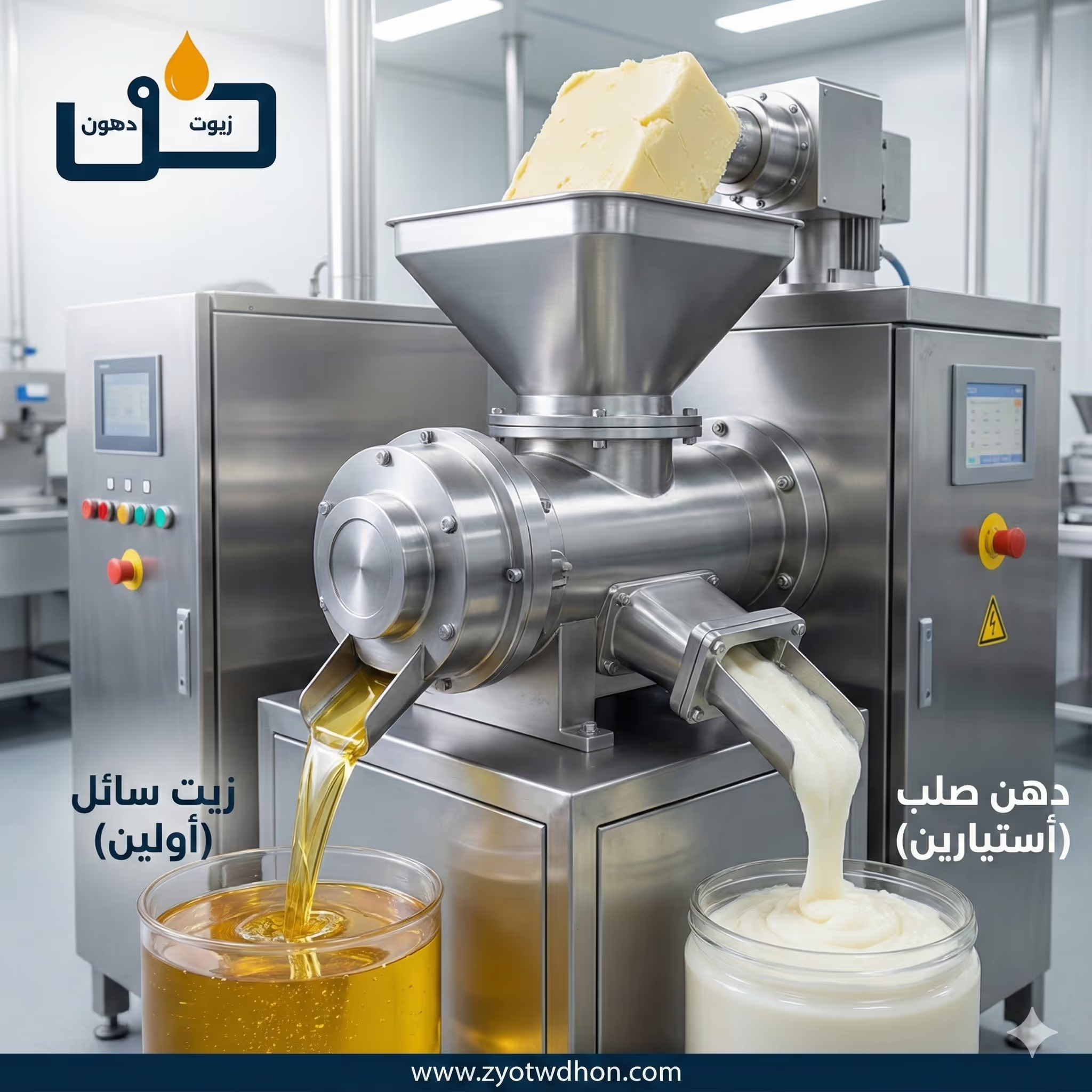
Fractionation is a completely physical process that depends on the difference in the melting points of triglycerides found in oil. It consists of three basic stages:
Cool the oil gradually To control crystal growth.
Crystallization of solid fat (Stearin) Which contains higher levels of saturated fatty acids.
Separation of crystals from the liquid part (Olein) using filtration or centrifuges.
The cooling rate is one of the most important factors. Slow cooling produces larger and more uniform crystals, improving separation efficiency, while rapid cooling leads to small, weak crystals that reduce the quality of the process. The exact technical values — such as cooling rates and ejection speed — vary depending on the type of oil and equipment used, so the figures are usually estimates rather than fixed.
📊 Types of segmentation used in the industry
There are three main techniques that differ in accuracy and cost:
1. Dry Fractionation
Without using any solvents or chemicals
It is the most used method industrially.
It relies only on cooling and filtration without solvents.
Low cost and environmentally friendly.
2. Solvent Fractionation
Provides higher purity for separated fatty ingredients.
Used in applications that require high precision such as chocolate and special desserts.
They require safety precautions and more sophisticated equipment.
3. Detergent Fractionation
Used in research and specialized applications.
It provides accurate separation but is less widespread synthetically.
⚖️ Why is fractionation a better alternative than hydrogenation?
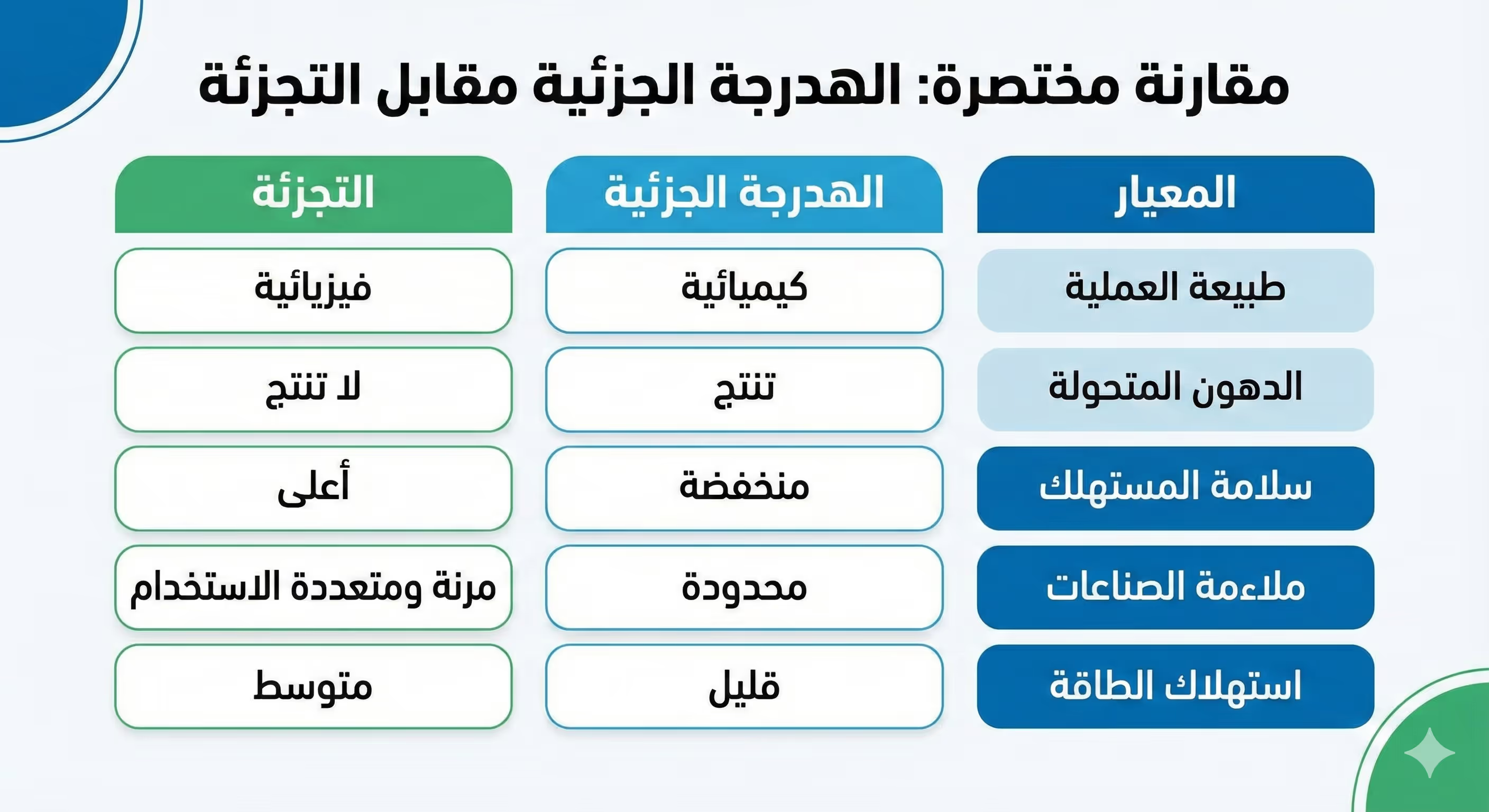
Partial hydrogenation is a chemical process that changes the composition of oil and produces trans fats with documented health risks. Segmentation is a purely physical process:
It does not produce trans fat.
Do not change the natural composition of fat.
It offers different hardness grades suitable for wide industrial applications.
It gives good thermal stability without additives.
A brief comparison
🚀 The technical development that has enhanced the position of retail
Recent years have seen significant advances in retail technologies, including:
1. Advanced cooling systems
Finer control of the thermal curve.
Improve crystal growth and increase separation efficiency.
2. High performance separation equipment
fine membrane filters.
centrifuges provide fast separation and higher efficiency.
3. Multi-stage segmentation
Producing several grades of stearin and olein from the same oil.
Providing customized products for specific types of industries.
4. Digital monitoring and smart control
Measurement of viscosity and density during the process.
Improve quality and reduce waste using smart control systems.
💚 Health and economic benefits
health benefits
Exclude trans fats from food products.
Providing more stable natural fats for industries aimed at children and adults.
Improve the quality of fat used without the need for chemical changes.
Economic benefits
Make optimal use of tropical oils with abundant production.
Improve the shelf life of products.
Reducing dependence on animal or hydrogenated fats.
The possibility of allocating fractionated fats to different applications, expanding production flexibility.
⚠️ Technical challenges and limitations
Challenges:
The need for high initial investments in refrigeration and separation systems.
Energy consumption due to repeated cooling processes.
Failure to reach a 100% separation rate in commercial factories.
RESTRICTIONS:
Preferring oils rich in saturated fats to achieve better results.
The need for a large operational space.
The difficulty of applying fractionation to low-hardness oils.
🌴 The most important oils that are indivisible
Palm oil: Most used globally for technical and economic reasons.
Palm kernel oil: Suitable for cocoa butter substitutes and desserts.
COCONUT OIL: It offers hard fractions for ice cream and special baked goods.
Cocoa butter: To produce high quality CBE/CBR alternatives.
Other oils: Like shea, and some medium-chain oils.
🏭 Most important industrial applications
Vegan ghee free of trans fat.
Chocolate and cocoa butter substitutes.
baked goods, pies and texture improvement.
Highly stable frying oils.
Plant-based dairy products such as ice cream and creams.
Advantages of fractionation compared to partial hydrogenation
1. From a health perspective:
It does not produce trans fats, other than partial hydrogenation.
It maintains the natural structure of fat without introducing new chemical bonds or reactions.
It contributes to reducing the risk of heart disease and lipid disorders in the blood when used within a balanced diet.
2. From a technical and operational perspective:
It allows obtaining different degrees of hardness and thermal stability to suit every industrial application (baked goods, frying, chocolate, vegetable ghee...).
Improves texture and texture properties without the need for complex synthetic additives.
It has been able to produce custom fatty ingredients (fractures) that support the development of new products with higher functionality.
3. From an economic and marketing perspective:
Maximize the use of tropical oils and natural oils by separating them into multi-valuable ingredients.
It helps factories comply with modern health legislation, opening the way to enter new markets that are more stringent in their standards.
It enhances the brand image by offering products that are “free of trans fats” and keeping pace with consumer trends towards healthy food.
📌 Most important recommendations:
Reevaluating product formulations that were based on hydrogenated fats and replacing natural fats that were produced in retail.
Investing in retail technologies (cooling equipment, crystallization systems, and separation methods) in line with production volumes and future expansion plans.
Cooperating with expert houses and technical suppliers to develop custom formulations for each production line (baked goods, frying, chocolate...) that achieve a balance between performance, cost and health.
Focus on marketing awareness by highlighting a phrase such as: free of trans fats and based on naturally fractionated oils in advertising materials and posters in order to enhance consumer confidence.
Follow up on international and local legislative developments regarding trans fats and food labels to ensure that products comply with regulatory developments and market opportunities.
With this approach, retail becomes not just a manufacturing technology, but a strategic tool to build safer and more competitive products that keep pace with the future of the food oil and fat industry.
Summary
Retail technology is a paradigm shift in the manufacture of dietary oils and fats. It has enabled factories to gradually eliminate hydrogenated fats and replace them with natural alternatives that are more stable and safer for consumer health. With the continuous progress in thermal control techniques, crystallization, and smart separation processes, retail is today one of the main pillars in the design and formulation of oils for different applications. It is expected that dependence on it will increase with the increasing global demand for healthy products that comply with international standards and legislation.
 Advertise