 Advertise

Note: This article was AI-translated from Arabic and is currently under manual review. The author is not responsible for any translation errors. Please refer to the original Arabic text for the most accurate and authoritative information.
Are you sure that the oil you sell or buy is pure... or is the appearance deceptive?
In a market full of fraud, mixing and quality manipulation, color, smell, or even price are no longer sufficient to judge the authenticity of an oil. Here comes Gas Chromatography (GC) Fatty Acid Analysis As a crucial scientific tool, it detects fraud, proves purity, and documents the credibility of a product in front of customers and suppliers.
Whether you are a trader, importer, manufacturer or keen buyer... this analysis is your real guarantee before making a deal. Don't rely on an impression... rely on analysis.
Dietary oils and fats are essential ingredients in our daily diet. They are not just a concentrated source of energy, but contribute to the absorption of fat-soluble vitamins, the formation of hormones, and the maintenance of cell membrane integrity and vital functions. With this great diversity of oil sources (vegetable and animal), and its composition affected by agricultural and climatic conditions, manufacturing and storage processes, there is a need for accurate analytical tools that ensure their quality and purity and detect any manipulation or fraud that may endanger the consumer.
Among these tools, gas chromatography takes a special place. It has truly become the cornerstone of the world of fat analysis because it allows us to see "Fat Fingerprint" of each oil with high accuracy, understanding its true composition away from any formal or marketing effects, making it the bridge between science, credibility and quality in oil and fat products.
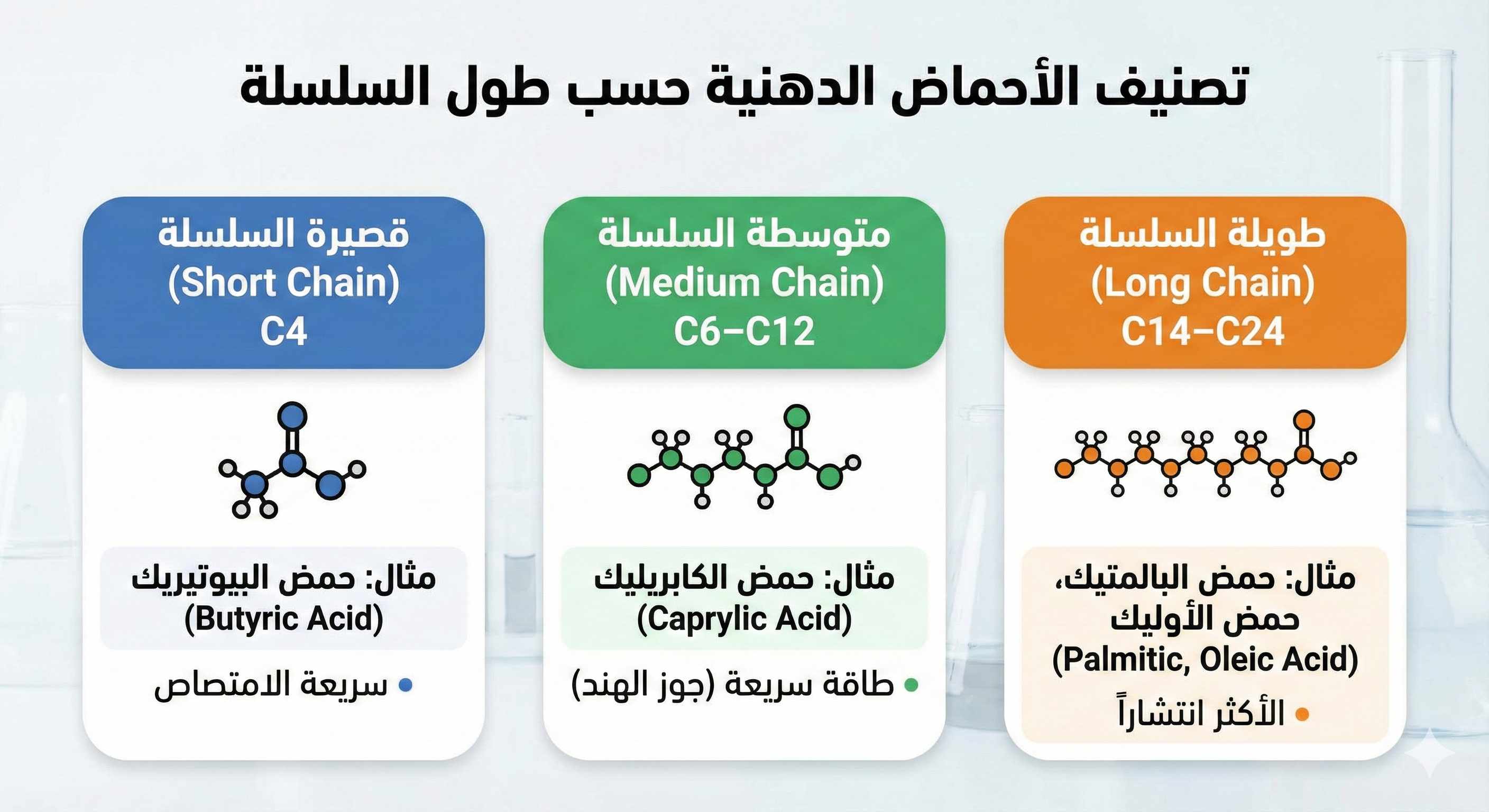
Fatty acids are organic compounds that consist of a hydrocarbon chain ending in a carboxylic group (—COOH). They are the main component of fats and oils.
The following infographic shows the classification of fatty acids based on the length of the carbon chain:
Gas chromatography is a physical separation technique based on the volatilization of sample components and their transformation into the gas phase, and then transported by an inert carrier gas (such as helium or hydrogen) through an accurate and long separation column. The inside of the column is coated with a specific material called the stationary phase. Each substance in the sample interacts with this stationary phase with a different affinity, slowing its passage to varying degrees, and therefore separating them based on their boiling point and polarity, causing them to elute one by one at characteristic retention times.
Fatty acids are characterized as semi-volatile compounds, making them ideal candidates for GC analysis. Each appears on the device as a peak on a graph called a chromatogram. The identity of a fatty acid is determined by its retention time, matched against reference standards, and its relative concentration is calculated by measuring its peak area, ultimately giving us an accurate digital fingerprint of the complete composition.
The analyst faces a major challenge: free fatty acids, especially long-chain ones (such as arachidic acid C20:0), have a high boiling point and high viscosity, making their direct separation by GC inefficient and resulting in broad, diffuse peaks that are difficult to measure.
Here comes the crucial step that precedes the analysis: the methylation process. It is a chemical reaction that converts fatty acids (whether free or linked to glycerol in the form of triglycerides) into Fatty acid methyl esters (FAMEs).
In short: Methylation is the "translation step" that converts the complex language of fatty acids into a simple and precise language perfectly understood by gas chromatography instruments.
The fatty acid profile of each oil represents its "molecular identity" or distinctive chemical fingerprint. The following chart shows the fundamental differences in the composition of some common oils:

Any deviation from the expected pattern of this fingerprint acts as an alarm bell:
There is no fixed formula for vegetable oil. Its chemical fingerprint is affected by:
Therefore, very narrow standards may unfairly penalize a pure natural product simply because it was grown in a different environment.
Here is the pivotal role of the Codex Alimentarius of the United Nations (FAO/WHO). The authority publishes internationally approved reference tables (such as standard CXS 210-1999) that define acceptable ranges for the fatty acid composition of each oil, based on thousands of samples worldwide.
Analysis is not limited to traditional GC. Today, Mass Spectrometry as detector (GC-MS) is used to confirm the identity of unknown peaks with absolute accuracy. High-precision separation columns (such as CP-Sil 88) are also used to separate geometric isomers (cis/trans) of unsaturated fatty acids, which is critical in health assessment. Automation of the methylation and analysis process is also being adopted to increase productivity and accuracy.
The complete separation of some complex mixtures (such as all omega-3 acids in fish oil) remains a technical challenge that requires improving separation programs and selecting appropriate columns. Additionally, analyzing free fatty acids only does not detect some sophisticated types of adulteration, which calls for complementary techniques such as High Performance Liquid Chromatography (HPLC) for triglyceride analysis.
Verifying the accuracy of separation and measurement of fatty acids is a crucial step to ensure the reliability of results. The performance of Gas Chromatography with Flame Ionization Detector (GC-FID) is evaluated through two main criteria:
It measures the ability of a system to separate two adjacent peaks (such as C18:0 and C18:1). A resolution value of 1.5 or more indicates complete and acceptable separation, while values less than 1.0 indicate unacceptable overlap. This value is affected by column efficiency and the temperature gradient program.
It is measured by how close the result is to the true value by:
These are routine tests prior to analysis that ensure the readiness of the instrument and method, the most important of which are:
The application of these comprehensive standards ensures that the results obtained are accurate, reliable, and dependable in evaluating the purity of oils and detecting any changes or adulteration.
The analysis of fatty acids by gas chromatography is not just a routine step in the laboratory. It is an advanced scientific defense to protect consumer health and maintain market integrity. It is the technology that transforms what is happening in the molecular world into clear figures and data that can be relied upon in decision-making; the decision to sell and buy, the decision to accept or reject, and the decision to trust or doubt any oil product put on the market.
However, the power of these data is complete only when read and interpreted consciously and wisely, within a flexible and fair scientific and legislative framework that takes into account the natural diversity in the composition of oils between one region and another, and between one season and another, without injustice to an honest product or tolerance for an adulterated one. Here comes the role of international standards, especially those issued by the Codex Alimentarius Commission, to constitute a reliable reference that ensures the standardization of evaluation and examination worldwide.
At the heart of this system is the expert in laboratory analysis as the crucial human element. The success of the analysis does not depend only on the accuracy of the equipment, but also requires an expert eye that knows the nature of the oil, its source, the conditions of its production and storage, and can link the digital results to their realistic context. The expert's understanding of the differences between virgin and refined oils, traditional and improved oils, and local and imported oils transforms the chromatogram from a mere curve into an integrated story about the origin, history and quality of the oil.
Thus, the analysis of fatty acids by gas chromatography becomes more than a laboratory technique. It is a bridge linking laboratory accuracy, fair legislation, analyst expertise, market reality, transparency of information, and consumer safety — to ultimately be a real tool for building sustainable confidence in our food and what is served on our tables every day.