 Advertise
Note: This article was AI-translated from Arabic and is currently under manual review. The author is not responsible for any translation errors. Please refer to the original Arabic text for the most accurate and authoritative information.
One of the most common images in people's minds is that solid fats in food enter the body as they are, then settle inside the arteries because they don't melt at body temperature. Some picture a piece of hardened butter, a firm animal fat, or a fatty layer that cooled on top of food, and imagine that something similar might happen inside the blood vessels.
But this picture is scientifically inaccurate. The body is not a small frying pan, the blood is not a bottle of oil, and the arteries are not tubes through which fat passes the way we see it on the table. Fats do not enter the blood as solid pieces, nor do they travel through it as free droplets of oil, nor do they freeze in the arteries simply because some of their fatty acids have a melting point higher than body temperature.
What actually happens is far more organized and complex. The body receives fats, breaks them down, digests them, absorbs their products, then repackages them into special transport particles suited to movement within the blood, because blood is a watery medium that does not allow oil to move through it freely the way it moves on the surface of soup.
So the correct question is not: did the fat melt at 37 degrees Celsius? But rather: what does the body do with fat from the moment it enters the mouth until it reaches the cells?
Fat is not something to be feared in all circumstances; it is an essential nutrient that supplies the body with energy, contributes to building cell membranes, and helps absorb fat-soluble vitamins such as vitamins A, D, E, and K. Some fatty acids also take part in functions related to immunity, inflammation, the brain, and the nervous system.
Fats also play an important role in food itself; they give food its texture, flavor, and sense of satiety, and they go into the making of many food products. But the problem is not the presence of fat, but rather its type, quantity, quality, and manner of use.
It is important here not to confuse two things: correcting the myth of "fat freezing in the arteries" does not mean that saturated fat can be consumed without limits, and recommending its reduction does not mean demonizing it entirely. What is required is understanding the vital role of fat, then balancing between saturated fats, monounsaturated fatty acids such as oleic acid, and polyunsaturated fatty acids such as omega-3 and omega-6, while avoiding industrial trans fats as much as possible.
Most of the fat we eat exists in a form called triglycerides. It can be simplified as a molecule that carries three fatty acids. These acids may be saturated or unsaturated, short- or long-chain, and each has different characteristics.
A limited part of fat digestion may begin in the mouth and stomach, but the most important stage takes place in the small intestine. Here the fundamental truth emerges: the body does not rely on body heat to melt fat the way it happens in cooking, but instead uses a specialized biological system of bile salts and enzymes.
The first important step is the arrival of bile salts, substances made by the liver and stored in the gallbladder. These salts do not digest fat chemically, but they play an important role in breaking large fatty masses into very small droplets, in a process called emulsification.
To simplify the idea with this example: when you see a large oil stain on top of water, you find it separate and clear. But if this stain turns into many small droplets, dealing with it becomes easier. This is what happens inside the intestine; fat turns into fine droplets that increase the area on which enzymes can work.
After that comes the role of the pancreatic lipase enzyme, which breaks triglycerides into smaller parts, the most important being free fatty acids and monoglycerides. These products then become more ready for absorption.
So fat does not remain as it was on the plate. A piece of butter or a spoon of oil does not travel inside the body in its original form, but its form changes inside the digestive system step by step.
After fat is broken down, another problem appears: the products of fat do not dissolve easily in water, while the intestine, blood, and lymph are watery environments. So the body uses a precise mechanism called micelles.
Micelles can be likened to small boats that carry the products of fat to the surface of the intestinal cells where they can be absorbed. After these products enter the intestinal cell, they are not left randomly nor pumped into the blood as free oil; instead the body reassembles a large part of them, then packages them into special transport particles called chylomicrons.
A chylomicron can be simplified as a "biological transport container" that carries fat inside it, with components on its surface that help it move within the lymph and blood. In this way the body can transport fat through a watery medium in an organized manner, instead of leaving it as free droplets of oil.
And this is a very important point: the fat that reaches the blood is not the same form we saw in food. It has passed through a stage of digestion, absorption, and repackaging. So it is not correct to imagine it as raw fat that enters the artery and sticks to it.
As for some short- and medium-chain fatty acids, they have a relatively simpler path, as they can move directly to the liver via the portal vein, often bound to proteins in the blood, without needing chylomicrons to the same degree as long-chain fats.
One of the most widespread ideas is that the body must melt fat with its heat. So if body temperature is around 37 degrees Celsius, and someone reads that a saturated fatty acid melts at 40, 50, or 70 degrees Celsius, they may think this acid will not dissolve inside the body, and therefore may settle in the blood vessels.
This is an incorrect understanding. Melting point is important in the science of oils and fats, because it explains why some fat is solid at room temperature and why some oil is liquid. But it is not the only thing that determines how the body digests fat or how it transports it.
A fatty acid in food does not usually exist alone as a pure solid piece, but is part of a complete food and a mixed triglyceride. It then enters a process of emulsification, enzymatic digestion, micelle formation, absorption, and repackaging. So the body does not expect a fatty acid to melt on its own at 37 degrees, but deals with it through an integrated digestive system.
Simply put: digestion is not a melting experiment in a lab tube, the arteries are not a refrigerator, the blood is not a vessel of oil, and atherosclerosis is not a direct freezing of fat.
The example of stearic acid is mentioned here, a long-chain saturated fatty acid with a relatively high melting point. Nevertheless, its digestibility and absorption do not depend on its melting point alone, but on the form in which it exists within the fat, on the nature of the food that contains it, and on the digestion and absorption process itself.
Correcting the idea of fat freezing does not mean that excessive saturated fat is harmless. The difference here is very important. Saturated fat does not enter the arteries as raw fat that freezes on their walls, but with chronic excess it may, in many people, contribute to raising the level of certain lipoproteins, foremost among them LDL, popularly known as bad cholesterol.
LDL is not a piece of fat from food, but a particle that transports cholesterol in the blood. When some of its particles rise, along with other factors such as inflammation, oxidation, high blood pressure, diabetes, smoking, obesity, and lack of movement, these particles may enter the artery wall and react within it. Over time, plaques may form that lead to narrowing of the arteries or an increased risk of clots.
So atherosclerosis is not fat that froze inside a tube, but a long and complex process involving food, genetics, lifestyle, blood lipids, inflammation, and blood vessel health.
From here comes the balanced message: we do not fear fat as a whole, nor do we believe it freezes in the arteries, but we also do not overdo saturated fat; it is preferable to reduce the excess of it, and to have a good proportion of it represented by excellent unsaturated fat alternatives, along with improving the entire lifestyle.
It is common to say that oils are liquid and fats are solid. This is often true, but it is not enough to judge health value. Olive oil, for example, is liquid and rich in oleic acid, a monounsaturated fatty acid. Some other vegetable oils are rich in polyunsaturated acids. In contrast, butter, ghee, lard, and some tropical fats are relatively more solid due to a high proportion of saturated fat.
But there are exceptions. Palm oil is plant-based yet relatively semi-solid (and the Malaysian Palm Oil Board works to support its research and develop its industrial standards), and fish oils are of animal origin yet rich in omega-3 acids. Liquid oil is also not always healthy if it is exposed to repeated heating or poor storage, because oxidation and quality deterioration can turn a good oil into an unsuitable choice.
So it is not enough to ask: is it plant-based or animal-based? Liquid or solid? We must ask: what is its composition? What is its quality? How was it stored? How was it cooked? How much do we eat of it? And what is its place within our daily diet?
Saturated fatty acids have straighter chains, so they tend to pack together and become solid. Unsaturated fatty acids have bonds that make the chain more curved, so they are usually more fluid.
But this should not be turned into a rigid rule: "saturated is always bad, and unsaturated is always good." The truth is that health depends on balance. Saturated fats should remain within moderate limits, and unsaturated fats should be predominant, from good and varied sources.
As for industrial trans fats, especially those produced by the partial hydrogenation of oils, they are the most concerning, because they are linked to increased cardiovascular risks. So it is preferable to avoid products containing partially hydrogenated oils as much as possible, and to read nutrition labels carefully.
After clarifying the differences between saturated, unsaturated, and trans fats, it becomes important to view saturated fats through a balanced scientific lens. They are not an absolute evil, nor are they a type that can be overconsumed without consequences. They contribute, along with other fatty acids, to building cell membranes and giving them a degree of structural stability, while unsaturated fats provide the flexibility and fluidity needed for efficient cellular functions.
The role of fat is not limited to producing energy or entering into the composition of membranes, but extends to forming the adipose tissue that acts as a protective cushion around some vital organs, such as the kidneys, heart, major vessels, and the eye. This tissue helps absorb shocks, fix some organs in their positions, and provide a degree of thermal insulation. Nevertheless, increased accumulation of fat around organs may be associated with health risks, especially heart and metabolic diseases.
So the issue is not eliminating saturated fat entirely, but controlling its quantity and sources within the overall dietary pattern. The World Health Organization recommends that the fat consumed, for those aged two and above, be primarily from unsaturated fats, with saturated fat not exceeding 10% of total energy, and trans fats remaining below 1%. In a simplified practical form, total daily fat can be in the range of about 30% of energy, with the larger proportion allocated to unsaturated fats, such as monounsaturated fatty acids, including oleic acid in olive and canola oil, and polyunsaturated fatty acids, including omega-3 and omega-6.
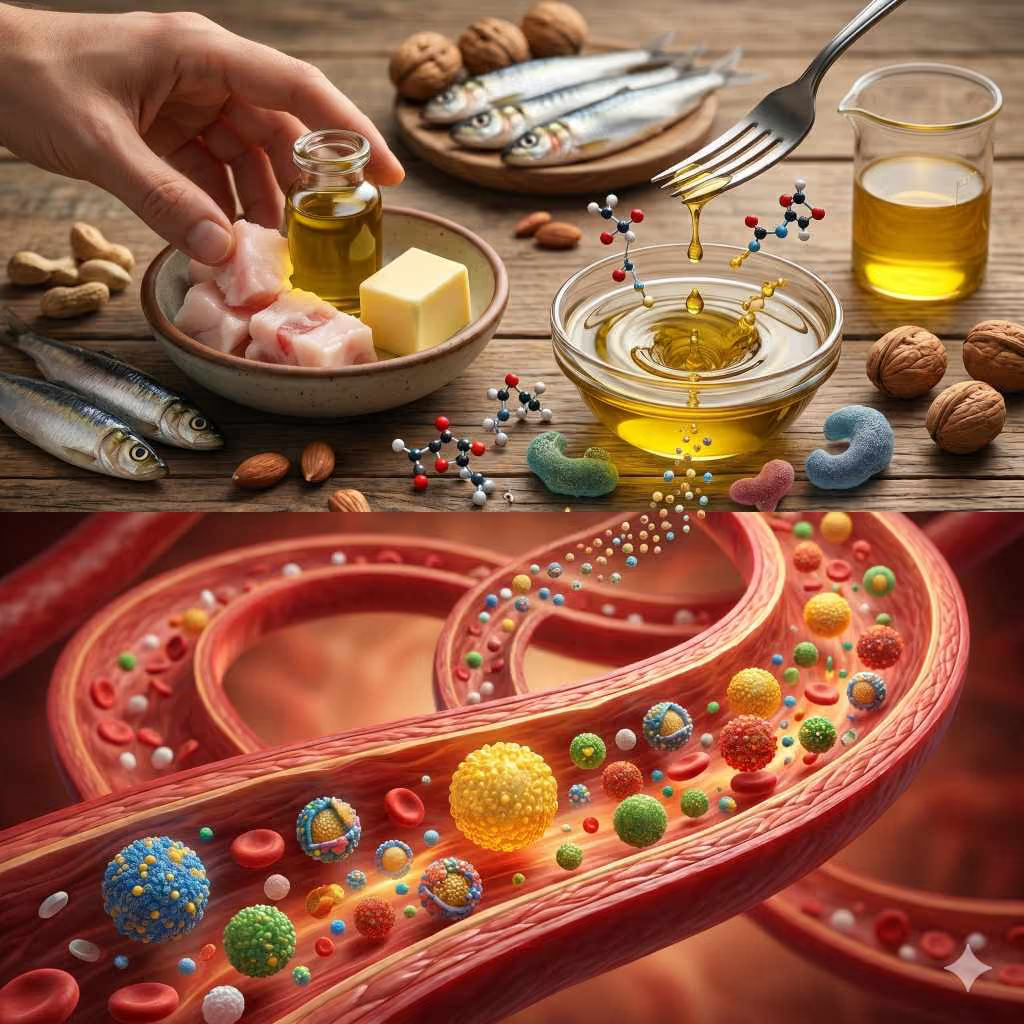
The following explanatory infographic helps simplify the idea visually for the site's readers:

Omega-3 and omega-6 are important fatty acids the body needs. Omega-6 is found in many vegetable oils and seeds, and omega-3 is found in some plant sources, as well as in significant forms in fatty fish such as sardines, mackerel, and salmon.
But omega-3 should not be portrayed as a magic solution, nor should omega-6 be demonized. Both have a role, and what matters is variety, balance, and not over-relying on a single source. It is best for the consumer to care about the quality of the entire diet, not just one component or one capsule.
The right choice does not mean banning fat from food, but using it sensibly. It is preferable that unsaturated fats predominate in the daily diet, from sources such as olive oil, canola oil, suitable vegetable oils, nuts, seeds, and fish. In contrast, it is preferable to reduce saturated fats, especially from high-fat or ultra-processed products, and to avoid industrial trans fats as much as possible.
In cooking, the nature of each oil must be respected. Some oils are better suited for salads and cold use, some tolerate moderate cooking, while long and repeated frying accelerates the deterioration of any oil. Storing oils in a hot place or one exposed to light and air also weakens their quality.
Balance is not measured by a single meal. A meal may contain some saturated fat without being a problem if the overall diet is balanced, rich in vegetables, whole grains, and good proteins, and dominated by unsaturated fats. But relying daily on fried foods, solid fats, and processed products may upset this balance, even if the quantities seem small each time.
Fat does not enter the body as we see it on the plate, nor does it travel in the blood as a layer of oil, nor does it settle in the arteries because it did not melt at body temperature. It passes through a precise journey that begins with emulsification in the intestine, then enzymatic digestion, the formation of micelles, absorption inside the intestinal cells, then repackaging into chylomicrons and lipoproteins, reaching the tissues where it is burned, stored, or used to build cells.
As for atherosclerosis, it is not a simple freezing of fat, but a chronic process involving blood lipids, inflammation, oxidation, the lining of the vessels, genetic factors, lifestyle, and the quality of food.
From here, the most important question becomes not: does this fat dissolve at body temperature? But rather: what is its type? What is its quality? What is its quantity? How was it used? And what is repeated in our diet day after day?
Fat is not understood by its solidity on the plate, nor by its melting point in the lab, but by its journey inside the body: how it is digested, how it is transported, how it is used, and how we choose it wisely. Food, in the end, is not merely a taste that satisfies us, but daily knowledge that builds our health step by step.