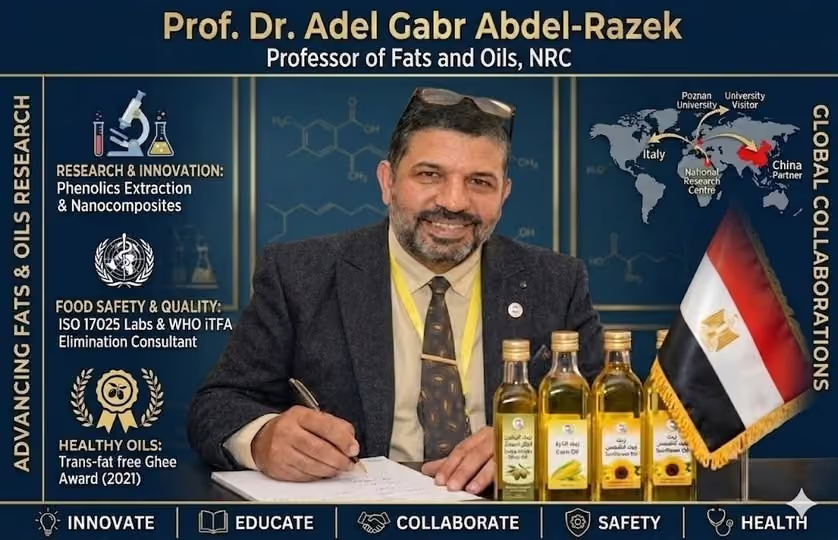
Professor of Oils and Fats at the National Research Centre; Vice-President of the Egyptian Food Safety Association; WHO National Consultant for the iTFA programme.
Publication Date:
January 2, 2026
·
—
Note: This article was AI-translated from Arabic and is currently under manual review. The author is not responsible for any translation errors. Please refer to the original Arabic text for the most accurate and authoritative information.
The journey of a food ingredient that has gone from demonization to science and appreciation
Late patent... but due!
For decades, fats and oils have been sentenced to dietary death!
She was accused of being the first enemy of the heart and arteries, and the main defendant in the crimes of obesity, stress and diabetes. People ran away from it and adopted the slogans of “fat-free” and “zero fat”, thinking that health lives in deprivation.
However, modern science today opens the case file again and offers a fair trial in which it removes these vital ingredients from the indictment cage and submits them to the honoring platform, not only as nutrients, but also as one of the most promising therapeutic and cosmetic weapons in modern medicine.
What was considered an enemy yesterday... turned out to be the silent doctor in your body.
What you've been avoiding for fear of your health... may be the secret to your health and longevity.
In this article, you'll learn how fat has gone from “demonizing ignorance” to “honoring science,” and how it has become nature's forgotten pharmacy that supplies life to our cells.
Chapter 1: The three major mistakes in our use of fat
Before we judge fat, we should understand how we abused it.
First mistake: trans fats (the real enemy)
The product of industrial hydrogenation processes that convert liquid oils into solid fats.
It raises bad cholesterol (LDL) and lowers good cholesterol (HDL).
The World Health Organization recommends that no amount of partially hydrogenated oils be consumed at all, and that the proportion of artificially trans fatty acids (IFA) should not exceed 2%, other than natural ones (found in milk fat and animal fats) in total fat in the food.
The second mistake: the imbalance between omega-6 and omega-3
Too much omega-6 (from refined vegetable oils) causes chronic inflammation.
The ideal balance is (4:1) between omega-6 and omega-3. The lower value in the equation, which represents the number one, relates to the percentage of omega-3 fatty acids and the higher number represents the percentage of omega-6 fatty acids.
In modern diets, the ratio is (20:1), which is an imbalance that weakens immunity and increases chronic diseases.
Mistake 3: Thermal Abuse
Exceeding the “smoke point” turns oil into toxic oxidizing compounds.
Reusing oil for frequent frying in excess of normal limits produces harmful compounds that may be toxic or may even be carcinogenic when the limits of normal use are exceeded.
The higher the cooking temperature and time, the lower the nutritional value of the oil.
Chapter 2: The Scientific and Biologic Basis of Lipids
After clarifying the mistakes, let's learn about the true scientific face of fat and its vital role in our lives.
What's the difference between fats and oils?
fat: solid at room temperature (like butter and ghee).
oils: liquid at room temperature (such as olive and corn oil).
The fundamental difference: At the point of saturation, saturated fats tend to harden, while unsaturated fats remain liquid.
Chemically, both are in the “triglyceride” family, but the type of fatty acid determines the health impact.
The vital roles of fat in the body
cellular building blocks
It forms the basic material of cell membranes and determines their elasticity and function.
hormone regulators
It is involved in the synthesis of estrogen, testosterone and cortisol and regulates mood and energy.
Sustainable and smart fuel
It provides the body with 9 calories per gram and keeps blood sugar stable.
The key to vitamin absorption
Vitamins (A, D, E, K) are absorbed only in the presence of fat.
Brain and mood food
60% of brain synthesis is fat, and omega-3 (DHA, EPA) improves memory, concentration and mood.
🌿 Chapter 3: From Food to Medicine - Oils as a Natural Pharmacy
Oils and fats are no longer just food ingredients... but integrated therapeutic and cosmetic tools.
1. In preventive and curative medicine
Omega-3 acids reduce inflammation and protect the heart and joints.
Olive oil, which is rich in polyphenols, is used as an antioxidant and cholesterol stabilizer.
2. In complementary skin nutrition (in cosmetic and skin care)
The benefits of oils and fats are not limited to nourishing the body from within, but also extend to serve as an external complementary food for the skin and skin, reflecting the Prophet's wisdom in the words of the Prophet (peace and blessings of Allaah be upon him) about olive oil:
“Eat oil and paint it with it. It is from a blessed tree.”
Just as eating it nourishes the body, fat nourishes the skin from the outside.
Natural oils (such as olive oil, jojoba, and sweet almond) work to rebuild the skin's natural lipid barrier, promoting its health and protection.
These oils help renew skin cells and reduce dryness and skin inflammation in order to maintain its freshness and vitality.
Essential fatty acids (such as linoleic and linolenic acids) are key to keeping skin young and shiny and strong.
3. In sports performance
The medium-chain fat (MCT) in coconut oil is a fast and safe source of energy for athletes.
🍳 Chapter 4: The Practical Guide to Healthy Fats
Having understood the value, let's now learn the proper usage.
Types of fat and their health impact
Safe usage guide
In daily cooking
Extra virgin olive oil: for mild cooking and salads.
Oleane oil: withstands high heat in frying and roasting.
Flax oil: for cold use only and as a source of omega 3.
In the daily diet
One to two tablespoons of healthy oil for each main meal.
Two servings of fatty fish per week.
A handful of unsalted nuts per day for those who have access to them.
In storage
Keep oils in dark sealed containers away from light and heat.
Do not buy large quantities at once and choose the appropriate packaging size for your consumption in order to avoid oxidation.
⚙ CHAPTER 5: FAT IN MODERN LIFE
Between tempting ads and fast food, scientific truth is lost.
Fast food: the hidden danger
It is cooked with refined, low-quality oils that are reused over and over again without controls.
They contain trans fats and oxidizing compounds that strain the liver and weaken the heart.
Practical tips for young people:
Choose grilled instead of fried.
Order sauces on the side.
Add olive oil instead of mayonnaise.
Remember that speed does not mean quality, and health requires awareness rather than long time.
The latest scientific research
Functional oils: olive and sesame oil, which are rich in polyphenols, as protective agents for the heart.
Medium-chain fat: instant energy that is safe for athletes and ketogenic diets.
High-oleic oils are more thermally stable and are used as a healthier alternative in the food industry.
How do you read labels smartly?
Avoid: “Partially Hydrogenated” or”Hydrogenated”.
Look for: “Virgin”, “Cold Pressed”.
Be careful: “Cholesterol free” are promotional words (all vegetable oils are naturally cholesterol-free).
Chapter 6: Frequently Asked Questions
Do I need omega-3 supplements?
Start with food first: fatty fish, flax seeds, and walnuts. Supplements are only when needed and under the supervision of a doctor.
Is coconut oil healthy?
It contains medium-chain fat (MCT) that is quick to digest and energy, but is not used as an essential oil for daily cooking.
How does fat affect mood?
Omega-3 deficiency is linked to depression and stress, while healthy fats balance happiness hormones (serotonin and dopamine).
💬 Conclusion: From demonization to awareness
At the end of the journey, we discover that fat has never been an enemy... it was the language of life that we did not understand well.
It is not a dietary luxury, but a messenger of biological wisdom that carries energy, medicine and balance.
Between excess and negligence... lies the golden equation: conscious choice.
A good spoonful of oil may nourish your cells for years, and a bad spoon may exhaust your heart in days.
Fat does not threaten life... it revives it when we understand it.
Let us make science our balance, awareness our weapon, and fat our gateway to health that is reconciled with nature.
Disclaimer: This article is for scientific education. It does not replace consulting a doctor or a nutritionist, especially for patients with heart disease, diabetes and lipid disorders.
 Advertise