 Advertise
Note: This article was AI-translated from Arabic and is currently under manual review. The author is not responsible for any translation errors. Please refer to the original Arabic text for the most accurate and authoritative information.
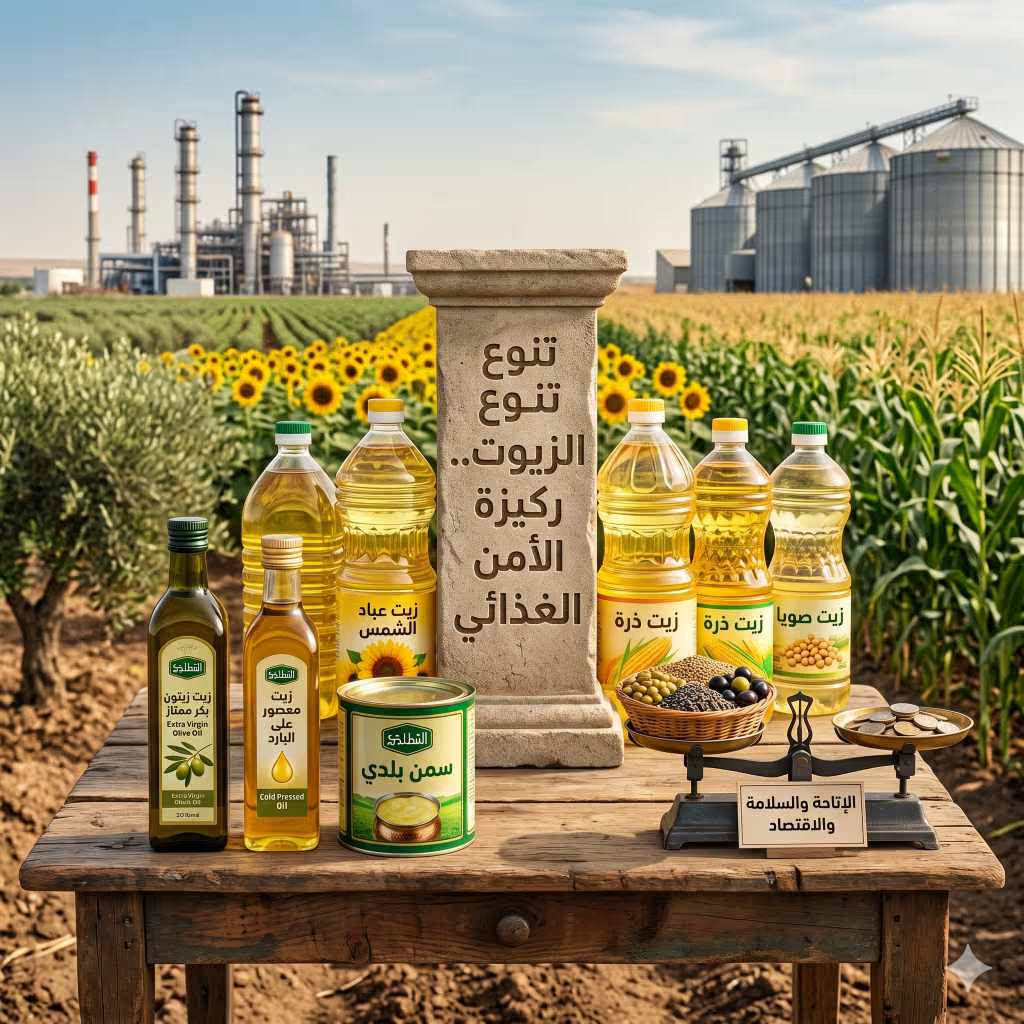
Virgin, Cold-Pressed, and Refined Oils, and Animal Fats: Between Science, Economy, and Food Safety
The matter of edible oils and fats is not merely one of personal taste, nor is it a battle between a "luxury" oil and an "ordinary" one, or between virgin and refined oils, or between vegetable and animal fats. It is, first and foremost, a matter of science, economics, food security, food safety, and equitable access..
Many people, and sometimes even some specialists, confuse their personal preferences with the actual needs of communities. They conflate an individual's ability to purchase premium virgin or cold-pressed oil at a high price with a nation's capacity to supply millions of families with safe, stable, and year-round accessible edible oils.
Personal preference is an undisputed right; consumers are free to choose virgin olive oil, cold-pressed oil, refined oil, or traditional animal fat, based on their taste, culinary culture, financial means, health status, and cooking methods. However, the problem arises when these individual preferences are transformed into universal judgments to be imposed on society as a whole, as if the world could subsist on a single type of oil or one grade of fat.
The scientific and economic reality is that the world does not consume oils and fats in a single form, nor does it require them for a singular purpose. There are oils consumed cold, oils suitable for cooking, oils that can withstand various frying temperatures, oils used in food manufacturing, fats utilized in baked goods and sweets, and animal fats that hold cultural and nutritional significance in many societies. Each type possesses its own characteristics, applications, price point, market, and safety parameters.
It is erroneous to categorize edible oils into "premium" and "basic" in a hierarchical or promotional sense. Extra virgin olive oil holds its own unique place and value, particularly for cold applications or gentle cooking, where it preserves some of its natural components, flavor, and sensory qualities. Meanwhile,cold-pressed oils have their own audience and market value, as they are produced with minimal heat intervention, thus retaining certain natural compounds linked to their plant source.
However, this does not imply that refined oils are of lesser value in terms of overall function or food security. When produced according to stringent specifications and quality control, refined oil plays a crucial role in making oil accessible to millions at an affordable price, offering consistent properties, a neutral flavor, extended shelf life, and enhanced suitability for everyday use and food manufacturing.
Without refined oils, a significant portion of global consumption cannot be met, vast sectors of the food industry cannot operate, and markets cannot remain stable amidst production and trade fluctuations. Therefore, the question isn't: which oil is "the best" overall? Instead, the more precise question is: Which oil is most suitable for which application? Is it for salads? Light cooking? Frying? Baking? Storage? Manufacturing? Low-income families? Restaurants? Schools and hospitals? Or for long supply chains?
There's no doubt that virgin and cold-pressed oils represent a significant segment within the food oil system. They reflect the quality of the raw material, the nature of the plant source, and a greater emphasis on minimizing thermal and chemical treatment. Consequently, they are often associated with a positive consumer perception, especially when produced, packaged, and stored properly.
However, these oils are not a universal solution for everyone or every application. They are often more expensive, less capable of meeting massive quantitative demand, and more susceptible to the quality of the raw material, storage conditions, light, heat, and oxygen. Furthermore, some virgin or cold-pressed oils may not be the most suitable for deep frying or large-scale industrial processing.
This is where the importance of a sound scientific perspective emerges: Respecting these oils and appreciating their value without making them the sole criterion for judging all other oils.An excellent product in one context may not be practical in another. What suits an affluent consumer in a city close to organized markets might not be suitable for a low-income family, a mass catering institution, or a nation striving to secure the needs of millions of its citizens.
One of the most common misconceptions is to view the word "refined" as an absolute negative judgment. In reality, refining in the oil industry is not a flaw, but a technological process aimed at removing impurities, reducing undesirable compounds, improving color, aroma, taste, and stability, and making the oil more suitable for a wide range of applications.
Good refined oil is not inferior oil; rather, it is oil that meets specifications, undergoes control and monitoring processes, and serves a different purpose than virgin oil. While virgin oil retains certain sensory and natural characteristics, refined oil offers stability, consistency, shelf life, affordability, and the capacity for trade and manufacturing that are indispensable in the global market.
Without refined oils from soybean, sunflower, corn, canola, palm, cottonseed, and others, many countries would not be able to meet their daily oil requirements. These oils are used in home cooking, canning, baked goods, sauces, ready-to-eat foods, and extensive supply chains. As such, they are an integral part of food security, not merely a low-grade alternative.
The complete picture of dietary fats is incomplete without discussing animal fats, such as ghee, butter, and other fats traditionally used in cooking. These fats are not merely food ingredients; they are an integral part of food cultures and culinary heritage in many societies. They possess sensory and functional properties that differ from vegetable oils, particularly in flavor, texture, and certain cooking and baking applications.
However, a scientific approach to them must be balanced, avoiding both absolute demonization and absolute glorification. Animal fats can be appropriate within certain limits and as part of a balanced diet, but they are not a universal substitute for all oils. Moreover, their high saturated fat content necessitates awareness of usage and quantities, especially for certain health-conscious groups.
Therefore, the role of the expert is to guide, not to intimidate; to balance, not to generalize. Society does not need a dietary narrative based on absolute prohibition or absolute glorification, but rather a scientific understanding that positions each fat correctly, according to its appropriate use, thereby ensuring food safety and respecting dietary habits without compromising public health.
The world needs a wide variety of oils and fats:
This diversity is not a luxury, but rather an economic and nutritional necessity. Food security is not achieved with a single oil, a single oil crop, or a sole source of import or production. Relying on one type makes the market vulnerable to climate fluctuations, plant diseases, trade disruptions, rising shipping costs, wars, and crises. Diversifying oil sources—including sunflower, soybean, corn, canola, palm, olive, sesame, flaxseed, cottonseed, and others—provides countries with greater flexibility and a better ability to secure their needs. It also paves the way for nutritional and functional integration among oils that vary in their fatty acids and minor components.
The issue extends beyond imports; it also involves encouraging local cultivation of oil crops, improving per-acre productivity, developing pressing, extraction, refining, and packaging systems, utilizing the resulting oilseed meal in the feed industry, and fostering a strong link between agriculture, industry, and scientific research.
The diversity among edible oils isn't just about their varying sources, prices, and uses; it also encompasses their scientific integration in terms of composition and biological value. Oils differ significantly in their fatty acid ratios; some are rich in monounsaturated fatty acids, others have higher proportions of polyunsaturated fatty acids, while still others contain varying amounts of saturated fatty acids.
This highlights the importance of balancing saturated, monounsaturated, and polyunsaturated fatty acids, as well as optimizing the ratio between omega-6 and omega-3 fatty acids in the daily diet. Not all oils are identical in their nutritional impact or chemical composition, nor should they be seen as interchangeable substitutes in all situations. Instead, they should be viewed as complementary components that can be integrated based on specific uses, overall consumption, and prevailing dietary patterns.
This integration doesn't imply random oil mixing or making unsubstantiated health claims. Instead, it means that diversifying oil sources within the food system helps improve the overall dietary balance and reduces reliance on a single fat profile where one specific fatty acid might dominate at the expense of others.
However, the true integration among oils extends beyond just fatty acids. It also encompasses their minor components, which possess significant functional and biological value. These include tocopherols, plant sterols, phenolic compounds, natural pigments like carotenoids and chlorophyll, and other accompanying compounds that vary from one oil to another depending on the plant source, extraction method, storage, and processing.
These components, despite their small quantities, contribute to enhancing the oil's quality, efficiency, stability, and its nutritional and sensory value. They can also impart natural advantages to certain oils that are not equally present in others. Some oils are notable for their natural antioxidant content, others for a unique sensory value, color, or flavor, and some contain compounds that contribute to the oil's stability or functional distinctiveness.
Therefore, a sophisticated scientific perspective doesn't view oils as being in constant conflict. Instead, it shifts them from a logic of competition to one of integration. Each oil can contribute to overall balance, whether through its fatty acid composition or its minor component content, making oil diversity a tool for enhancing food quality and efficiency, rather than merely a commercial diversification in the market.
When discussing oils and fats, it's crucial to distinguish between two integrated concepts: Food safety andFood security.
An oil might be high-quality in terms of sensory attributes, but unavailable to most people due to price or scarcity. Conversely, an oil might be widely available and economically viable, but require strict oversight to ensure its safety and quality. Therefore, a responsible approach does not favor appearance or brand name, but rather combines safety, availability, price, shelf life, and appropriate use.
This is where the importance of standard specifications, quality analysis, oversight of storage, transport, and packaging, monitoring spoilage and oxidation indicators, preventing commercial fraud, and regulating marketing claims becomes evident. An oil is not good merely by its name or public perception, but by its adherence to scientific and regulatory standards that ensure its safety for the consumer.
An individual has the right to say: 'I prefer extra virgin olive oil.' Another has the right to choose sunflower oil, corn oil, traditional ghee, or cold-pressed oil. However, no one has the right to turn their personal choice into a universal rule applicable to everyone. Food choices are linked to income, habits, health, availability, geographical location, cooking style, family size, and storage capacity.
A true expert doesn't just ask: 'Which oil do I prefer?' Instead, they ask:
In this sense, oil and fat policy is not built on personal taste, advertising, or general impressions, but rather on consumption data, population needs, production capacities, supply chains, safety specifications, and the balance between quality, price, and availability.
The oil industry doesn't begin with the bottle or package, but with the seed, the field, the press, the factory, the laboratory, and the transport and storage chain. Every oilseed is a complete nutritional and industrial storehouse: it yields oil, meal used in animal feed, and secondary components that can be utilized in various industries.
Therefore, developing the oil industry represents a major economic opportunity. Instead of selling crude at a limited price or importing the final product at a high cost, an integrated system must be built that includes cultivating oil crops, collection, drying, storage, pressing, extraction, refining, packaging, quality analysis, and utilizing by-products.
This system provides job opportunities, improves farmers' income, supports the feed industry, reduces pressure on hard currency, and increases the state's ability to cope with global price fluctuations. The stronger the local industry, the greater society's ability to provide safe, diverse, and stable oils, rather than relying excessively on external sources.
Terms like "natural oils," "pure oils," "healthy oils," and "premium oils" are common in the markets. These terms may sometimes be accurate, but they are also sometimes used in a marketing manner that requires regulation. What is natural is not always safe just because it is natural, what is refined is not harmful just because it is refined, and what is virgin is not suitable for every use just because it is virgin.
The real point is not the slogan written on the package, but in the oil's source, extraction method, transportation, storage, packaging, shelf life, quality indicators, and compliance with specifications. A poorly stored virgin oil may lose many of its advantages, while a well-manufactured and handled refined oil may be more suitable for certain uses than a more expensive oil that is unsuitable for the intended purpose.
Therefore, consumers need awareness, the market needs oversight, the industry needs transparency, and scientific discourse needs accuracy to prevent both exaggeration and misinformation.
The criterion of prudence in matters of oils and fats is not to impose a single type on everyone, nor to reduce science to a personal preference or commercial propaganda. True prudence lies in building a system of oils and fats that is safe, diverse, available, and suitable for people's different uses, economic capabilities, and health and nutritional conditions.
Virgin and cold-pressed oils have their place, refined oils have their necessity, and animal fats have their context and prudent use. What unites them all is an indispensable condition: safety, compliance with specifications, oversight, good handling, and appropriate use.
Food security in the oils and fats sector will only be achieved if we move from the logic of emotional preference to the logic of a scientific system; from the question "Which oil do I like?" to the question "How do we provide safe, diverse, and suitable oils and fats for everyone?". The world does not feed its population through individual choices alone, but through science, production, manufacturing, diversity, oversight, and equitable access.
The message to specialists and the general public alike is that edible oils are not adversaries in a battle, but components in a system. The better we understand their properties, integrate their roles, control their quality, and guide their use, the more we will move from a market based on promotional competition to a food system based on scientific integration and civilizational advancement.