 Advertise
Note: This article was AI-translated from Arabic and is currently under manual review. The author is not responsible for any translation errors. Please refer to the original Arabic text for the most accurate and authoritative information.
Can you believe that most of what we hear about cholesterol... is closer to myth than science?
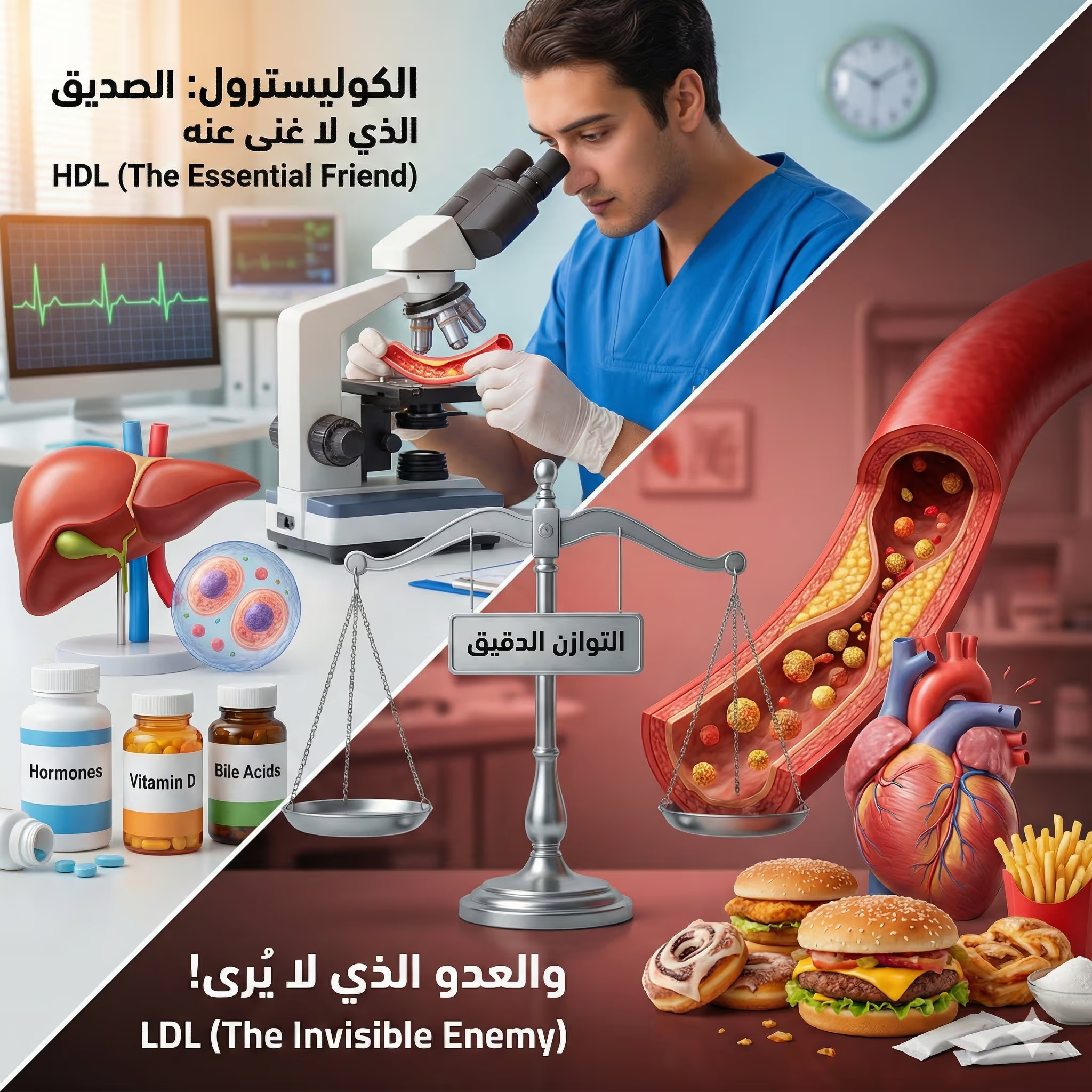
Among those who fear it as a “health bomb” and those who think it is just an annoying number in the analyses, the truth has been lost amid the noise. In fact, this permanent suspect is originally an unknown soldier without whom your cells do not exist. He is a key pillar in building hormones, vitamin D and bile. Yes... cholesterol is useful before it is dangerous, and necessary before it is a suspect.
However, the imbalance begins when the delicate balance between its types is disturbed. Its noble mission turns into a burden that threatens the arteries. In this article, we reveal to you the full picture: how does it work? Why do we need it? When does it become an invisible enemy? It's a journey to understand the hidden truth behind a huge amount of confusing information... a journey that redefines your relationship to cholesterol again.
In the health world, we rarely find a substance that has such a paradox as cholesterol. At the same time, he is a brave hero without his presence, our cells would not have been able to survive. He is also a key suspect in the crimes of arterial obstruction. There is a distance between friend and enemy that can only be determined by our lifestyle and daily choices.
Although cholesterol seems like a visitor that comes with food, the fact is that your body is the largest manufacturer of this vital substance. It produces The liver alone is about 80% Of the total cholesterol in the blood, the intestines, the adrenal glands and the skin participate in the manufacture of the rest of the percentage in smaller amounts.
As for the The remaining 20% It comes from food, especially from animal sources such as red meat, poultry, eggs, and full-fat dairy. What is amazing is that this external source has a limited effect in many people, because the liver has a smart feedback mechanism. As the amount of cholesterol coming with food increases, its internal production is reduced to maintain balance.
However, this fine system may be disrupted in some people due to genetic predisposition or excessive saturated fat and sugars. The body fails to control production and cholesterol levels rise to the point where this necessary friend becomes an enemy that threatens the arteries and the heart.
Within your body, cholesterol acts like a resident engineer and a relentless maintenance officer:
Even when you eat a hearty meal, this “active employee” participates in the manufacture of bile to digest fat. However... this loyal friend may become a dangerous opponent if we ignore the rules of dealing with him.
Cholesterol is classified into two main types:
This explains why a person may stick to a strict diet while cholesterol levels remain high in blood tests.
Imagine bad cholesterol (LDL) as a “delivery” or a professional “truck” going from your liver to deliver cargo to your cells. It does its job accurately, but an increase in the number of trucks or a malfunction in pickup points causes cargo to accumulate in roads — that is, arteries.
Over time, these charges begin to accumulate on the internal walls. The passages narrow little by little, making the journey towards the heart or brain risky.
LDL receptors are like “smart reception gates” that spread on the cell walls of your body. They act as professional receptionists whose mission is to identify the “postman” (LDL) and pass vital cholesterol shipments into the cell in a timely manner and in the required amount.
These gates function not only for reception, but also act as a “traffic regulator” that maintains the flow of cholesterol in the bloodstream. As these receptors are active and numerous, they capture most of the cholesterol shipments going to the cells, and the “transportation routes” — the arteries — remain cleaner and safer.
However, when this system is disrupted, whether due to genetic factors or due to constant stress from saturated fat and an unhealthy diet, the number or efficiency of receptors begins to decline. Then, the “unreceived messages” accumulate in the bloodstream, turning into deposits on the walls of the arteries. The chances of a “traffic jam” that may end in a serious blockage increase.
Therefore, these receptors become an essential key to understanding the cholesterol puzzle. They are the safe bridge through which cholesterol crosses to perform its functions within cells. If the bridge is destroyed or narrowed, the necessary friend becomes a lurking enemy that threatens cardiovascular health.
On the other hand, good cholesterol (HDL) appears as a professional rescue team; it roams the bloodstream to pick up excess cholesterol and return it to the liver for disposal. The stronger and more numerous this team is, the safer your heart and the purer your arteries.
The scene is not complete without talking about the “bad guys” who accompany cholesterol on a journey of danger. They are the unwanted guests:
The presence of these elements together is like a spark meeting with dry fuel... a health explosion becomes closer than we think.
Many oil and ghee packages include “Cholesterol free”This claim is technically true because cholesterol is found only in animal products and not in vegetable oils at all.
According to the U.S. Food and Drug Administration (FDA), this logo is allowed if a product contains less than 2 mg of cholesterol per serving and less than 2 grams of saturated fatty acids, to ensure that the claim is not used to deceive the consumer that the product is “healthy” while raising bad cholesterol in other ways. Therefore, the phrase “cholesterol-free” is not sufficient to judge the safety of a product for the heart unless saturated and trans fats are actually low.
Balance is the key word in the cholesterol story. To achieve this balance, everyone needs to know their own limits:
Regular screening every 6 months is not a luxury, but an early way to avoid diseases that may develop without any symptoms.
The goal is not to eliminate cholesterol, but to teach it the rules of healthy hospitality within your body. Here's a practical and balanced roadmap:
Cholesterol is neither a natural enemy nor an unconditional friend. It is a vital element that may turn dangerous if you neglect its balance. A true friend is the one who has improved his treatment; cholesterol is a friend that needs wise management, not fear or exaggeration. Learn his language... understand his messages... and make sure to keep him a friend rather than an adversary. Your health is more precious than being subject to chance or randomness. It starts with one step of awareness... from you.
“The journey to balance cholesterol is not a fast race, but a daily journey of exploration of your body. Every healthy choice you make is a message of appreciation to your heart and arteries. Don't wait for the perfect motivation... Start where you are and where you can, and you'll find that real change starts with one step, followed by another, until healthy habits become an integral part of your life.”
“Remember that every small step makes a big difference... From a handful of nuts to add to your meal, to more walking minutes a day.”
“You don't need to change your life overnight... The most important thing is continuity. Even if you start with 10% of the changes and reach only 50%, you are on the right track and achieve satisfactory results.”