 Advertise
Note: This article was AI-translated from Arabic and is currently under manual review. The author is not responsible for any translation errors. Please refer to the original Arabic text for the most accurate and authoritative information.
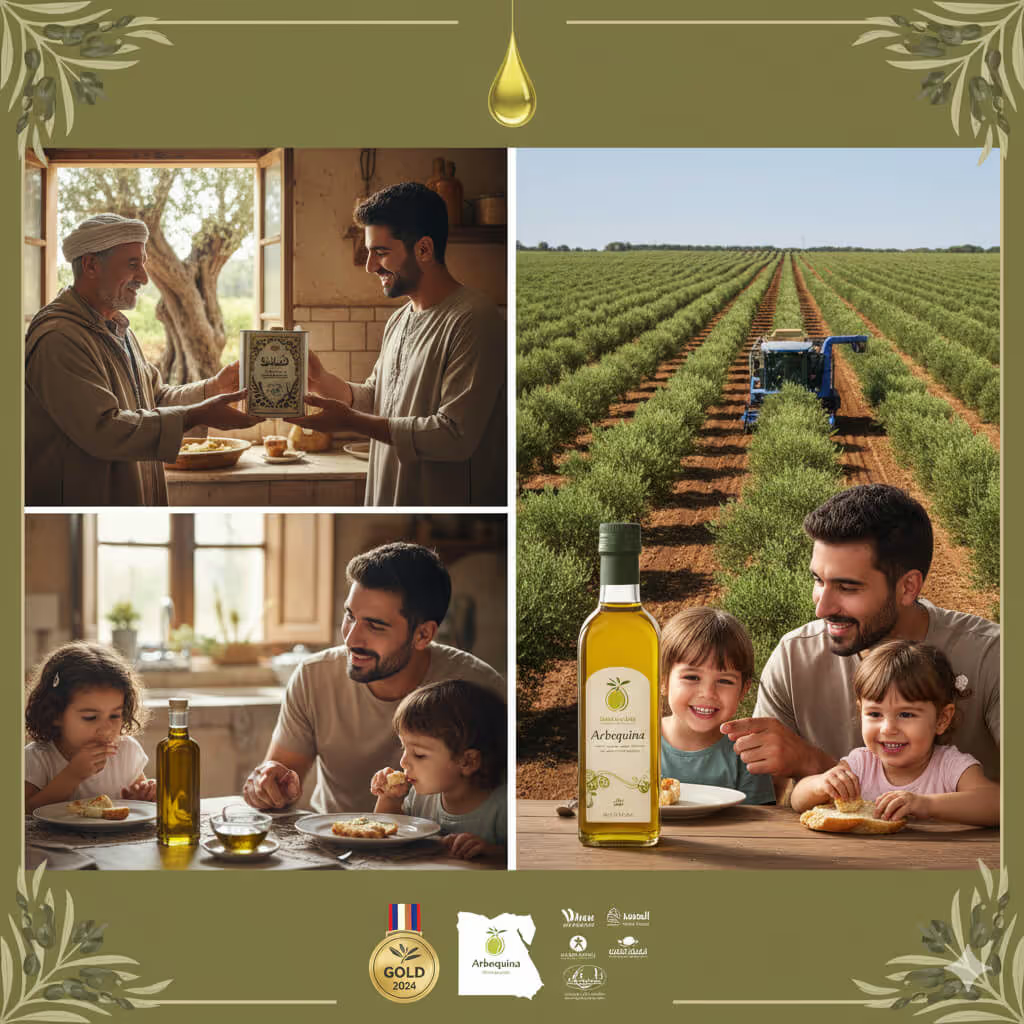
Upon his return from Jordan, my dear friend Mohammed Al-Nuaimi (Abu Ammar) gave me a pot of oil as a gift from Palestine. He told me: “Olive oil is a story. I want to get it in Jordan with difficulty due to the lack of production in beloved Palestine.”
Some merchants used the high-quality and highly reputable Palestinian product by mixing it with lower quality products and promoting it as a Palestinian product.
With my joy at this precious gift, I started using it carefully. But the strange thing is that my children do not like its bitter taste, burning or strong smell with food, despite the fact that bitterness, heartburn and its strong smell are among its most important characteristics.
I started buying sweet and light olive oil because of the recent era of children dealing with olive oil. The most suitable oil for this purpose is Arbequina olive oil, which has unique properties, such as its sweet and light fruity flavor.
The boys started using it regularly and asking about it. Due to the spread of high-density agriculture in Egypt, we will go on to explain everything related to:
It has a high economic value in intensive agriculture due to its high yield and fast production, although its oil is sensitive to oxidation and is not stable for long-term storage due to its low polyphenol content (on average 180 ppm).
It is preferred to introduce people to olive oil. It has been used to open new markets in Japan and China because it has a slightly sweet and moderately fruity flavor, making it suitable for direct use on food. Its smell may be felt by the smell of green almonds, walnuts or tomatoes for those who specialize in the sensory taste of olive oil.
One of the most important features of Arbequina, a Spanish variety, is that the tree has a small size and flexible branches. It is suitable for automated harvesting in large farms, and its production is high. It is difficult to collect its fruits by hand because of the small size of the fruits, which results in a quick economic return.
The tree has resistance to frost and salinity, but is sensitive to very calcareous lands.
It is preferable to grow using permanent irrigation. Its cultivation is not suitable in areas that rely on rain only (as it is called rain-fed agriculture) because it is sensitive to drought and susceptible to olive fly.
We note the spread of arbequina olive oil worldwide as well as in Egypt.
In all olive oil competitions worldwide in 2024, some of the top medal producing countries are:
We note a list from the global ranking of companies for arbequina oil for 2024.
Therefore, Egyptian companies and investors have started to turn to economic agriculture with high and fast production with the use of mechanization and automated harvesters. We encourage them to develop the Egyptian olive oil sector. Among the important companies in Egypt are (Hashemiya, Mafaza, Janayen Siwa, and many others who started to pay attention to intensive agriculture), which has caused rapid development in oil tree plantations in Egypt in the recent period.
After all this talk, we should thank our friend Mohammed Al-Nuaimi for the Palestinian olive oil tanka, which represents origin, heritage and steadfastness with its strong taste, distinctive color and distinctive smell. It opened the talk about arbakina olive oil, which contributes to the spread of olive oil culture among new generations and its economic impact.
Finally, together for a healthy future using olive oil, and together for the revival of the national economy.