 Advertise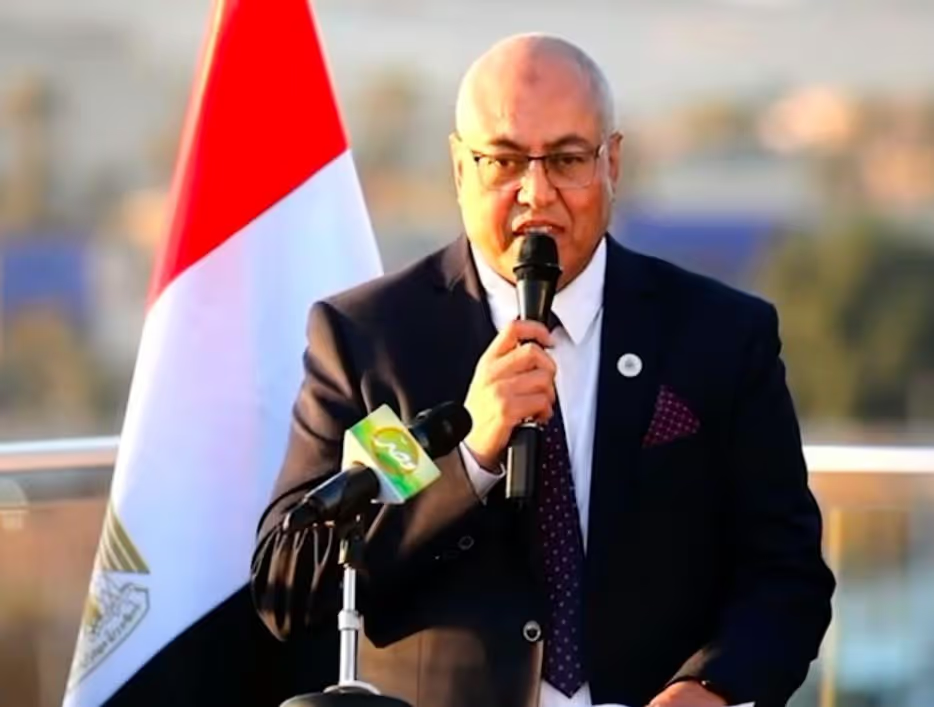

Note: This article was AI-translated from Arabic and is currently under manual review. The author is not responsible for any translation errors. Please refer to the original Arabic text for the most accurate and authoritative information.
The latest edition of the Istanbul International Olive and Olive Oil Competition saw unprecedented Arab participation, both in terms of the number of Arab producers and the involvement of a select group of Arab experts on the judging panels. This momentum reflects the advanced position that Arab products now hold in the table olive and olive oil sector, and their ability to compete in one of the most important global arenas.
Arab producers presented advanced samples of table olives and olive oil, securing high rankings in multiple categories and outperforming products from countries considered global leaders in this field during last year's international competitions. We anticipate impressive results this year, as this excellence is attributed to significant advancements in cultivation, pressing, and packaging methods, in addition to Arab producers' commitment to international quality standards. The competition received 421 entries from 22 countries.
The excellence was not limited to quality alone but also extended to the visual identity of Arab products. A notable Egyptian product featured a design incorporating Pharaonic identity in its details, embodying the product's connection to the ancient Egyptian civilization. This design was recognized among the best entries in the competition, an achievement that reflects how national identity is not merely an aesthetic element but an added value that gives a product a strong presence and uniqueness in international competitions.
In another equally symbolic scene, a product named "Palestine Olive Oil" appeared, holding a special significance for Arab participants. Arab judges gathered around it, appreciating its symbolism and believing that a Palestinian product reaching an international platform in Istanbul is an achievement in itself, a message of resilience reflecting the Palestinian product's ability to compete despite challenges.

One of the most prominent aspects of Arab presence in the competition was the participation of a group of Arab experts on the judging panel, which reflects international recognition of their competencies and expertise. Among the participating Arab names are:
The presence of these names boosts the confidence of Arab participants and gives the competition an important Arab dimension. It also contributes to the transfer of expertise and the development of quality standards in the region, alongside a group of international experts from various countries (Turkey, Italy, Spain, Greece, Croatia, France, Sweden, Brazil, Argentina, Peru, Uruguay).
Participation in international competitions holds significant importance for Arab producers, as it:
The Istanbul Competition is considered one of the most important internationally recognized competitions in the olive sector, for several reasons:
When Arab products achieve top rankings in international competitions, this directly benefits consumers by:
The growing Arab presence at the Istanbul International Olive Competition is more than just symbolic participation; it's proof that Arab products are now globally competitive. The quality of Arab table olives and olive oil now rivals—and sometimes even surpasses—those from countries with a long history in this field.
With national identity emerging in designs—such as a simple Egyptian product featuring a Pharaonic symbol, showcasing design ingenuity—and the appearance of products with deep Arab symbolism, like Palestinian olive oil, the Arab role in this global arena is solidified. This also boosts pride in national products that combine quality, identity, and competitiveness.