Advertise
Note: This article was AI-translated from Arabic and is currently under manual review. The author is not responsible for any translation errors. Please refer to the original Arabic text for the most accurate and authoritative information.
In modern economic terms, olive oil is no longer merely an agricultural product measured in tons, or a healthy food whose benefits we boast about; instead, it has transformed into a strategic asset and a mirror reflecting the maturity of nations' economic visions.
In the global arena, competition is no longer limited to who owns the oldest tree, but rather to:
The Arab world is characterized by a unique natural diversity that has given us (an environmental signature) specific to each region, making the oil's taste reflect the 'spirit of the land.' And although we contribute approximately 22% of global production, the absence of 'sovereignty over the final product' and its export as a raw material has caused us to lose the lion's share of the financial returns.
Arab olive oil cannot be reduced to a single taste; it is a living mirror of what is globally known as the 'Terroir'.. This term expresses the distinctive essence that the land imparts to the fruit as a result of the harmonious combination of soil, water, and climate.
A Map of the Aromatic and Flavorful Differentiation of Arab Oils:

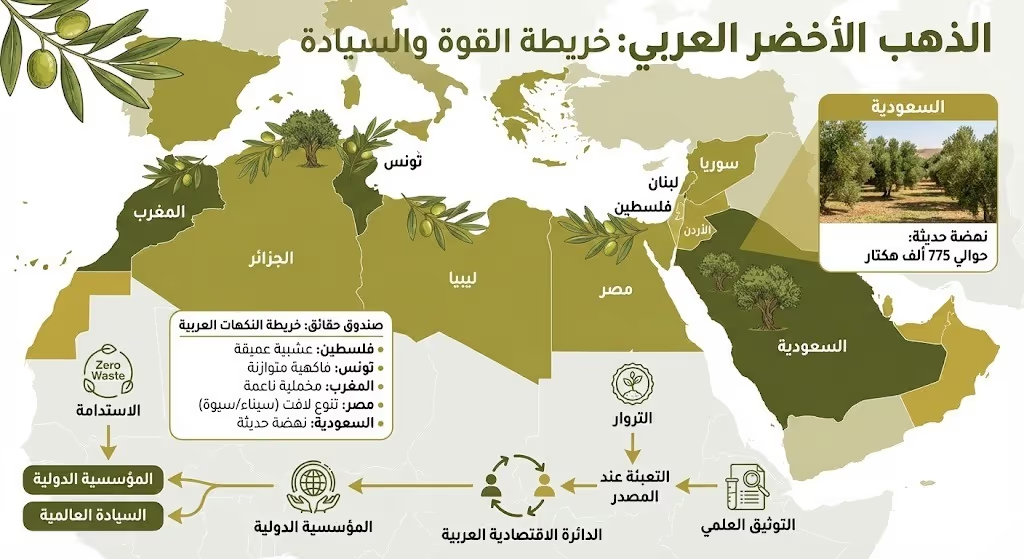
Diversity as a Competitive Advantage: This diversity is not a fragmentation, but an opportunity to transition from mere 'oil producers' to 'designers of culinary experiences' that cater to all global tastes.
Despite massive production, the Arab share of the final value does not exceed 30%, while approximately 70% is lost when oil is exported in bulk. A radical shift begins by ending the era of "raw material export" in favor of "final packaging" that carries the producing country's name.
5 Proposed Mechanisms to Maximize Added Value:
A genuine revival requires managing the sector based on circular economy principles, where waste transforms from a burden into a resource:
The world doesn't deal with small units, but with blocs. The Arab Olive Oil Union doesn't mean unifying flavor; it means:
1. Under the Umbrella of the International Olive Council:
An Arab network of reference laboratories, joint sensory evaluation committees, and experience exchange programs must be established to gain international technical legitimacy.
2. The Arab Market... The Starting Point:
It's illogical to import foreign oils while Arab products struggle to enter neighboring markets. The solution lies in:
Arab olive oil is no longer just a celebrated heritage; it has become an economic reality that demands a transition from "local uniqueness" to "global leadership."
Competition in the 21st century is not won by the number of trees, but by controlling value-added chains. We possess the unique "terroir," the knowledge, and the vision; all that remains is to boldly pursue integration with decisive action and a shared destiny, to restore Arab green gold to its rightful place.
The path from local excellence to global power is now clear… all that remains is to walk it.