 Advertise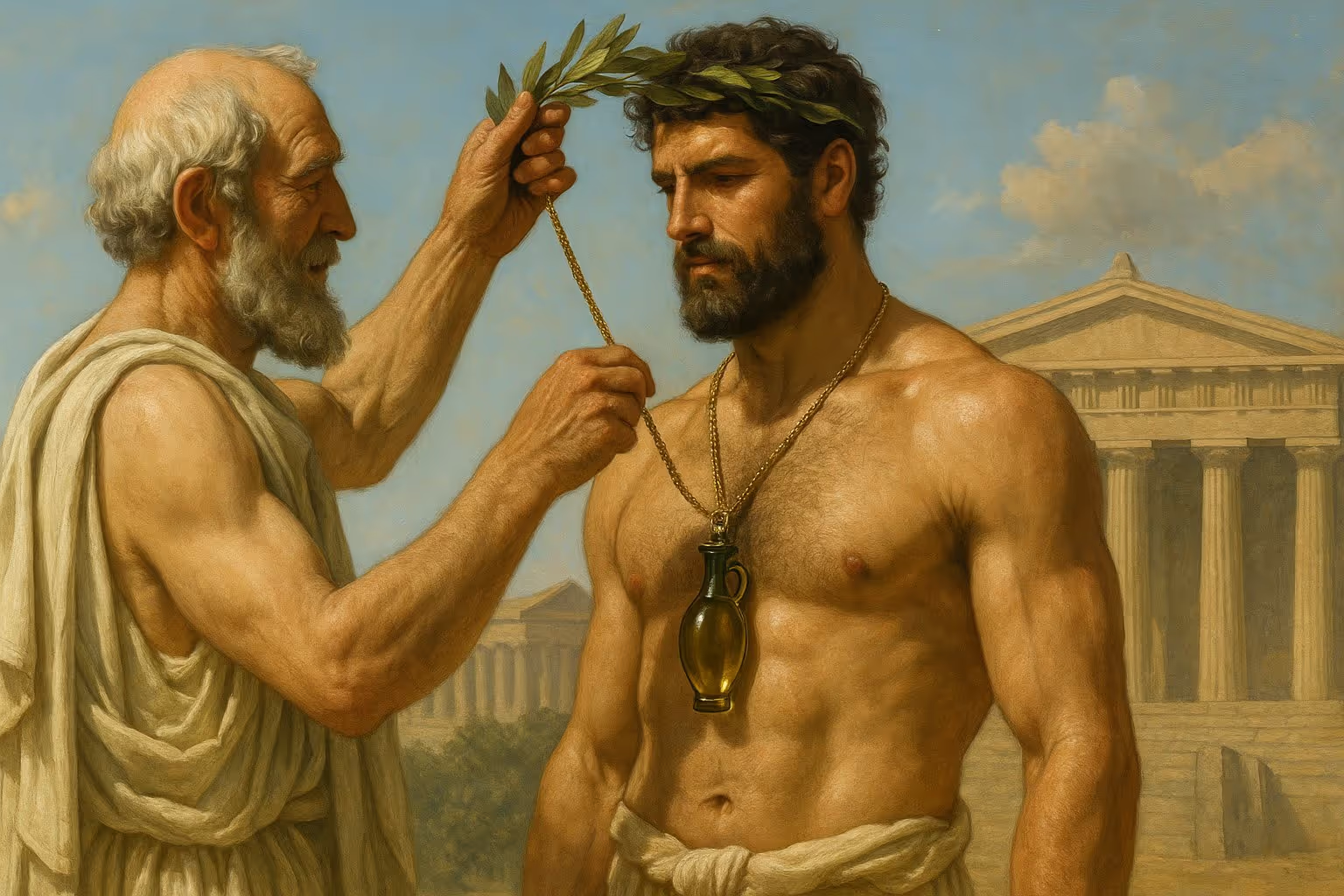
Note: This article was AI-translated from Arabic and is currently under manual review. The author is not responsible for any translation errors. Please refer to the original Arabic text for the most accurate and authoritative information.
When people think of sports in ancient Greece, the first thing that comes to mind is the Olympics.
And this is understandable, because it was these games that inspired our modern version of the Olympics.
The ancient Greeks celebrated their Olympic Games for nearly A thousand years.
These games attracted athletes from a thousand Greek city-states spread across the Mediterranean basin.
Those were the Olympics, just like our modern games, The biggest sporting event in the world.
Therefore, our focus on this festival held every four years in honor of Zeus, the ruler of the gods, is quite understandable.
But what many don't realize is that the Olympics were only one aspect of sports in ancient Greece.
It was part of an international sports tournament known as the “Great Tournament” (Periodos), which also included three other festivals held in Corinth, Nemea and Delphi.
Almost every Greek city had its own sports festival.
Hundreds of these local games have been recorded.
Traditional education for boys included training in the games that were common to all these festivals.
That's why sport was in ancient Greece A competitive and educational activity at the same time.
The biggest of these local games was the Great Panathenaea.
It was organized by Ancient democratic Athens every four years In honor of her patron goddess Athena, the daughter of Zeus.
Despite being a local festival, the Great Panathini was just as important as the Olympic Games.
The peak of both festivals was in the fourth century BC, with Athens spending 650 kg of silver On every major Panathini cycle.
For this reason, those games included Twice the number of competitions Compared to the Olympics, and continues For a double period.
The Athenians have celebrated it for a thousand years as well.
But there was Three big differences Between the Olympic Games and the Athens Games:
At the Olympics, awards were only symbolic: Garlands of olive leaves.
In Athens, they awarded the winners A huge custom made tractor For each cycle, they are called “panathenic amphores.”
These amphiphires were decorated with the image of the goddess Athena on one side and a sports scene on the other.
These jars were found throughout the Mediterranean basin, indicating that the participants were international as in the Olympic Games.
But the real prize was not the tractor itself, but what was inside it: olive oil.
The winners were getting Amazing amounts From oil. It was distributed at each session 2100 Amphora, the capacity of each one 36 liters.
This means that the total amount distributed in one session exceeded 75,000 liters of olive oil!
The reason for these amounts is due to the myth that Athena competed with her uncle Poseidon to be the guardian goddess of the city.
Poseidon created a salt spring and Athena showed the world's first olive tree.
Since Zeus considered olives more useful than non-potable water, he chose Athena as the winner.
It was later discovered that the origin of these events dates back to another myth that says that Zeus, when he became ruler of the gods, fought the giants with the help of Athena, who was His best warriors.
Therefore, the “Apopatis” event was a simulation of its method of fighting. “Al-Barikhi” was the dance I created to celebrate victory.
There were competitions dedicated to the cavalry, mock battles between mounted units, battleship races, and team competitions that demonstrated manly courage.
The Great Panathenie (the Pompi) parade featured thousands of soldiers and horsemen offering weapons as offerings to Athens.
The Athenians used to see themselves as “the sons of Athena” and believed that they were like her, The best warriorsThanks to it, they will always achieve victory.
Source: Mirage