 Advertise

Note: This article was AI-translated from Arabic and is currently under manual review. The author is not responsible for any translation errors. Please refer to the original Arabic text for the most accurate and authoritative information.
A major concern for the food industry is the reduction of contaminants throughout the manufacturing and production chain. For industries based on vegetable oil production, hydrocarbons, abbreviated as (MOSH) and (MOAH) are at the forefront of current concerns due to the complexity of their contamination pathways and their health effects.
These contaminants fall under the category of "hydrocarbons," but each has a distinct chemical behavior and biological effect that necessitates differentiation:
These substances infiltrate through specific vulnerabilities in the production chain, from the field to the final product:
![Illustrative image: A diagram showing the contamination pathway from the environment, harvesting, and transport to packaging - The Arabic infographic should preferably be inserted here]
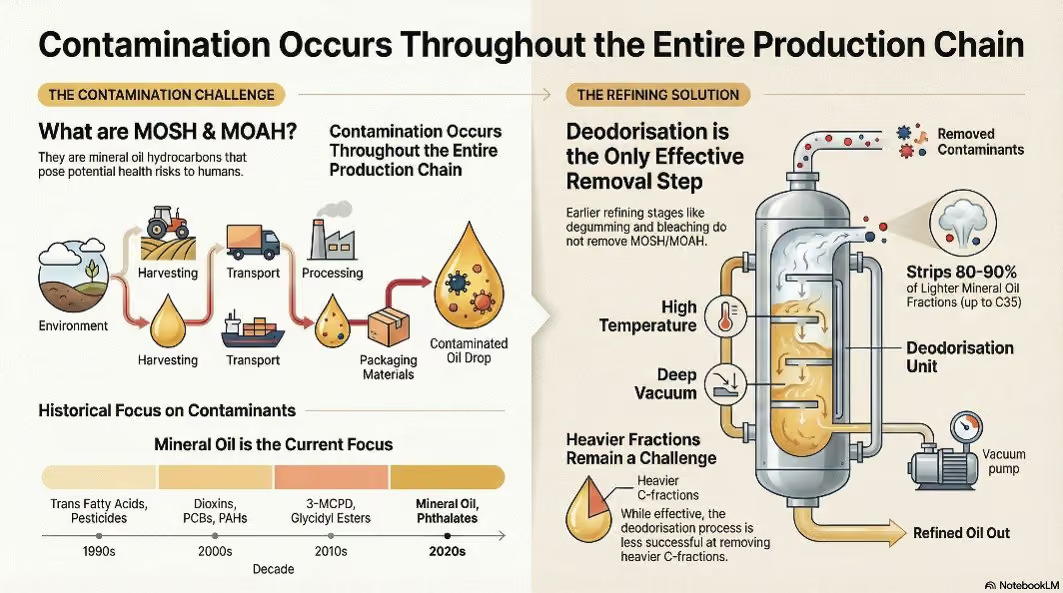
The refining stage is the last line of defense, but it requires intelligent and precise management of variables:
1. DeodorizationThis is the "golden stage" for reducing contaminants, where the oil is exposed to temperatures (200-240°C) under high vacuum. Low molecular weight contaminants evaporate and are removed with the vapors.
2. Thermal Balancing (Thermal Balancing)The engineering challenge lies here; excessive heat can significantly improve the removal of (MOSH/MOAH), but conversely, it stimulates the formation of other dangerous thermal contaminants such as:
Therefore, production engineers must precisely adjust "Retention Time" (Retention Time) and temperature with extreme precision to achieve the best possible purity without creating new contaminants.
To mitigate these contaminants, a comprehensive preventive approach based on international quality standards must be adopted:
The European Commission (EU) has begun imposing strict limits and continuous monitoring. The recommendation (EU) 2017/84 is currently the primary reference for monitoring these contaminants, with a strong international trend towards making these tests mandatory for all exported oil shipments, putting pressure on producers to comply with standards.
Controlling MOSH/MOAH contaminants is not merely a laboratory detection procedure; it is an integrated manufacturing culture that begins with selecting the farm location and ends with the type of ink used for label printing. Excellence in managing this issue is what gives companies the ability to compete in global markets that no longer tolerate any laxity in chemical safety standards.