 Advertise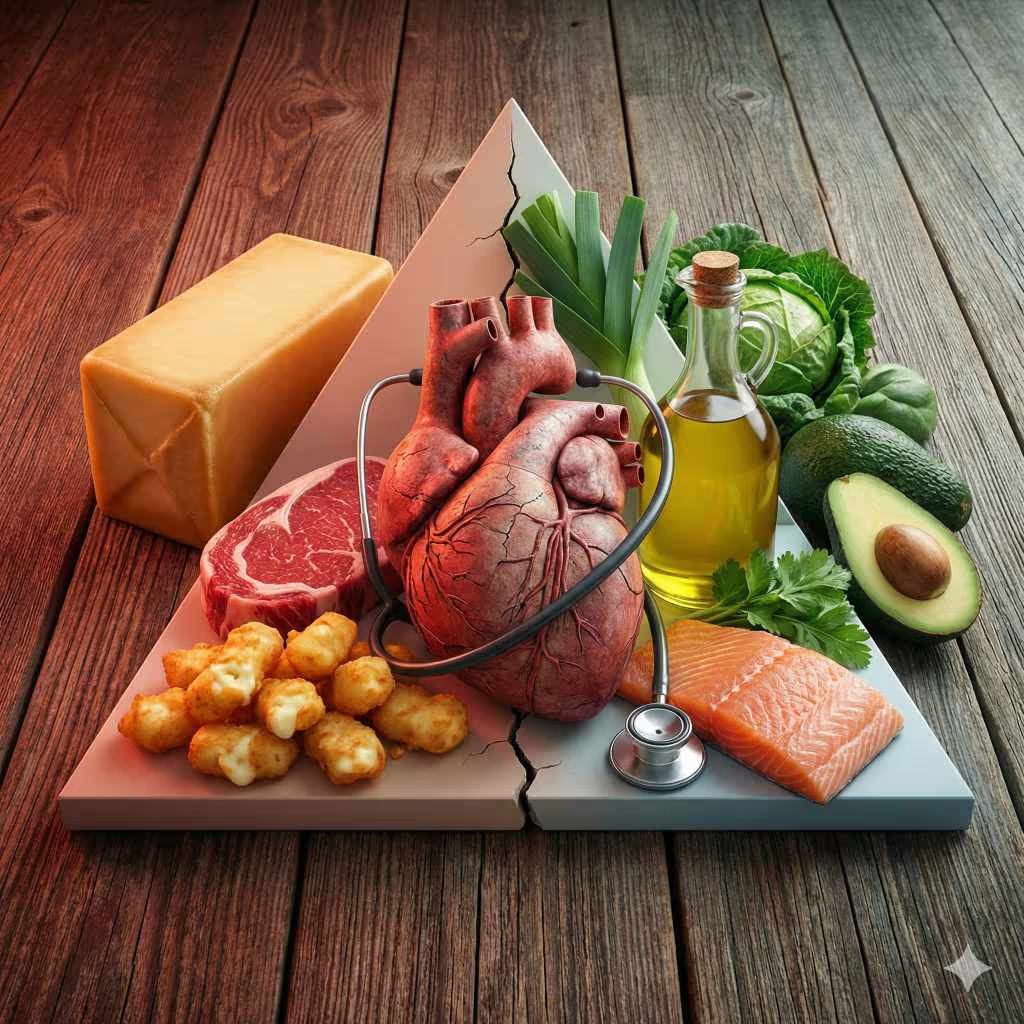
Cardiologists say they are concerned that eating more saturated fat and animal protein will fuel heart disease, the leading killer of men and women in the United States.
Heart disease has been the top killer of American women and men for more than 100 years. Cardiovascular disease is the leading cause of death among adults worldwide, responsible for one in every three deaths globally.
Cardiologists blame physical inactivity, smoking, high blood pressure, high cholesterol and diabetes, along with an unhealthy diet full of refined grains, added sugars and artery-clogging saturated fat found in red and processed meats and full-fat dairy products.
The newly released "Dietary Guidelines for Americans 2025-2030" restrict refined grains, added sugars and ultra-processed foods, a move welcomed by medical organisations.
However, the revised food pyramid, which flips previous pyramids upside down, also gives red meat and other foods rich in protein and saturated fat a prominent place at the top tier, alongside fresh fruit and vegetables known for their health benefits.
Leading cardiologists told CNN this is backwards thinking.
"Promoting saturated fat and increasing protein intake goes against all nutrition and cardiology science," said Dr Kim Williams, chair of the department of medicine at the University of Louisville in Kentucky.
"We have researched this for decades, and we know unequivocally that saturated fats, such as those in butter, beef tallow and red and processed meats, are strongly linked to increased deaths from cardiovascular disease. This doesn't align with President Trump's Executive Order 14303, which requires all federal policies to use the best available scientific evidence," added Williams, a former president of the American College of Cardiology.
That executive order, signed by Trump on 23 May 2025, called for a return to the "gold standard of science" to ensure "that federal decisions are informed by the most reliable, credible and unbiased scientific evidence available".
Yet unbiased, proven and reliable science is exactly what the new guidelines ignore, according to cardiologists. Randomised controlled clinical trials, the current gold standard of research, have found that replacing saturated fat with vegetable and seed oils reduces cardiovascular disease by about 30%, a benefit comparable to statin drugs.
"There is no question that when we remove saturated fat from the diet and add polyunsaturated and monounsaturated fats from fish, seeds and plant sources, we save lives by improving cardiovascular health," said Dr Monica Aggarwal, assistant clinical associate professor of cardiovascular medicine at the University of Florida in Gainesville.
"People are going to look at the new pyramid and think, 'Oh, I can eat as much steak as I like.' Social media is already full of headlines like 'Beef is back on top,' 'Butter's back,' or 'Beef tallow is the way to go.' Yet there's no debate that the saturated fat in those foods is linked to heart disease," Aggarwal added.
Abandoning decades of science
At a press conference on 8 January regarding the new guidelines, federal officials voiced their disdain for previous dietary guidance.
"For decades, we were fed a corrupt food pyramid that had a myopic focus on demonising natural, healthy saturated fats, telling you not to eat eggs and steak while ignoring a giant blind spot: refined carbohydrates, added sugars and ultra-processed foods," US Food and Drug Administration Commissioner Dr Marty Makary said at the briefing.
The new dietary guidelines call for less than 10% of total daily calories to come from saturated fat, which is not far off the American Heart Association's recommendation to keep unhealthy fats below 6%.
However, experts say a target of 10% or less is impossible if the main focus of the "Make America Healthy Again" movement is on eating more protein alongside saturated fat.
The Nutrition Source, an online resource from Harvard's T.H. Chan School of Public Health, recently ran the numbers on the new dietary guidelines, which recommend three servings of dairy products a day.
If all three dairy servings are full-fat, whole milk containing about 5 grams of saturated fat, and roughly a cup of full-fat Greek yoghurt with one ounce of cheddar cheese, each containing 6 grams of saturated fat, that totals 17 grams.
According to Harvard's calculations, for someone following a 2,000-calorie-a-day diet with a maximum of 22 grams of saturated fat, that leaves only 5 grams for the rest of the day. Add a single tablespoon of butter (7 grams) or beef tallow (6 grams), and a person would already exceed the daily limit of 10% saturated fat.
Add a standard homemade burger patty (more than 13 grams), or a Steak 'n Shake "7x7 Steakburger" (66 grams of saturated fat and 7 grams of trans fat) along with a large order of their beef-tallow fries (24 grams of saturated fat and 2.5 grams of trans fat), and dangerous fat levels skyrocket. CNN reached out to Biglari Holdings, which owns Steak 'n Shake, for comment but did not receive a response before publication.
The role of trans fats in heart health
Experts say the trans fats found in Steak 'n Shake's food are considered the worst kind of saturated fat. This type of fat is banned in the United States except in negligible amounts because of its strong link to heart attacks and stroke. Trans fats, made through an industrial process in which hydrogen is added to liquid vegetable oils to make them more solid, are cheap to produce and extend the shelf life of food.
Natural sources of trans fats are found in meat, milk, butter and cheese from ruminant animals: cattle, sheep and goats, which some in the MAHA movement consider healthy.
Cardiologists disagree. Williams said the natural trans fats found in foods from ruminant animals, and to a lesser extent in pork and poultry, are "actively pro-inflammatory" and contribute to hardening of the arteries.
"Beef tallow contains ruminant trans fats at levels far higher than what's considered safe. And when combined with high saturated fat, as in fried foods or fatty burgers, the combined risk is significant," he said.
Long-established science
Warnings about the dangers of saturated fat are not new. The American Heart Association recommended switching from disease-causing saturated fats to healthier options back in 1961, based on data-driven recommendations from its nutrition committee, first established in 1954.
Updates to the American College of Cardiology and American Heart Association guidelines over the years have repeated that advice, citing hundreds of gold-standard studies on the role of fat in heart disease.
"The advice was never fat-free or low-fat," said Dr Andrew Freeman, a preventive cardiologist and director of cardiovascular disease prevention and wellness at National Jewish Health in Denver.
"All types of fat can play a role in a healthy diet, but the focus is on polyunsaturated and monounsaturated fats. That's what the Mediterranean diet and other predominantly plant-based diets have shown," Freeman added.
Studies have found that the award-winning Mediterranean diet can reduce the risk of diabetes, dementia, memory loss, depression and breast cancer. Research has also linked the diet to stronger bones, lower cholesterol, a healthier heart and a longer life.
The Mediterranean diet pyramid focuses on fresh fruit and vegetables, whole grains, seeds, some fish and heart-healthy olive oil, with an emphasis on sharing meals with family and friends and daily exercise. Red meat and sweets are highly restricted, meant to be served only on special occasions.
Is there not enough protein?
FDA Commissioner Makary also focused on the need for more protein in the American diet, particularly for children.
"The old guidelines had such a low recommendation for protein that we're increasing it by 50% to 100%. Children need protein. The old protein guidelines were designed to prevent famine and wasting. These new protein guidelines are designed for American children to thrive, and they're based on science, not dogma," Makary said.
However, experts say most Americans today, including children, already consume far more protein than they typically need.
"Except for the very sick or the elderly, protein deficiency barely exists in the United States. We also know that excess protein strains the kidneys and is linked to certain cancers," Freeman said.
"If you look at what the MAHA movement stands for, it's the complete opposite of what Trump is doing with these guidelines. It doesn't make sense. We need our politicians to focus on changing unhealthy behaviours, not promoting them. Increasing saturated fat, which often comes paired with the proteins recommended in the new pyramid, isn't in anyone's interest," he said.
Source: CNN