 Advertise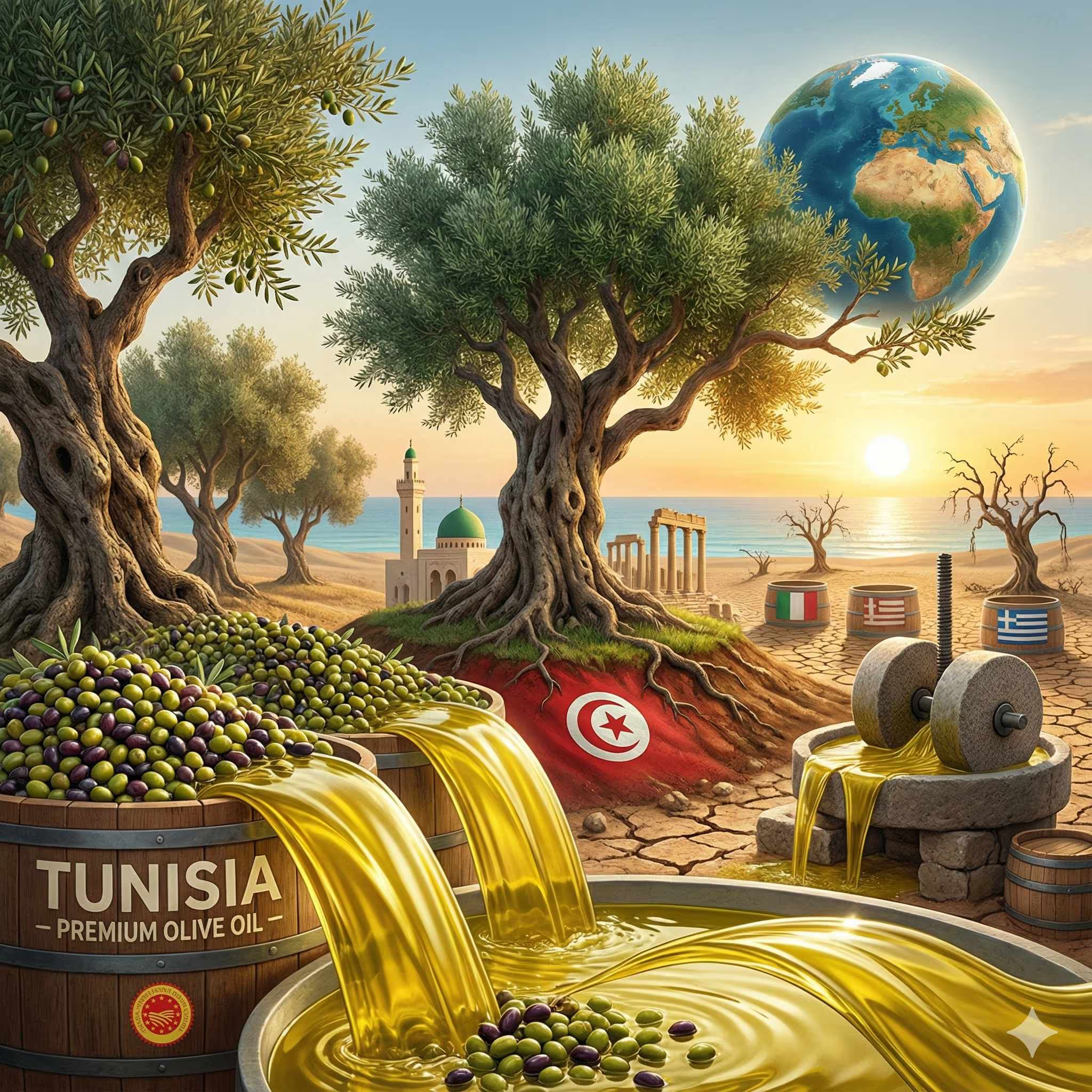
Tunisia is redrawing the global olive oil market, reviving glories it once enjoyed under ancient Rome. While Europe's leading olive oil producing regions, such as Italy and Greece, struggle with a climate crisis, Tunisia alone has managed to bring in a bumper, record harvest. The Tunisian government has elevated olive oil from a simple agricultural product to a strategic national asset, launching a sweeping economic diplomacy campaign around it.
Rabobank, the financial institution with strong credibility in agricultural finance, said on the 1st of the month that Tunisia's olive oil production this year will reach at least 380,000 tonnes and could climb as high as 400,000 tonnes. That figure exceeds last year's output of 280,000 tonnes by more than 35%. Najeh Saidi Hamed, head of the Tunisian olive producers' union, told the Financial Times that this year's harvest could reach as much as 500,000 tonnes, which would be an all-time record for Tunisia's olive sector.
According to a report by the US Department of Agriculture's Foreign Agricultural Service (FAS), global olive oil production currently stands at around 2.7 million tonnes, while consumption exceeds 3 million tonnes, leaving a supply deficit of roughly 300,000 tonnes, or about 10% of production. Successive waves of drought in Italy and Greece, the two leading production regions, have cut their output by half.
Greece's 2024 production fell by 49% compared with 2023, while Italy's output last year dropped 39% compared with 2024. If Tunisia produces more than 380,000 tonnes of olive oil this year as expected, it would more than offset the shortfalls in Italy and Greece. At the same time, Tunisia is poised to overtake both countries to rank as the world's second-largest olive oil producer and exporter, behind only Spain.
Olive oil accounts for more than 40% of the total value of Tunisia's agricultural exports and is a key driver of the country's trade balance. Tunisia's government treats olive oil as a cultural product and strategic asset rather than merely a foodstuff. While Italy and Greece have faced existential threats from severe climate-linked drought and olive quick decline syndrome, Tunisia's government has planted more seedlings of its drought-resistant varieties, such as Chetoui and Chemlali, to boost output.
In 2024, Tunisia's Ministry of Foreign Affairs placed olive oil, long overshadowed by European nations, at the heart of its diplomacy. Foreign Minister Mohamed Ali Nafti announced a "Tunisian Olive Oil Diplomacy Day" on 22 December. It is a sophisticated diplomatic strategy to leverage olive oil to drive tourism, logistics and international cooperation. "Tunisia's 100 million olive trees and two million hectares of olive groves are not just farmland," Nafti said, adding that "olives symbolise Tunisian sovereignty and economic self-reliance." He cited the Sherafat Olive Tree, the country's oldest olive tree at more than 2,500 years old, asserting that "Tunisia is the true rightful heir of Mediterranean agriculture."
In Asia, Tunisian olive oil remains largely unfamiliar. To date, about 80% to 90% of Tunisian olive oil is exported in bulk, unpackaged, to Europe, particularly Italy. Tunisian olive oil outcompetes other European products on price, as farm labour wages in Tunisia run between a fifth and a tenth of those in Italy or Spain. In addition, North Africa's sunshine near the Sahara helps prevent pest and disease damage. Compared with Europe, which sits at a relatively higher latitude, organic farming is easier in Tunisia. In theory, the cost of producing premium Tunisian olive oil is roughly 30% to 40% lower than its European counterpart. Yet its acidity level, the key quality measure for olive oil, remains at 0.2% to 0.3%, placing it among the best in the world.
Italian companies have long imported relatively inexpensive Tunisian olive oil in bulk whenever domestic production falls short, then re-exported it under Italian brands. Under the EU's Inward Processing Relief rules, Italian olive oil brands can blend domestic and Tunisian oils for sale. They need only note in small print on the back label that it is an "EU/non-EU blend". Some simply bottle Tunisian olive oil and sell it labelled "bottled in Italy".
Experts believe this year is the ideal moment for Tunisia to shine in the olive oil market. With major European producers recovering only slowly, Tunisia is expected to act as a balancing force, helping stabilise global olive oil prices. Global olive oil prices hit a record in 2024, surpassing $10,000 a tonne. Since then, prices have remained elevated above $9,000 a tonne, based on Italian olive oil prices.
Agricultural expert Fawzi Zayani told the Financial Times: "This year will go down as a golden era in the history of Tunisian agriculture." He added: "We must strengthen Tunisia's unique Protected Designation of Origin (PDO) status in the international market and raise the share of premium bottled products, currently below 10%, to more than 30%."
Source: Al Mal Forum