 Advertise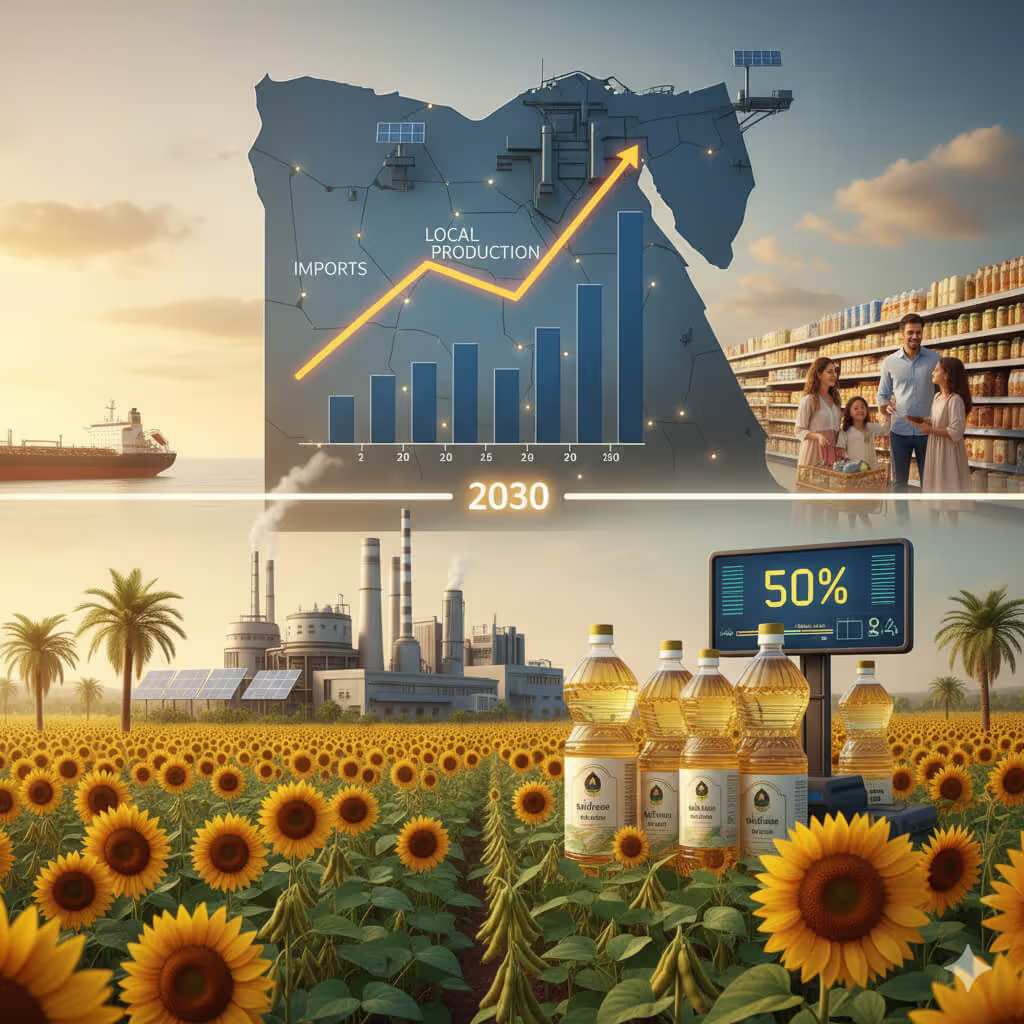
To counter global challenges and rising oil prices, the Egyptian government is taking serious steps to boost self-sufficiency and reduce reliance on imports. The Ministries of Supply and Agriculture have adopted an ambitious plan to raise the country's oil self-sufficiency rate to 50% by 2030. The plan relies on expanding cultivation of oil crops, building modern factories, and forging strong partnerships with the private sector, backed by unprecedented investment incentives.
Egypt's heavy reliance on imported crude cooking oil, which currently stands at 96%, is placing significant pressure on the country's balance of payments. The low self-sufficiency rate of just 3% is attributed to the limited area planted with oil crops in the country.
The government's plan to boost self-sufficiency includes expanding strategic crops (such as soybeans, sunflower, palm oil and canola), while adopting a contract farming system to guarantee fair prices for farmers. The plan also involves establishing oil-processing industrial complexes in strategic areas (including Borg El Arab, Sohag, and Sadat City) in cooperation with the private sector, with investments estimated at around 6 billion Egyptian pounds. In addition, tax and credit incentives will be offered to investors in the sector to cut domestic production costs and attract investment. The Ministry of Supply is also working to establish new companies to increase domestic production volumes.
The Ministry of Supply is seeking partnerships with the private sector, whose stake in some projects could reach 70%, aiming to improve the efficiency of companies affiliated with the Holding Company for Food Industries. This is being done by reviving historic brands such as "Abu El-Hol" and "Tanta," and boosting their competitiveness through plans to modernise factories and increase production capacity to 2,400 tonnes per day.
Falling Imports
Alongside these efforts, data from the Central Agency for Public Mobilisation and Statistics (CAPMAS) showed a notable decline in Egypt's sunflower oil imports, which fell 57% during the first half of the current year to $198.4 million, compared with $461.1 million in the same period last year.
Supply Ministry Initiative
In response to rising oil prices in the markets, the Ministry of Supply is pursuing several tracks, most notably launching an initiative in cooperation with the private sector to significantly cut prices and ensure they reach consumers at affordable levels. This has been accompanied by intensified inspection campaigns to curb commercial fraud.
The ministry launched an initiative to cut prices by 15% in cooperation with major private oil companies, with the reductions applied immediately, as part of the state's directives to ensure the availability of safe, high-quality food products.
The ministry outlined the participating companies and the reduction rates:
Serious Steps
Dr Sherif Farouk, Minister of Supply and Internal Trade, affirmed that the coming period will see intensified inspection campaigns on markets and oil factories, alongside strengthened cooperation with the private sector to ensure compliance with standards and firmly address violations.
The minister stressed the need for all parties (producers, importers and manufacturers) to coordinate their efforts with the Food Safety Authority and regulatory bodies, to ensure that safe, high-quality products reach Egyptian consumers and to combat commercial fraud.
He noted that although Egypt imports more than 95% of its needs, the country has strong expertise in oil blending, which allows it to add value and generate gains. He explained that he had met with oil producers and reached an agreement to keep prices stable, as there was no justification for an increase.
He affirmed that the state has begun taking concrete steps towards achieving self-sufficiency by expanding oil crop cultivation through major projects such as Toshka, East Oweinat and "Mustaqbal Misr" (Future of Egypt).
Competitive Edge
Meanwhile, Ayman Qorra, a board member of the Chamber of Food Industries, explained that the shortfall in vegetable oil supply is very large, driving up reliance on imports. Qorra believes that the costs of cultivating oil crops (planting, harvesting, irrigation) abroad are lower than in Egypt, noting that Egypt lacks a competitive advantage in these crops due to limited water and land resources.
He added that farmers get a better return from other crops (such as wheat and sugarcane), especially since cultivation abroad relies on rainwater and vast land areas, which are not available in Egypt, making imports less costly than domestic cultivation.
He continued that the current approach should focus on growing products with a competitive advantage and importing products in which Egypt does not excel, with the aim of maximising the return from every cubic metre of water. He pointed out that the new concept of food security does not require self-sufficiency, but rather focuses on achieving a positive trade balance (exporting more than importing).
Qorra noted that the state's price-cutting initiative had contributed to a roughly 36% drop in free-market prices, alongside the ministry's provision of 70 million subsidised bottles of oil per month at cost price, describing the oil market as low-margin and highly competitive. Regarding the impact of climate change and wars, he affirmed that these factors affect the "price" of the commodity, not its "availability."
Source: Al-Ahram Al-Iqtsadi