 Advertise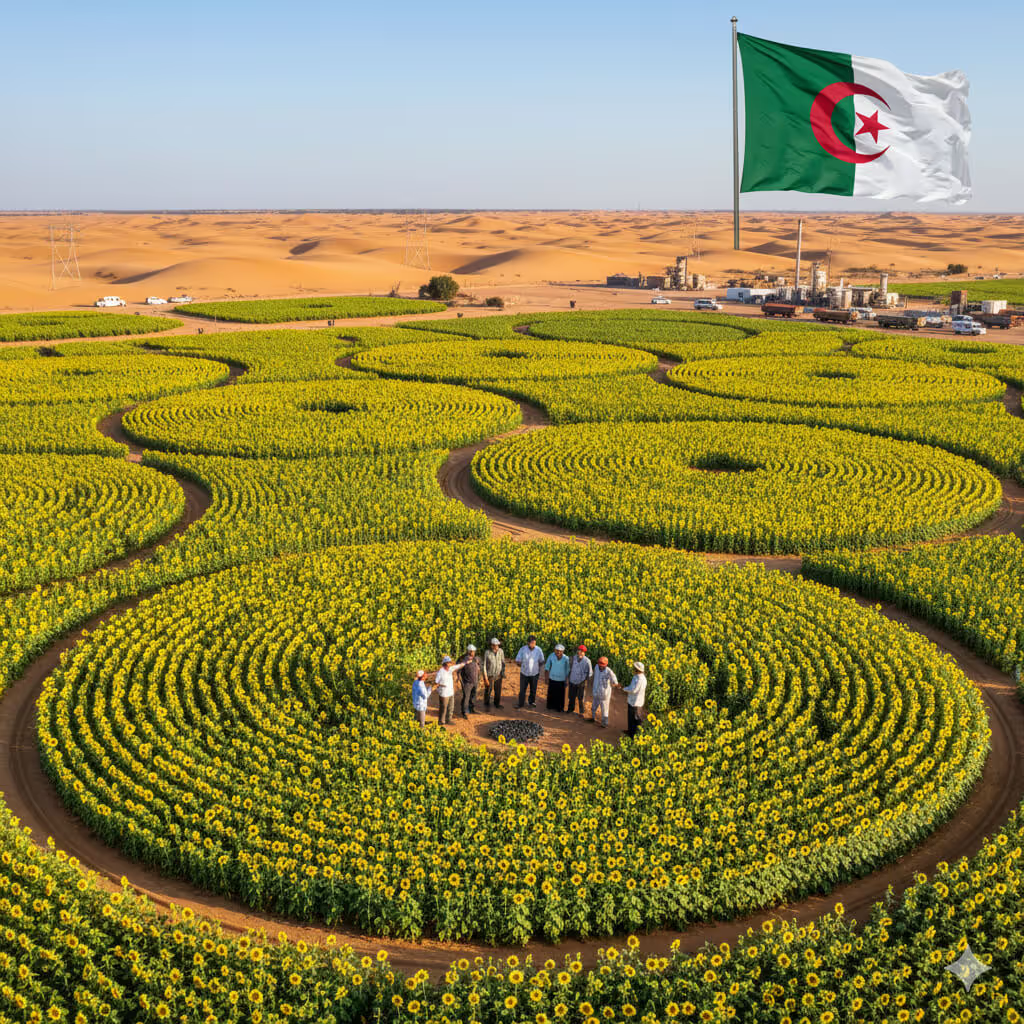
Oued Souf province is currently witnessing growing agricultural momentum, positioning it as a leading model for using desert resources to produce new strategic crops, most notably sunflower.
Sunflower cultivation is gradually expanding and becoming a key pillar in Algeria’s oilseed development program. After successful trials in municipalities such as Taghzout, Guemar, and Hassi Khalifa, sunflower has attracted the attention of local authorities and agricultural engineers as an alternative source of vegetable oils and a new economic resource that strengthens national food security.
The experience also confirms the ability of southern Algeria to become a diversified and sustainable production region.
Sunflower cultivation in Oued province has made a notable leap in recent years, moving from limited experiments on some farms to an organized, officially supported agricultural activity accompanied by specialized techniques.
The crop, which began on small areas in Taghzout, Guemar, and Hassi Khalifa, delivered encouraging results in terms of production and seed quality. This encouraged authorities to expand cultivation within a national strategy aimed at reducing the import bill for vegetable oils and strengthening local production.
Thanks to a suitable climate and fertile sandy soil, Oued province today represents one of the field models for successful oilseed crops in southern Algeria.
Agricultural engineers attribute this success to the combination of field experience and technical expertise acquired by farmers through training and agricultural extension programs organized by the provincial Chamber of Agriculture.
These programs were not limited to theoretical training. They also included field visits and practical applications that enabled farmers to master planting, irrigation, and harvesting stages according to modern standards.
This technical support restored confidence among local investors and encouraged them to try an unconventional crop for the region, one that has proven highly profitable and adaptable to the desert climate.
This transformation is part of Algeria’s national policy to develop strategic crops. The Ministry of Agriculture has included sunflower cultivation among its priorities in the south, within a forward-looking vision to achieve self-sufficiency in vegetable oils.
Oued province has therefore become a key station in this direction, with authorities seeking to expand planted areas and link them to industrial processing routes for local oil production.
This gradual development reflects the province’s transition from experimentation to the actual construction of an integrated production chain combining primary agriculture and food manufacturing, reinforcing desert agriculture as one of the pillars of Algeria’s new national economy.
Sunflower: A Promising Economic Resource on the Path to Expansion
Oued’s sunflower trials have shown the crop’s ability to play an important economic role in diversifying agricultural production and increasing added value in the farming sector, especially in desert areas seeking viable alternatives to traditional crops.
Growing production of sunflower seeds opens the door to a new processing industry in the south, targeting local vegetable oil production and reducing reliance on imports that cost the public treasury hundreds of millions of dollars annually.
In this way, the young crop could move from a local experiment to an economic driver that may position Algeria competitively in the regional oilseed sector in the coming years.
Agricultural experts confirm that sunflower productivity in Oued’s sandy soils exceeded expectations, as the dry soil and high solar radiation provide ideal growth conditions.
This has encouraged many young farmers to try the crop, benefiting from government support in financing, extension, and marketing.
Rising demand for natural oils in local and global markets has also increased interest in oilseed crops, making sunflower a real opportunity to direct investment toward the south within the national food security policy.
Although planted areas remain limited, current indicators show clear upward growth. The number of farmers entering sunflower cultivation is increasing season after season, supported by encouraging field results and technical guarantees provided by specialized public institutions.
The Chamber of Agriculture, in coordination with the Agricultural Services Directorate, is preparing a roadmap to double planted areas in coming seasons, with a focus on integrating sunflower into a sustainable crop rotation alongside wheat and potatoes. This would ensure environmental and economic balance and provide farmers with stable production throughout the year.
From Field to Factory: A Promising Production Chain Taking Shape
Sunflower cultivation in Oued represents a first step toward building an integrated production chain that begins in the fields and ends in industrial processing units.
Successful agricultural trials can only be completed by developing a processing industry capable of absorbing production and converting it into locally made oils and food and industrial derivatives.
Sources from the Ministry of Agriculture indicate that the next stage will focus on attracting investors to establish small and medium-sized plants for oil extraction and refining, while encouraging public-private partnerships to accelerate the process.
The aim is to create real added value for the local product and transform it into a marketable and exportable commodity instead of stopping at the farming stage.
Local authorities in Oued are seeking to use existing infrastructure and the transport network connecting the province with the rest of the country to facilitate moving the product to processing units, whether inside the province or in neighboring provinces such as Biskra and Ouargla.
There is also consideration of small mobile units to process seeds on site, reducing costs and improving farmer returns.
Although these steps are still in their early stages, they reflect growing awareness of the need to move from primary agriculture to agro-industrial processing, which has often been the missing link in earlier agricultural projects.
Agricultural economists believe that if this experience succeeds in building an integrated chain, Oued could become a central hub for developing industrial crops in the south, not only for sunflower but also for dual-use food and energy crops such as rapeseed and soybean.
Every new hectare planted in the sands today could become added economic value tomorrow, contributing to food security and sustainable energy for the country and confirming that southern Algeria can become a national agricultural production reservoir if its natural and human potential is properly used.
Oued: A Model for Smart Farming in a Harsh Desert Environment
The sunflower experience in Oued province has shown that desert agriculture is now a scalable reality thanks to modern techniques and the determination of local farmers.
The region, once known mainly for potatoes and seasonal vegetables, has become a field for trials in high-value industrial crops, reflecting a deep shift in agricultural thinking from consumption crops to manufacturing-oriented agriculture.
This shift is supported by field research carried out by universities and agricultural research centers in partnership with chambers of agriculture, including studies on soil, salinity levels, and drip irrigation. The goal is to provide a smart agricultural model capable of adapting to a harsh environment and making the best use of every drop of water and every square meter of land.
With continued government support for local initiatives, signs of a new development model are emerging in Oued based on agricultural diversification, field processing, and technical innovation.
Sunflower cultivation has become a symbol of the ability to turn the desert into a real source of production. In this sense, Oued today represents the productive south rather than the consuming south: a south that grows oil in the sand to feed a national economy seeking food security through its own resources and through farmers who have turned the desert into fertile ground for hope and work.
Source: Al-Ayyam News