 Advertise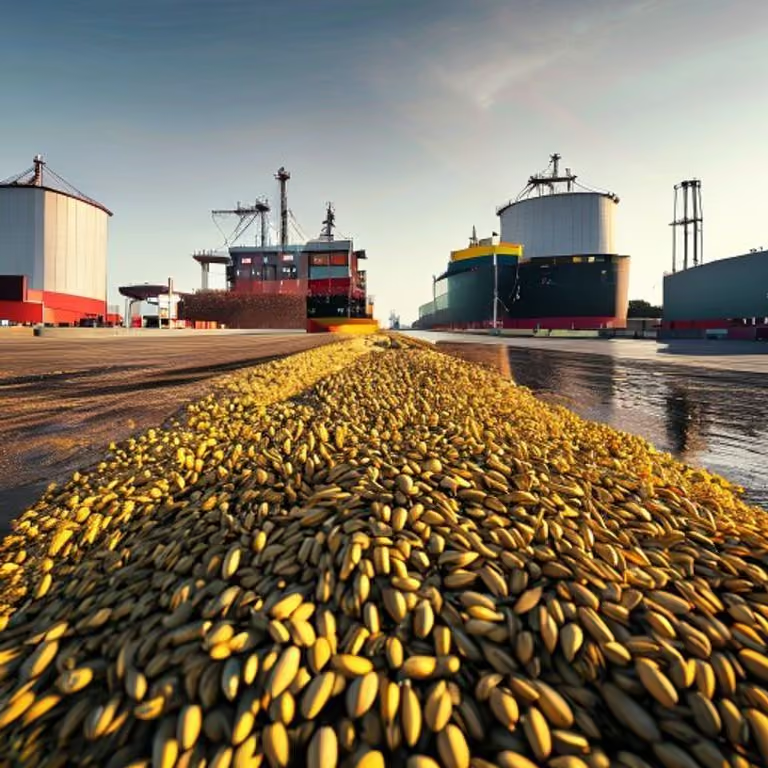
Russia is preparing for the 2026/27 season with projections of its largest-ever sunflower harvest, a development analysts believe will enable the nation to reinforce its role as a leading global producer and exporter of sunflower oil and meal. This outlook persists despite ongoing challenges such as high export duties, a strong ruble, and increased competition from key rivals like Ukraine and Argentina.
Official estimates, released in late June, forecast Russian sunflower seed production to reach approximately 19.5 million tonnes in the upcoming season, an increase of about 11% compared to the previous year. This growth is primarily attributed to an estimated 7% expansion in planted area, bringing the total to 11.2 million hectares, coupled with higher expected yields. Separately, the Institute of Agricultural Market Studies (IKAR) has even raised its forecast to 19.7 million tonnes, an upward revision from its previous 19.0 million tonnes estimate and significantly above last season's 16.9 million tonnes.
The significant increase in acreage is largely an economic response rather than purely weather-driven. With grain profitability squeezed by rising production costs and export duties, Russian farmers have strategically shifted land towards sunflowers. This crop benefits from robust domestic crushing demand and firm export markets. Analysts anticipate the national sunflower area to expand to around 13 million hectares in 2026, marking an approximate 4% increase and solidifying the crop's growing share within Russia's agricultural output. Complementing this harvest growth, processing capacity is also expanding. The Oil and Fat Union of Russia has indicated that the country's oilseed processing capacity is projected to grow by roughly 9% by year-end, reaching approximately 38 million tonnes, as multi-year investments in crushing infrastructure near completion.
Export forecasts for the forthcoming season are largely optimistic, though specific estimates vary by source. The Oil and Fat Union of Russia projects sunflower oil exports around 4.8 million tonnes in 2026, an increase from 4.62 million tonnes the previous year. Concurrently, the U.S. Department of Agriculture (USDA) forecasts Russian sunflower oil exports at 4.85 million tonnes for 2026/27, marking a substantial rise from 4.2 million tonnes a season earlier—an increase of roughly 15.5%.
This optimism follows a period of mixed results for Russian exporters. Despite a strong harvest and increasing overall vegetable oil output, Russian sunflower oil exports saw a 14% decline in the first half of the 2025/26 season. This downturn was attributed to squeezed margins, a strong ruble, transportation bottlenecks, and elevated export duties, even as global sunflower oil prices climbed over 15% throughout 2025.
However, more recently, market conditions have become more favorable for exporters. A decision in June to cut Russia's sunflower oil export duty to its lowest level since late 2024 has significantly improved export margins and stimulated a fresh wave of shipments. Consequently, Russia exported 2.55 million tonnes of sunflower oil in the first half of 2026, representing a 6% year-on-year increase. Total vegetable oil exports also rose by 5% to 3.73 million tonnes during the same period. India and Turkey remain the primary destinations for Russian sunflower oil, with Turkish demand currently heightened ahead of its own domestic sunflower harvest.
Despite the anticipated record output, Russia is not projected to be the outright leader in sunflower oil exports by volume. According to USDA estimates, Ukraine is expected to export 5.1 million tonnes of sunflower oil in 2026/27, surpassing Russia's projected 4.85 million tonnes. This indicates that while Russia is likely to maintain its position as the world's largest sunflower oil 'producer', Ukraine is set to continue leading in 'exports', with the USDA estimating this gap could be around 250,000 tonnes in the new season.
Ukraine's recovery from a ten-year production low is notable, with USDA projecting its sunflower seed production to climb to 13.5 million tonnes in 2026/27, an increase of nearly 23% from the 11 million tonnes recorded the prior season. That prior season's figure was itself a decade low. Nevertheless, Russia is expected to retain a substantial production lead, with its own sunflower seed crop forecast to rise from 17.5 million to 19.2 million tonnes—a gap of approximately 5.7 million tonnes over Ukraine, though narrower than the 6.5-million-tonne difference observed in the preceding season.
Russia's export ambitions are unfolding within a broader reshaping of the global oilseed trade. The European Union is also expected to experience a significant rebound in sunflower production for 2026/27. German analysts at 'Oil World' forecast EU output at 9.8 million tonnes, an increase of 1.1 million tonnes year-on-year, following the previous season's drought-affected harvest. Meanwhile, Argentina has sharply increased its sunflower seed and oil exports in 2026, particularly targeting the EU and India, thereby introducing a new layer of competitive pressure to the global market complex.
Russian officials have also emphasized a strategy of diversification beyond crude oil exports. The Federal Center 'Agroexport' has highlighted Russia's status as the world's largest exporter of both sunflower oil and sunflower meal. Exporters are increasingly focusing on buyers in North Africa, the Middle East, and Asia for oilcake and meal shipments, an area that officials describe as having significant untapped growth potential.
Multiple forecasts consistently point to record or near-record Russian sunflower seed production for 2026/27, with estimates generally clustering between 19.2 and 19.7 million tonnes. However, Russia's own sunflower oil export forecasts (ranging from 4.8 to 4.85 million tonnes) are consistently below Ukraine's projected 5.1 million tonnes. Consequently, Russia's claim to overall market leadership rests specifically on its production volumes and, according to Russian officials, its combined oil-and-meal export volumes, rather than being the single largest sunflower oil exporter by volume alone.
The data clearly illustrates a 'before and after' pattern: exports declined by 14% in the first half of 2025/26 under a higher duty regime, then rebounded sharply once the duty was cut in June 2026 to its lowest level since late 2024. This suggests that Russian export volumes this season will likely track policy decisions on the duty rate at least as closely as they track the physical size of the harvest. A record crop, therefore, does not automatically translate into record shipments if margins are squeezed by policy.
A strong ruble and elevated production costs have been repeatedly cited as significant constraints on Russian exporters' ability to fully capitalize on high global prices, acting distinctly from and in addition to the export duty issue. This implies that even with a record supply, Russian export competitiveness will remain highly sensitive to the ruble's strength—a factor largely outside exporters' direct control and one that has already suppressed exports once this season despite otherwise favorable global prices.
Ukraine's recovery from a decade-low production, Argentina's significantly expanded shipments (particularly into the EU and India, both crucial Russian markets), and a rebounding domestic EU crop collectively mean that Russia's record harvest arrives into a global market characterized by more competing supply than in recent years. This increased competition tends to cap the upside for Russian export prices, even if Russian volumes rise as forecasted.
With India and Turkey repeatedly named as Russia's primary buyers, Russian export performance is closely tied to the import cycles of these two key demand centers: India's seasonal stock replenishment and Turkey's timing relative to its own domestic harvest. A larger Russian crop amplifies the importance of demand remaining firm in these specific markets, as a slowdown in either would have a disproportionately large effect on Russia's ability to move a bigger harvest.
Disclaimer: The figures presented above are compiled from a range of sources current as of mid-to-late 2026, including the Oil and Fat Union of Russia, USDA, IKAR, Oil World, Federal Center Agroexport, and various industry market reports. Forecasts, particularly for the 2026/27 season, remain subject to revision based on final planting and harvest results, prevailing weather conditions, and policy changes such as adjustments to export duties. The trade analysis section reflects an interpretation of the reported data rather than additional sourced facts. Source: Business Upturn